Key Takeaways
- CMO Owls is not one chatbot with a marketing costume on. It is an AI marketing team of 21 specialist agents, each built for one job, coordinated by Game Plan Owl into a single marketing roadmap.
- Every agent works from real data: your live site, your Search Console and Analytics numbers, live search results, and live competitor activity. Nothing is guessed, and nothing goes live without human review.
- The depth comes from a shared 22-module audit engine. That's why a CMO Owls SEO audit reads like a specialist team's report, not a checklist.
Introduction
One principle sits underneath every part of CMO Owls: none of the agents post anything on your behalf without human review.
It isn't a feature. It's a design decision, and once you understand it, the rest of the platform makes sense.
Most AI marketing agents are built to look busy. They generate, they schedule, they publish, and you find out what they said about your brand when a customer quotes it back to you. CMO Owls was built the other way around. Twenty-one agents, each named after an owl, each doing one job well, all reporting to you like a department reports to its AI CMO.
This guide walks through the whole flock: what each owl does, what data it actually works from, and how every finding turns into one plan you control.
A Marketing Department Is Not One Genius. It's Twenty-One Specialists.
Think about how a real marketing department works. The person running your technical SEO is not the person writing your LinkedIn posts. The person watching competitors is not the person producing video ads. Specialists exist because each job has its own data, its own rules, and its own ways to fail.
Generic marketing automation ignores that. One model, one prompt box, one flat answer to every question. It's fast, and it's shallow in exactly the places where marketing is hardest.
CMO Owls mirrors the real org chart instead. The 21 agents fall into clear lanes: search and content, AI visibility, social and community, intelligence and strategy, creative and video, site health, and a creator marketplace. Each owl knows its lane. One owl, Game Plan Owl, knows all of them.
That's the whole thesis in one line: specialists do the work, a strategist decides the order, and you approve the output.
The Engine Under the Hood: 22 Modules, One Picture
Start with the owl that sees the most. Owl-gorithm Hacker runs a full technical and on-page SEO audit of your website. It crawls your real pages and checks the fundamentals that decide search performance: titles, meta tags, heading structure, content depth, keyword targeting, internal linking, and site architecture.
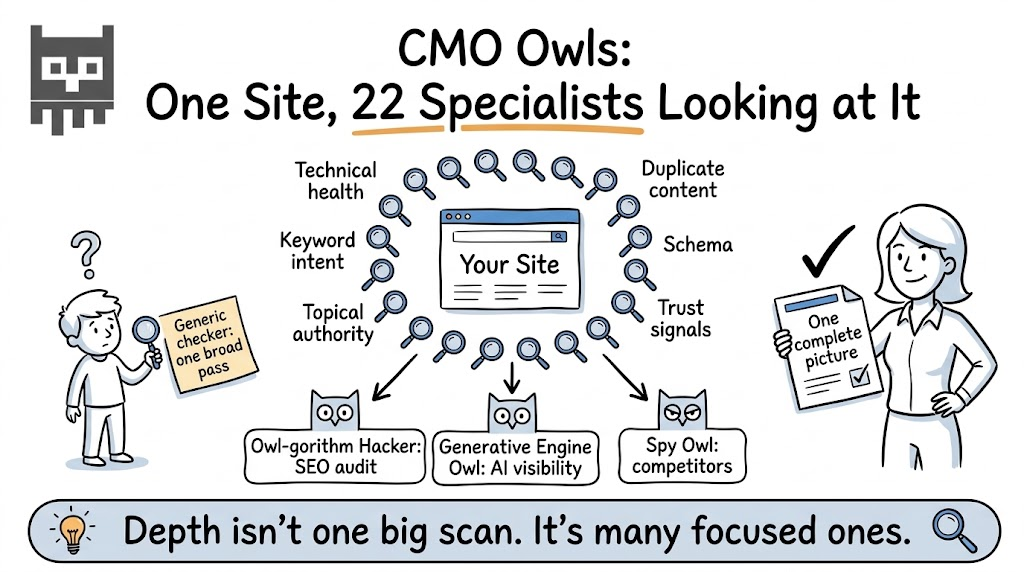
The interesting part is how. Behind that audit sits a dedicated intelligence engine made of 22 specialized analysis modules. One looks only at technical health. Another at keyword intent. Another at topical authority, another at duplicate content, and so on. Each examines your site from its own angle, and the findings are combined into one picture.
A single generic checker makes one broad pass. This makes twenty-two focused ones. That's the difference between a checkup and a panel of specialists.
The same engine powers two more owls. Generative Engine Owl uses the modules built for AI visibility: whether ChatGPT, Perplexity, and Google's AI Overviews can understand, trust, and cite your brand. It audits your entity clarity, structured data, schema markup, and trust signals, which is what generative engine optimization (GEO) actually comes down to. Traditional rankings aren't enough anymore when AI search answers the question before anyone clicks. We covered how that shift works in how AI agents are changing SEO in 2026.
And Spy Owl, covered in more detail below, borrows the modules built for external competitive intelligence and competitor GEO positioning. Three owls, one engine, three very different questions answered with audit-grade depth.
Audits Are Worthless Until Something Ships
Most marketing teams have a folder of audits nobody acted on. An audit that doesn't turn into work is just an expensive list of regrets.
Opportunity Owl exists to close that gap, and it does it in two stages. First, triage: every finding from the audit is classified as either a mechanical fix (a missing canonical tag, a lazy-loading gap, a broken internal link, anything with a clear, calculable correction) or a content opportunity (a keyword gap or thin page that needs real writing). Second, resolution: mechanical issues get a precise, evidence-backed fix, and content opportunities go to a writing stage that produces a complete, publish-ready article grounded only in what the audit actually found.
Nothing invented. Nothing generic. Every article comes with supporting images made for it and a validation pass on length and structure before it lands in your queue. That's what SEO fixes should look like: shipped, not suggested.
Then there's Owlthor, the owl for when you already know the keyword you want to win. It runs a real production line: live keyword research on who ranks, what people ask, search volume, and competitiveness; then angles and titles built around genuine content gaps; then a long-form article, typically 1,500+ words, optionally grounded in your own product knowledge base; then charts and images. Connect WordPress and it can publish too, but only because you switched that on.
Buzz Creator Owl is the action arm of Generative Engine Owl. Where one diagnoses how AI engines describe you, the other builds the content that changes the answer. Its pipeline is the most thorough on the platform: brand profiling, brand voice calibration (cached, so every future run sounds like you), angle research against live search data, prioritization, then up to five full articles per run with matching visuals.
And Growth Hacker writes the "your brand vs. competitor" pieces your prospects are already searching for. It doesn't guess which comparisons matter. It pulls them from your competitive intelligence data and your AI-visibility findings, then writes an evidence-grounded comparison using the same trusted process as Opportunity Owl.
Every Channel Speaks Its Own Language
Here's where most AI tools quietly fail: they write one post and paste it everywhere. A Medium essay, a LinkedIn update, an X thread, and a Reddit reply are four different animals. CMO Owls gives each one its own owl.
Medium Owl researches your topic with live web information and drafts a long-form, storytelling-style piece matched to Medium's format and tone, with images placed where the story calls for them.
LinkedIn Owl writes LinkedIn posts grounded in your real positioning and voice, then grades its own draft. If the post misses its structural standards for length, structure, or tone, it revises itself before you ever see it. That's an owl with standards.
X Owl researches first and writes second, so your posts and threads reflect what's actually true and current, not a recycled hot take.
Then the hardest room in the internet. Reddit Owl treats Reddit marketing the only way that works: conversation first, reply second. It pulls real keywords and candidate subreddits from your own website, searches live discussions to find active, relevant threads, loads the full conversation so you can read what's actually being said, and only then drafts one context-aware reply. You copy it. You post it. In your own voice. The same guided flow works for Hacker News, tuned to that community's norms.
The Owls That Never Sleep
Content is half the job. The other half is noticing things before they cost you. Three owls stand watch.
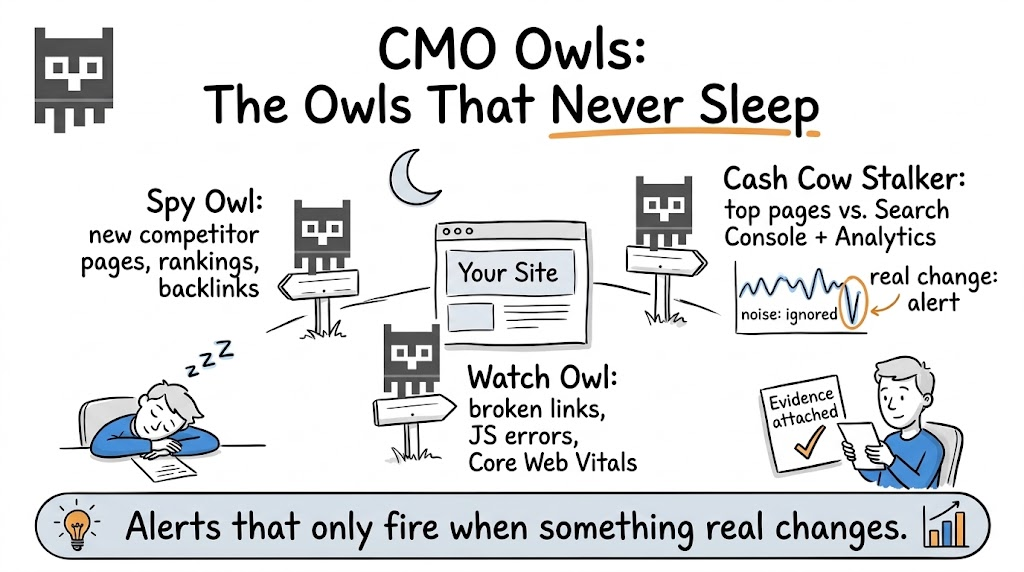
Spy Owl runs continuous competitor intelligence, not a one-time snapshot. It tracks new pages your competitors publish, movement in their rankings, and changes in their backlink profile, and you can keep a watchlist of the domains you care about most. Real competitor analysis is a film, not a photograph.
Watch Owl handles site monitoring by crawling your live site the way a real visitor would. Broken links, JavaScript errors, accessibility issues, broken forms, each with evidence attached. It also checks Core Web Vitals separately for mobile and desktop. Watch Owl reports facts, not opinions, which is exactly why you can act on what it finds without a second opinion.
Cash Cow Stalker guards the pages that pay your bills. Every 5 days it checks your top pages against real Search Console and Analytics data, and it only speaks up when something meaningful changes. A real ranking shift. A real traffic drop. It never cries wolf over normal daily noise, which means when it does talk, you listen.
Video, Creators, and the Work Most AI Tools Skip
Most AI marketing platforms stop at text. CMO Owls keeps going, into the formats that actually win attention on social.
Owl Cam produces UGC video ads, the authentic, creator-style format that performs across platforms. It writes the hook and script from your chosen persona, brand voice, and product knowledge base, generates a storyboard image for the opening scene, then produces the finished video, with the option to extend its runtime. Not a script. Not a draft. A video.
Owl Studio does the same for brand-led ad creative, with one crucial difference: it starts from your real product photos, not an AI-generated storyboard. Your actual images are the foundation, so the product on screen is the product you sell.
And Owl Match solves the messiest part of influencer marketing: trust. You browse real, verified rate cards, place an order, and pay securely inside the platform before either side exchanges names or contact details. A private, anonymized chat opens once the order is placed, and identities stay hidden until both of you choose to share them.
The CMO Owl: Where Findings Become a Plan
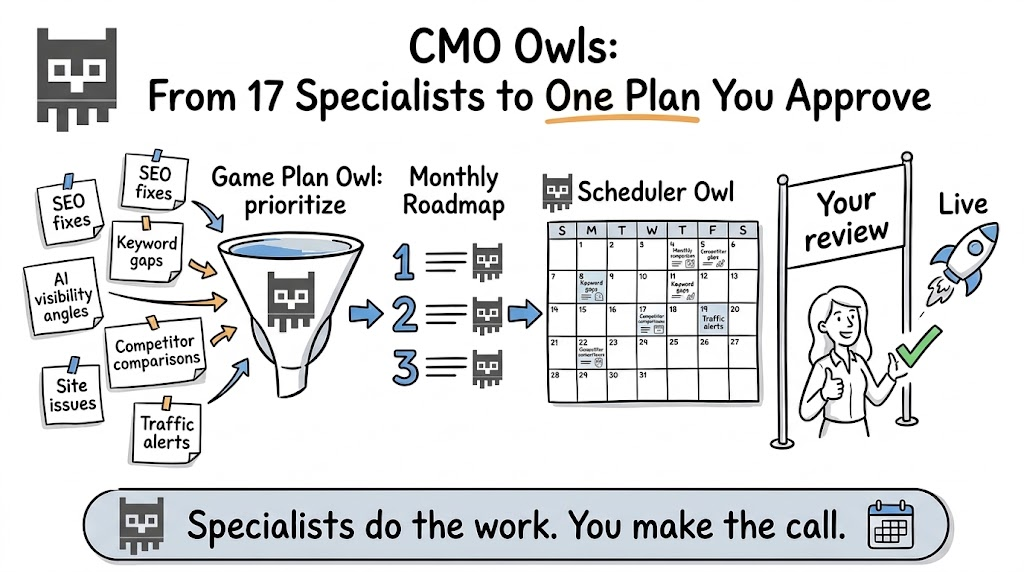
Seventeen specialists produce a lot of findings. Findings without priorities are just noise with good formatting. This is where the platform earns the word CMO.
Game Plan Owl is the coordinator. It pulls in the real opportunities every other owl surfaces, SEO fixes, keyword gaps, brand-discoverability angles, competitor comparisons, and more, and turns them into one prioritized marketing roadmap sized to what you can realistically act on each month.
The detail that matters most: every item on that roadmap links straight to the owl that will produce it. No dead-end suggestions. No "consider improving your content strategy." Every line is a queued, one-click action.
Scheduler Owl then lays that roadmap across a real content calendar, spreading the month's backlog over actual days so your publishing cadence is something a human team can keep. Click any day, and you're inside that piece's generation flow. That's content strategy you can execute on a Tuesday afternoon.
Nothing Goes Live Without You
Every piece of content, every fix, every recommendation lands in front of you first.
It would be easy to read that as "slower." The better word is "accountable." An agent that auto-publishes is making a bet with your brand's name on it, and you don't find out whether the bet paid off until it's public. Human review isn't friction in this system. It's the reason the output is safe to use at all.
And because every owl works from real inputs, the review is fast. You're not fact-checking hallucinations. You're approving work built on your own site, your own analytics, live search results, and live competitor data. Reviewing grounded work takes minutes. Rescuing ungrounded work takes weeks.
A Note on Where This Comes From
This article is published by CMO Owls, and that affiliation should be weighed when reading it.
Notice, though, what it doesn't claim. It doesn't promise rankings. It doesn't say the owls "understand your business better than you do." Every capability described here reflects what the product actually does today, and every agent named links to its own page so you can verify it.
That's the standard any AI marketing team should be held to: show what data it uses, show the steps, and show the output before the world sees it. CMO Owls was built to pass that test on purpose.
What a Month With the Owls Actually Looks Like
Abstract architecture is easy to nod along to. Here's an illustrative example of how a month can play out; the specifics will depend on your site.
Week one. Owl-gorithm Hacker runs your SEO audit and Generative Engine Owl checks how AI engines see you. Opportunity Owl triages the findings: fourteen mechanical fixes land in your queue with exact corrections, and three content opportunities are already being drafted.
Week two. Spy Owl flags that a competitor published a comparison page targeting your brand name. Growth Hacker picks up the opportunity and drafts your side of that comparison, grounded in real data instead of their spin. Meanwhile Watch Owl finds a broken form on your pricing page. Evidence attached.
Week three. Game Plan Owl folds everything into one roadmap. Scheduler Owl spreads it across the calendar. Owlthor drafts the keyword article you've been meaning to write for six months. LinkedIn Owl and X Owl turn it into posts. Reddit Owl finds a live thread where someone is asking exactly the question that article answers.
Week four. Cash Cow Stalker stays quiet, because nothing real changed on your top pages. Owl Cam delivers a UGC ad for the product launch. You approved all of it. You wrote none of it.
That's not a tool. That's a department.
FAQ
What are the AI marketing agents in CMO Owls?
CMO Owls is a team of 21 specialist AI marketing agents, each named after an owl. They cover SEO audits, AI visibility, articles, social posts, Reddit engagement, competitor tracking, site monitoring, traffic alerts, strategy, content scheduling, video ads, and an influencer marketplace.
How is CMO Owls different from a single AI marketing tool?
A single tool runs one model over every job. CMO Owls assigns each job to a dedicated agent with its own data and process, then Game Plan Owl combines all their findings into one prioritized roadmap. Several agents also share a 22-module audit engine for depth a single checker can't reach.
Does CMO Owls publish content automatically?
No. Every draft, fix, and recommendation lands in your review queue first. Reddit Owl replies are always posted by you, and Owlthor only publishes to WordPress if you connect it and choose to.
What data do the agents use?
Real data only: your live website, your Search Console and Analytics data, live search results, and live competitor activity. Opportunity Owl's articles are grounded strictly in what the audit found.
Can CMO Owls improve how ChatGPT and Perplexity describe my brand?
Yes. Generative Engine Owl audits your entity clarity, structured data, and citation-readiness for AI engines, and Buzz Creator Owl builds the content needed to close the gaps it finds.
Does CMO Owls handle video and influencers?
Yes. Owl Cam produces UGC-style video ads, Owl Studio builds ad creative from your real product photos, and Owl Match connects you with creators through an anonymous, secure marketplace.
The Bottom Line
The strength of CMO Owls isn't any single owl. It's how they fit. Audits feed fixes. Fixes feed content. Monitoring feeds alerts. Everything feeds the roadmap. And the roadmap feeds your review queue, not the public internet.
Marketing doesn't need one more clever generator. It needs a team that knows its job, works from real evidence, and asks before it acts.
A great AI CMO doesn't replace your judgment. It gives your judgment twenty-one specialists to work with.
See What the Owls Find on Your Site
Start where every audit should: with evidence. Run a free Watch Owl scan on your live site and see every broken link, error and failing form, each with proof attached. When you want the full parliament on your site, compare the plans or get started free, no credit card required. Then meet the rest of the 21-agent team.