There are thousands of AI marketing tools, and most small businesses need only a handful. The trick is to choose by job, not by hype. This guide sorts AI marketing tools for small business by the work they do, shows the free ones worth using first, compares single tools with an all-in-one platform, and gives you six checks to run before paying for anything. It's part of our guide to AI marketing for small business.
Key Takeaways
- Choose AI marketing tools for small business by job: writing, design, social, email, search visibility and reporting.
- Start free. Google Search Console, Google Analytics, your Google Business Profile, a free chatbot tier and free site checkers cover a lot.
- Single tools are flexible but you connect them; an all-in-one platform does the connecting for you.
- Before you pay, check six things: data access, a review step, cost per output, export, privacy and fit with your channels.
- Fewer tools, used every week, beat a big stack nobody opens.
What Counts as an AI Marketing Tool for a Small Business?
An AI marketing tool is any software that uses AI to do a marketing task for you: draft, design, schedule, analyse or suggest. For a small business they fall into three groups:
- General assistants like ChatGPT, Claude and Gemini, which draft anything you ask for but don't know your business unless you tell them.
- Single-job tools, built for one task such as design, email or social scheduling.
- All-in-one platforms that run several jobs from your real data with one plan. The leading ones are compared in Best AI CMO in 2026.
Most small businesses are already experimenting. The U.S. Chamber of Commerce found 58% use generative AI, while the Census Bureau found fewer than 20% of the smallest firms use AI in their operations. The tools are easy to try; building them into a routine is the hard part, and that's what the right stack fixes.
AI Marketing Tools for Small Business, Sorted by Job
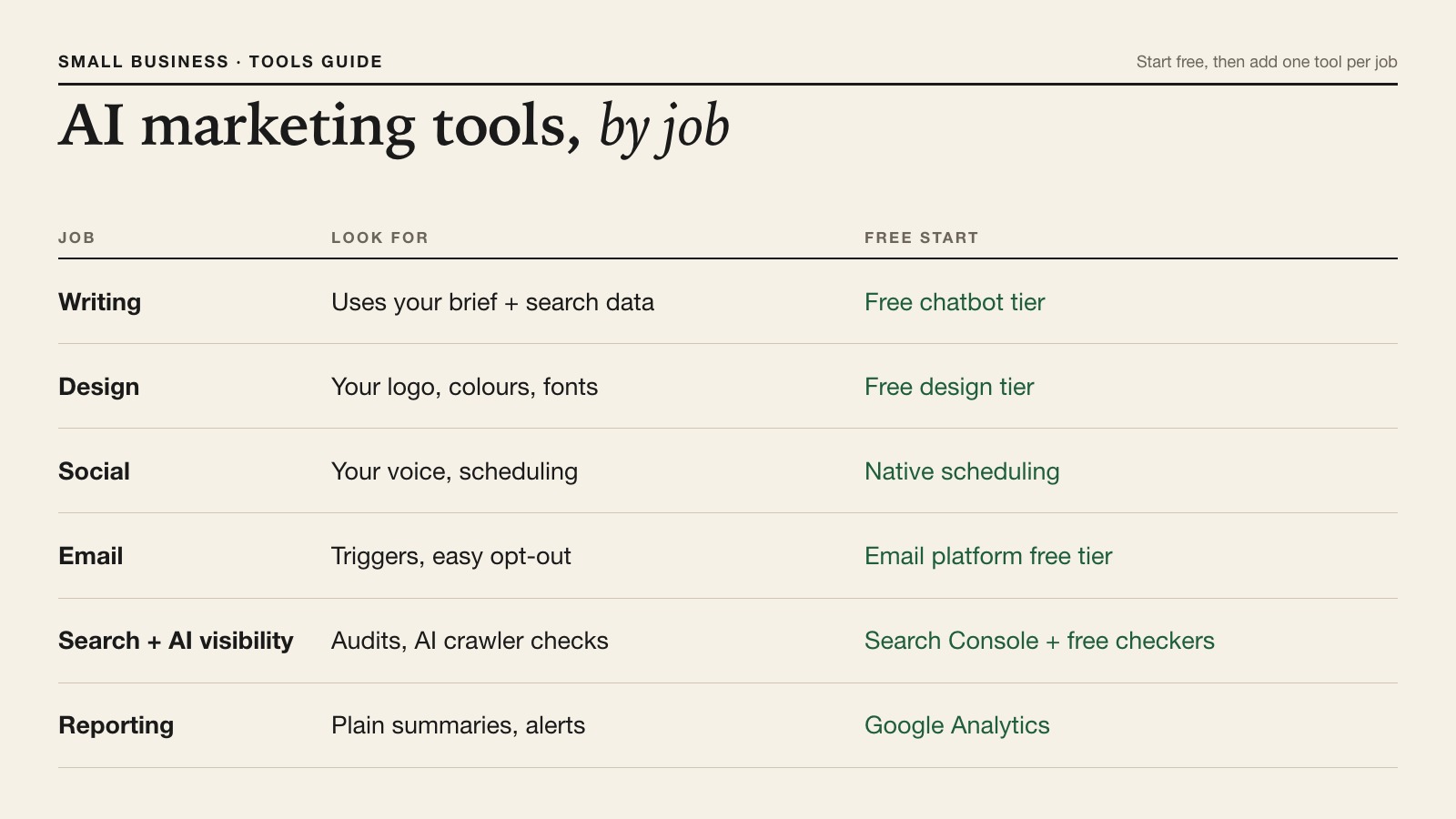
Pick one tool per job you actually do, and skip the jobs you don't. Here's what to look for in each, and a free place to start:
| Job | What to look for | Free starting point | All-in-one option |
|---|---|---|---|
| Writing (blog, website copy) | Uses your brief and real search data | A free chatbot tier | Article agents with a review queue |
| Design and ad creative | Uses your logo, colours and fonts | A free design tool tier | Owl Studio for ad concepts |
| Social media | Drafts in your voice, schedules | Native scheduling in each platform | Social owls + Scheduler Owl |
| Templates, triggers, easy opt-out | Free tier of an email platform | Your email platform | |
| Search and AI visibility | Site audits, AI crawler checks | Search Console + free CMO Owls tools | Site QA and audit agents |
| Reporting | Plain-English summaries, alerts | Google Analytics | Traffic alerts + one roadmap |
Email is the one job where a dedicated email platform usually stays the right tool, even if you use an all-in-one for everything else, because it handles your list, consent and opt-outs.
Free AI Marketing Tools Worth Using First
A small business can cover the basics for $0 before buying anything. These are worth setting up first:
- Google Search Console shows how your site performs in Google Search and alerts you to problems (Google's overview).
- Google Analytics shows who visits, from where, and what they do (how it works).
- Your Google Business Profile, where customers leave reviews. Google notes that replying to them shows customers you value their feedback.
- A free chatbot tier for first drafts, ideas and rewriting.
- Free site checkers. The AI Visibility Checker tests whether AI crawlers can read your site, the Broken Link Checker finds dead links, and the Schema Checker reviews your structured data. All six free tools work without an account.
Google's own SEO starter guide is the best free reading on the basics, and it applies whether a person or a tool writes your pages.
Single Tools vs an All-in-One Platform
Single tools win on choice; an all-in-one platform wins on time, because it shares one plan and one set of data across every job.
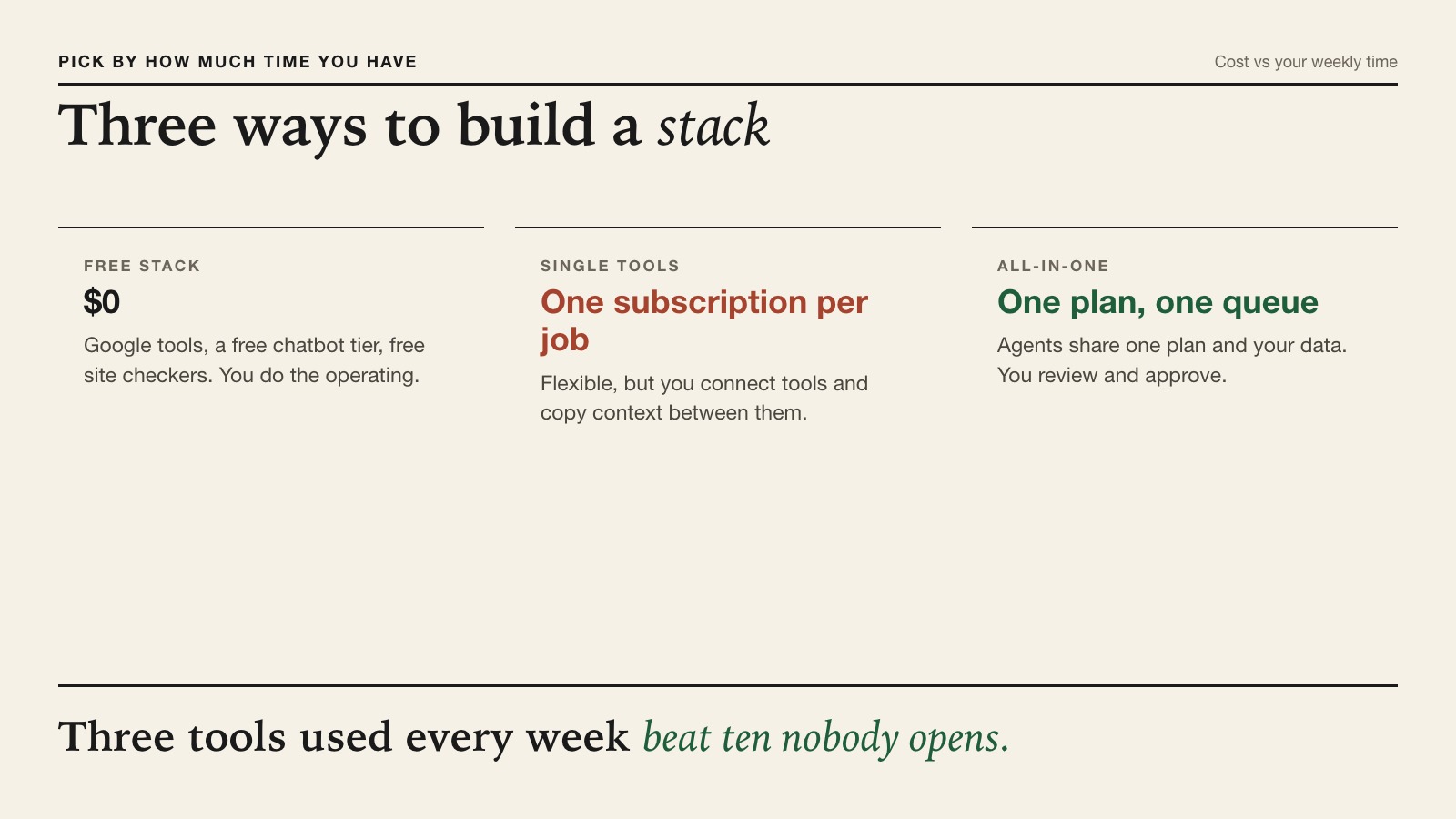
| Factor | Several single tools | All-in-one platform (e.g. CMO Owls) |
|---|---|---|
| Setup | One account and login per tool | One account |
| Shared plan and data | You copy context between tools | Every agent reads one strategy |
| Cost | A subscription per tool, adding up | One plan; CMO Owls from $0, paid from $106/mo billed annually |
| Your weekly time | Highest: you operate each tool | Lowest: you review a queue |
| Flexibility | Swap any tool | Covers the jobs it includes |
CMO Owls is built for the all-in-one route: article agents, Medium Owl for long-form drafts, Buzz Creator Owl for AI brand discoverability, Growth Hacker for comparison pages, and Owl Studio for ad concepts, all working from the same plan.
How to Choose AI Marketing Tools: 6 Checks
Run these six checks before you pay for any AI marketing tool.
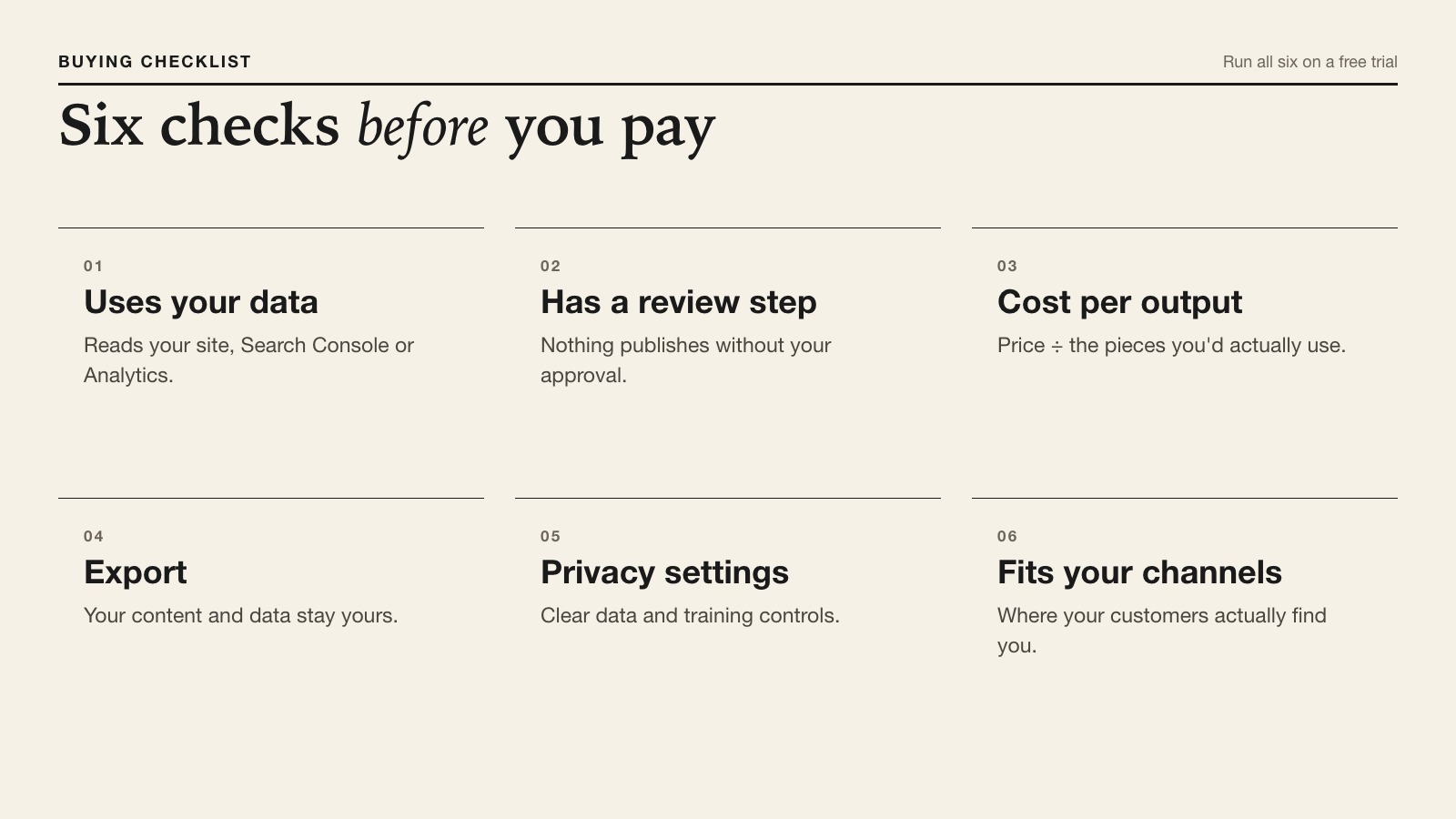
- Does it use your real data? Tools that read your site, Search Console or Analytics give better suggestions than ones working from a blank prompt.
- Is there a review step? Nothing should publish under your name without your approval. Google advises fact-checking AI output before publishing.
- What does each output cost? Divide the price by the posts, articles or reports you'd actually use in a month.
- Can you export your work? Make sure your content and data stay yours if you leave.
- How does it handle customer data? Read the privacy and training settings, and don't paste sensitive customer details. The FTC's guide to protecting personal information is a good checklist.
- Does it fit your channels? A brilliant Instagram tool is useless if your customers find you on Google and by email.
Three Example Stacks for Small Businesses
Match the stack to how your customers find you. Three common examples:
- A neighbourhood café: Google Business Profile, a free chatbot tier for weekly posts and review replies, and native Instagram scheduling. Cost: $0.
- A local service business (plumber, salon, clinic): Search Console, Analytics, Business Profile, a free email platform tier for appointment follow-ups, and the free AI Visibility Checker. Cost: $0 to one subscription.
- A small online shop: the free Google tools, an email platform, and an all-in-one AI marketing team for content, social, site QA and traffic alerts, with a person approving the queue.
Once the tools are chosen, decide which jobs run on their own. Our guide to small business marketing automation covers what to automate first, and the AI marketing assistant guide shows how to brief your tools so they sound like you.
How Much a Small Business Should Spend on AI Marketing Tools
Spend nothing until a free tool shows you a gap, then pay only for tools whose output you can measure. A simple way to decide:
- Step 1: list the jobs you do every month and how long each takes you. Writing posts, replying to reviews, checking the site, reporting.
- Step 2: price your time. Even a rough hourly figure for your own time makes the comparison honest.
- Step 3: compare. If a tool costs less per month than the hours it saves, and the output is good enough to publish after a light edit, it earns its place.
- Step 4: review after two months. Keep it only if visits, enquiries or sales moved, or if it clearly freed time you used elsewhere.
A worked example with round numbers: if writing four posts and two review replies a week takes you three hours, and a tool cuts that to one hour of editing, it saves about eight hours a month. Whatever your hourly value is, multiply it by eight and compare with the subscription. Most owners find one or two tools pass this test easily, and the rest don't.
What AI Marketing Tools Can't Do
AI tools can draft, sort and suggest, but they can't know your customers the way you do, guarantee results or take responsibility for what's published. Be clear about the limits before you rely on one:
- They don't know what they haven't been told. A tool without your brief, prices and real proof will fill gaps with plausible guesses.
- They can be confidently wrong. Dates, prices, opening hours and claims need a human check every time.
- They can't build trust on their own. Reviews, word of mouth and mentions from other sites come from real customers and real relationships.
- They don't replace a plan. A tool makes each task faster. Deciding which tasks matter is still your job, which is why the hub guide starts with priorities, not software.
Mistakes to Avoid With AI Marketing Tools
- Buying too many tools. Each one needs setup and attention. Three used weekly beat ten forgotten.
- Publishing without reading. AI can state wrong prices, dates or claims with total confidence.
- Faking social proof. The FTC's rule bans fake reviews and testimonials, including AI-generated ones.
- Skipping the basics. If Google or AI crawlers can't read your site, no writing tool will fix it.
FAQ
What are the best AI marketing tools for a small business?
The best ones match the jobs you actually do: a writing tool, a design tool, your Google tools, an email platform and a site checker. If you want one system instead of several, an all-in-one AI marketing platform covers most of them.
Are there free AI marketing tools for small business?
Yes. Google Search Console, Google Analytics, Google Business Profile, free chatbot tiers and free site checkers like the AI Visibility Checker all cost nothing.
Do I need more than ChatGPT for marketing?
For drafting, a chatbot is enough. For running marketing every week, you also need your data, a schedule and a way to measure results, which chatbots don't provide on their own.
Which AI marketing tool should a local business start with?
Start with your Google Business Profile and Search Console, both free. Then add a writing tool for review replies and weekly posts.
Can AI tools make my marketing graphics?
Yes, AI design tools can draft social graphics and ad concepts. Give them your logo, colours and fonts, and check that every image fits your brand before it goes out.
Are AI marketing tools safe for customer data?
It depends on the tool. Check its privacy and training settings, avoid pasting sensitive customer details, and follow the FTC's guidance on protecting personal information.
How many marketing tools does a small business need?
Usually three to five: your Google tools, one writing or all-in-one tool, and an email platform. Add more only when a job is clearly not getting done.
How do I know if a paid tool is worth it?
Compare its monthly cost with the outputs you actually use and the visits or enquiries they bring. If it doesn't earn its place in two months, cancel it.
The Verdict
The right AI marketing tools for small business are the few you'll use every week. Start with the free Google tools and site checkers, add one tool per job you really do, or move everything into one all-in-one platform when connecting tools starts eating your time. Next, read the hub guide to AI marketing for small business.
Sources
- U.S. Chamber of Commerce, Empowering Small Business, August 18, 2025.
- U.S. Census Bureau, AI use by business size, May 26, 2026.
- Google Search Console Help, About Search Console.
- Google Analytics Help, How Google Analytics works.
- Google Business Profile Help, reading and replying to reviews.
- Google Search Central, SEO starter guide.
- Google Search Central, using generative AI content.
- FTC, final rule banning fake reviews and testimonials, August 14, 2024.
- FTC, Protecting Personal Information: A Guide for Business.
- CMO Owls pricing, checked October 7, 2026.