Most small business owners are their own marketing department, and the job never ends: posts to write, reviews to answer, a website to keep working, and no time to check what's actually bringing customers in. AI marketing for small business is about handing the repetitive part of that work to software, so the hours you have go to decisions and customers. This guide covers where AI helps, what it costs, what must stay human, the rules that apply, and a 30-day plan to start.
Key Takeaways
- AI marketing for small business means using AI to research, create, publish and measure marketing, with you approving what goes out under your name.
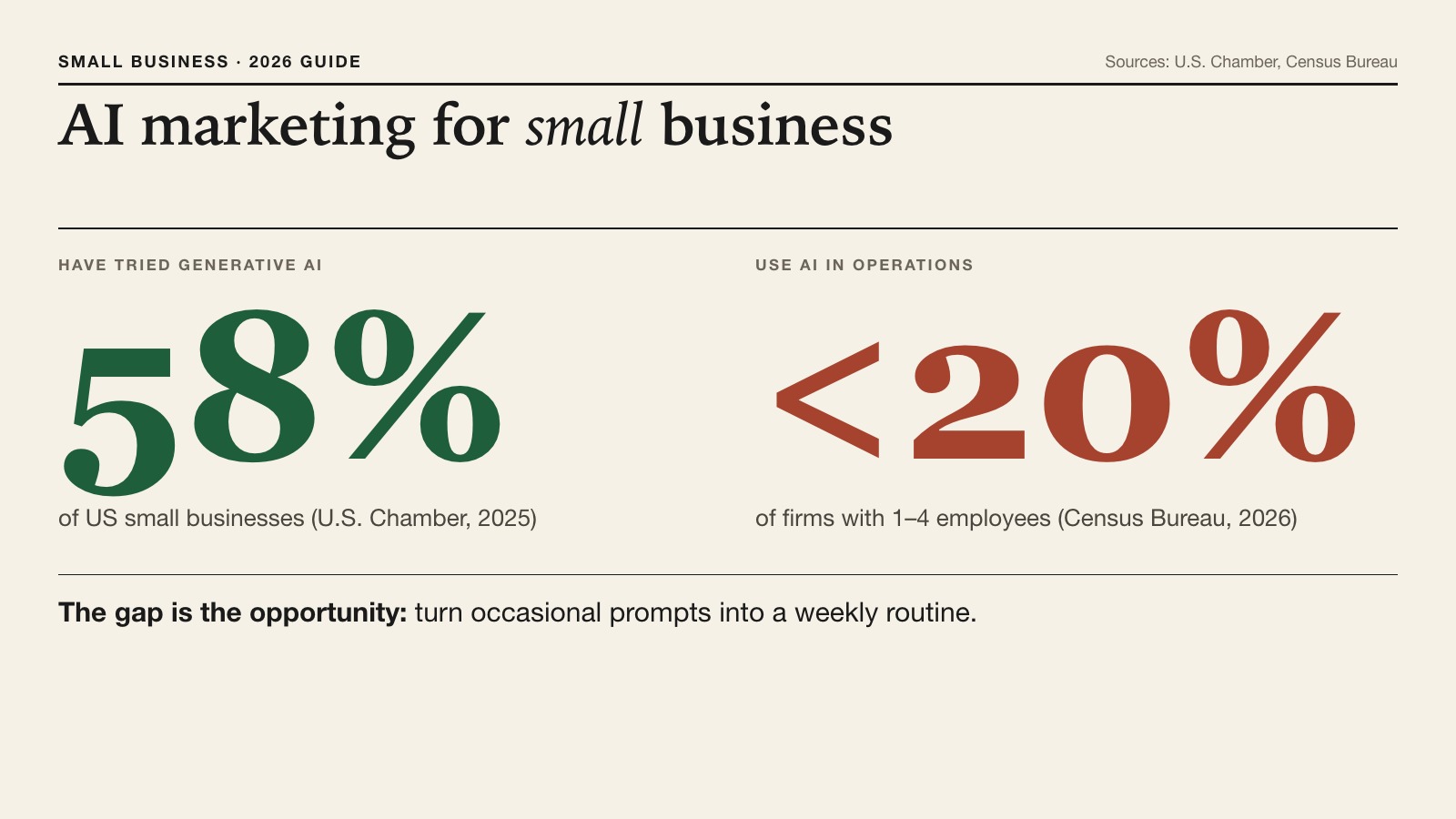
- Most small businesses have tried it, few have built it in. 58% say they use generative AI, but fewer than 20% of firms with one to four employees use AI in their operations.
- Start with the jobs that repeat: content, local search, social posts, review replies, monitoring and reporting.
- Keep people on pricing, promises, complaints and anything legal. AI drafts; you decide.
- There are three ways in: free chatbots, single-job tools, or an all-in-one AI marketing team such as CMO Owls. Pick by how much of the work you want off your plate.
What AI Marketing for Small Business Means in 2026
AI marketing for small business is the use of AI tools to do marketing work a small team doesn't have time for: researching what customers search, drafting content, scheduling posts, watching results and suggesting the next step. You stay the editor and the decision-maker.
In practice it comes in three levels:
- A general chatbot such as ChatGPT, Claude or Gemini. You ask, it drafts. It doesn't know your website, your data or last month's plan unless you paste them in.
- Single-job tools for one task each: writing, design, email, scheduling or SEO. Useful, but you connect them yourself. Our guide to AI marketing tools for small business sorts them by job.
- An all-in-one AI marketing team: several AI agents working from your real data and one shared plan, with a review queue for you. That's what an AI CMO is; see Best AI CMO in 2026 for how the main options compare.
Small businesses matter here because they are most businesses. The SBA Office of Advocacy counts 36.2 million small businesses in the US, 99.9% of all firms, employing 45.9% of American workers. Most of them don't have a marketing hire.
How Small Businesses Actually Use AI Today
Most small businesses have experimented with AI, but only a minority use it as part of how they operate. Two credible sources show the gap clearly.
The U.S. Chamber of Commerce's 2025 Empowering Small Business report found that 58% of small businesses use generative AI, up from 40% in 2024 and 23% in 2023. The Census Bureau's Business Trends and Outlook Survey asks a stricter question, whether firms use AI in producing goods or services, and found that fewer than 20% of firms with four or fewer employees do, compared with 37% of firms with 250 or more.
Both are right. The first counts anyone who has used a chatbot to draft an email. The second counts AI built into the work. That gap is the opportunity: the owner who moves from occasional prompting to a steady, repeatable routine gets the benefit most competitors are still missing.
Where AI Helps a Small Business's Marketing Most
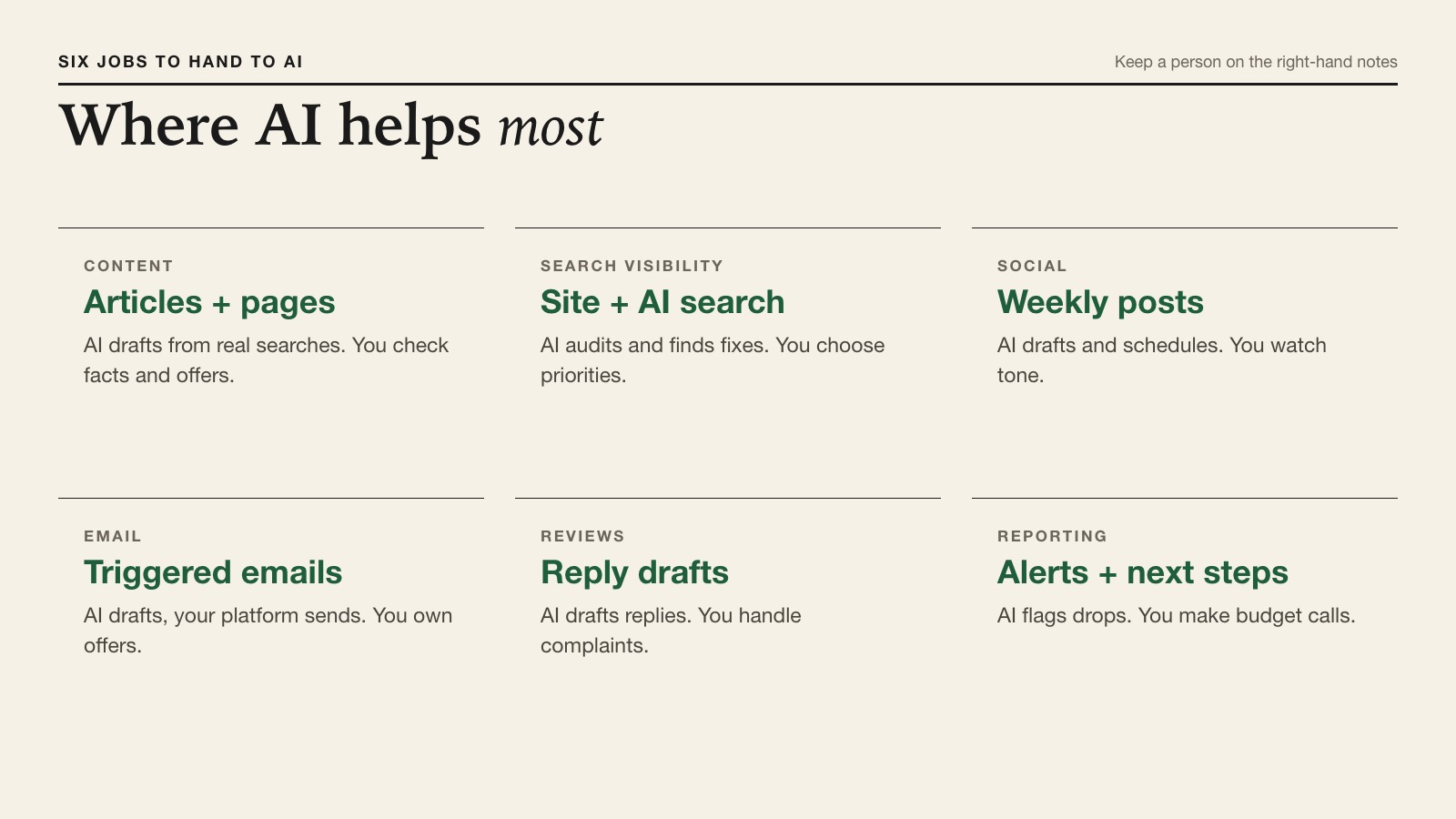
AI helps most with marketing jobs that repeat every week and follow a pattern. Here's where it saves the most time, and what should stay with a person:
| Marketing job | What AI does | Keep human | Go deeper |
|---|---|---|---|
| Content and blog posts | Researches searches, drafts articles | Facts, offers, final edit | Tools guide |
| Local and search visibility | Audits your site, finds fixes, checks AI search | Choosing priorities | Free AI checker |
| Social media | Drafts posts, fills a calendar | Tone on sensitive topics | Assistant guide |
| Drafts campaigns, sends triggered emails | Offers and promises | Automation guide | |
| Reviews | Drafts replies to reviews | Complaints and refunds | Automation guide |
| Reporting | Watches traffic, flags drops, suggests next steps | Budget decisions | Assistant guide |
A simple example: a local bakery publishes one helpful post a week about seasonal orders, answers every Google review within a day, and gets an alert when traffic to its order page drops. None of that needs a marketer on payroll once it's set up, and the owner still approves every word.
What AI Marketing Costs a Small Business
AI marketing can start at $0, and an all-in-one AI team costs a few hundred dollars a month at most, far below one marketing salary. The real choice is how much of the work you want handled.
| Level | Typical cost | Your time each week | Best for |
|---|---|---|---|
| Free chatbots + free Google tools | $0 | High: you do the operating | Testing the water |
| A few single-job tools | A subscription per tool | Medium: you connect them | One or two channels |
| All-in-one AI marketing team | From $0; CMO Owls paid plans from $106/mo billed annually | Low: review and approve | Owners who want it done |
For the full comparison against hiring a person or an agency, read AI CMO vs traditional marketing. For tool-by-tool advice, including the free ones worth using first, read AI marketing tools for small business.
What to Automate and What to Keep Human
Automate the triggers and the routine; keep people on judgment and promises. A welcome email when someone signs up, a review request after a purchase, a weekly post schedule and a traffic alert are perfect for automation. A reply to an angry customer, a discount decision or a public statement isn't.
The rule of thumb: if a mistake would cost you money or trust, a person signs off. Our guide to small business marketing automation lists the seven workflows to set up first and the legal rules each one must follow.
Your AI Marketing Assistant: A Simple Weekly Routine
An AI marketing assistant works best on a fixed weekly rhythm: check, create, publish, reply, report. Monday it checks your site and traffic, midweek it drafts posts and articles, and Friday it tells you what worked.
With CMO Owls, that rhythm is built in: Watch Owl crawls your site for broken pages, LinkedIn Owl and the other social owls draft posts for review, Scheduler Owl spreads the month's content across a real calendar, and Game Plan Owl ranks what to fix next. The AI marketing assistant guide shows how to brief any assistant so its drafts sound like you.
Getting Found in AI Search as a Small Business
Customers now ask AI assistants for recommendations, so a small business needs to be readable and quotable by AI, not only ranked in Google. Google shows AI Overviews and AI Mode in search, and Pew Research found that people who saw an AI summary clicked a regular result in 8% of visits, against 15% without one.
Three basics make the difference: AI crawlers must be allowed to read your site, your business facts (name, address, hours, services) must match everywhere, and your pages should answer real questions in plain sentences. Run the free AI Visibility Checker to see if AI crawlers can reach you, and follow how to check your AI visibility for the rest. All our free marketing tools work without an account.
The Risks and Rules of AI Marketing
AI makes mistakes, and the law treats AI-written marketing the same as anything you write yourself. Four rules cover most small businesses:
- Check facts before publishing. Google allows AI-assisted content that helps people, but warns that mass-produced pages with no added value can count as scaled content abuse, and says AI output should be fact-checked.
- Never fake reviews. The FTC's rule on fake reviews, in force since October 2024, bans fake reviews and testimonials, including AI-generated ones, and allows civil penalties.
- Follow email law. Under CAN-SPAM, commercial emails need an honest subject line, your physical address and a working opt-out honoured within 10 business days. Each violating email can cost up to $53,088.
- Reply to reviews as a person would. Google notes that replying shows customers you value their feedback. Let AI draft the reply; read it before it posts.
Mistakes Small Businesses Make With AI Marketing
Most AI marketing problems come from skipping the basics, not from the AI itself. The five most common:
- Starting with content before access. If Google and AI crawlers can't read your site, more posts won't help.
- No brief. AI without your customers, offers and tone writes like everyone else.
- Publishing unchecked drafts. Wrong prices or promises are your responsibility, whoever wrote them.
- Too many tools at once. Pick one routine, make it work, then add the next.
- Measuring activity instead of results. Count visits, enquiries and sales, not posts.
A 30-Day AI Marketing Plan for a Small Business
Start small, prove one routine works, then add the next. This plan fits around a working week.
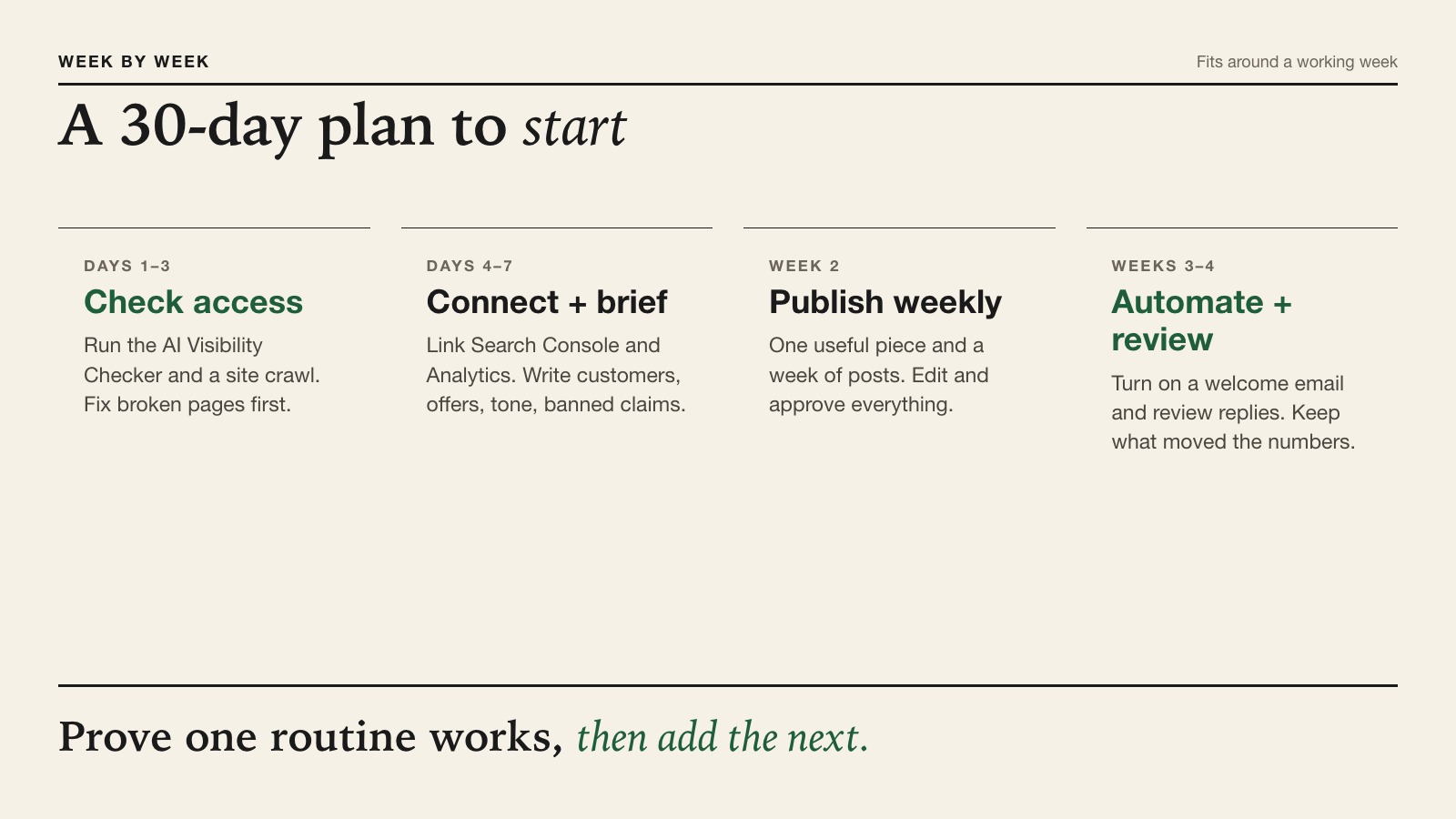
- Days 1–3: Check access. Run the free AI Visibility Checker and a site crawl. Fix broken pages and blocked crawlers first.
- Days 4–7: Connect your data and write your brief. Link Google Search Console and Google Analytics, and write down your customers, offers, tone and claims you never make.
- Week 2: Publish one useful piece and a week of posts. Let AI draft from your brief; edit and approve every piece.
- Week 3: Turn on two automations. A welcome email and a review-reply routine are the easiest wins.
- Week 4: Review and adjust. Check what brought visits and enquiries, cut what didn't, and repeat the routine next month.
FAQ
What is AI marketing for small business?
It's using AI tools to research, create, publish and measure a small business's marketing. The owner stays in charge and approves what goes out.
Is AI marketing worth it for a small business?
Usually yes, if you use it for repeat work like posts, review replies and reports. The value comes from a steady weekly routine, not one-off prompts.
Where should a small business start with AI marketing?
Start by checking your website can be read by Google and AI crawlers, then connect your analytics. After that, pick one routine, such as a weekly post, and build from there.
Can AI write my small business's social media posts?
Yes, AI can draft them well if you give it your audience, offers and tone. Read each post before it goes live, especially anything about prices or promises.
Does AI marketing work for a local business?
Yes. Local businesses benefit from AI for review replies, consistent business details, local search content and simple posts about what's happening this week.
Can I use AI to write customer reviews or testimonials?
No. The FTC's fake-reviews rule bans fake reviews and testimonials, including AI-generated ones. Use AI to reply to real reviews, never to create them.
Do I need technical skills to use AI marketing?
No. Most tools work in plain language. The skill that matters is knowing your customers, so you can judge whether a draft is right.
How do I know if AI marketing is working?
Watch visits, enquiries and sales in Google Analytics, and search impressions in Search Console, month over month. If a routine doesn't move those numbers after a few weeks, change it.
The Verdict
AI marketing for small business works when it becomes a routine, not an experiment. Check access, connect your data, let AI handle the repeat work and keep the decisions yourself. Go deeper with the three guides in this series: tools, automation and your AI marketing assistant.
Sources
- SBA Office of Advocacy, small business count, June 30, 2025.
- U.S. Chamber of Commerce, Empowering Small Business, August 18, 2025.
- U.S. Census Bureau, AI use by business size, May 26, 2026.
- Pew Research Center, clicks with AI summaries, July 22, 2025.
- Google Search Central, using generative AI content.
- Google Search Central, AI features and your website.
- FTC, final rule banning fake reviews and testimonials, August 14, 2024.
- FTC, CAN-SPAM Act compliance guide for business.
- Google Business Profile Help, reading and replying to reviews.
- CMO Owls pricing, checked October 7, 2026.