Most small business owners would love a marketing assistant: someone to keep the posts going, draft replies, watch the website and say what to do next. An AI marketing assistant for small business can do much of that today, if you set it up properly. This guide explains what an AI marketing assistant is, how it differs from a chatbot, a realistic weekly routine, how to brief it so drafts sound like you, and what it should never do on its own. It's part of our guide to AI marketing for small business.
Key Takeaways
- An AI marketing assistant for small business works from your data on a schedule; a chatbot only answers when you ask.
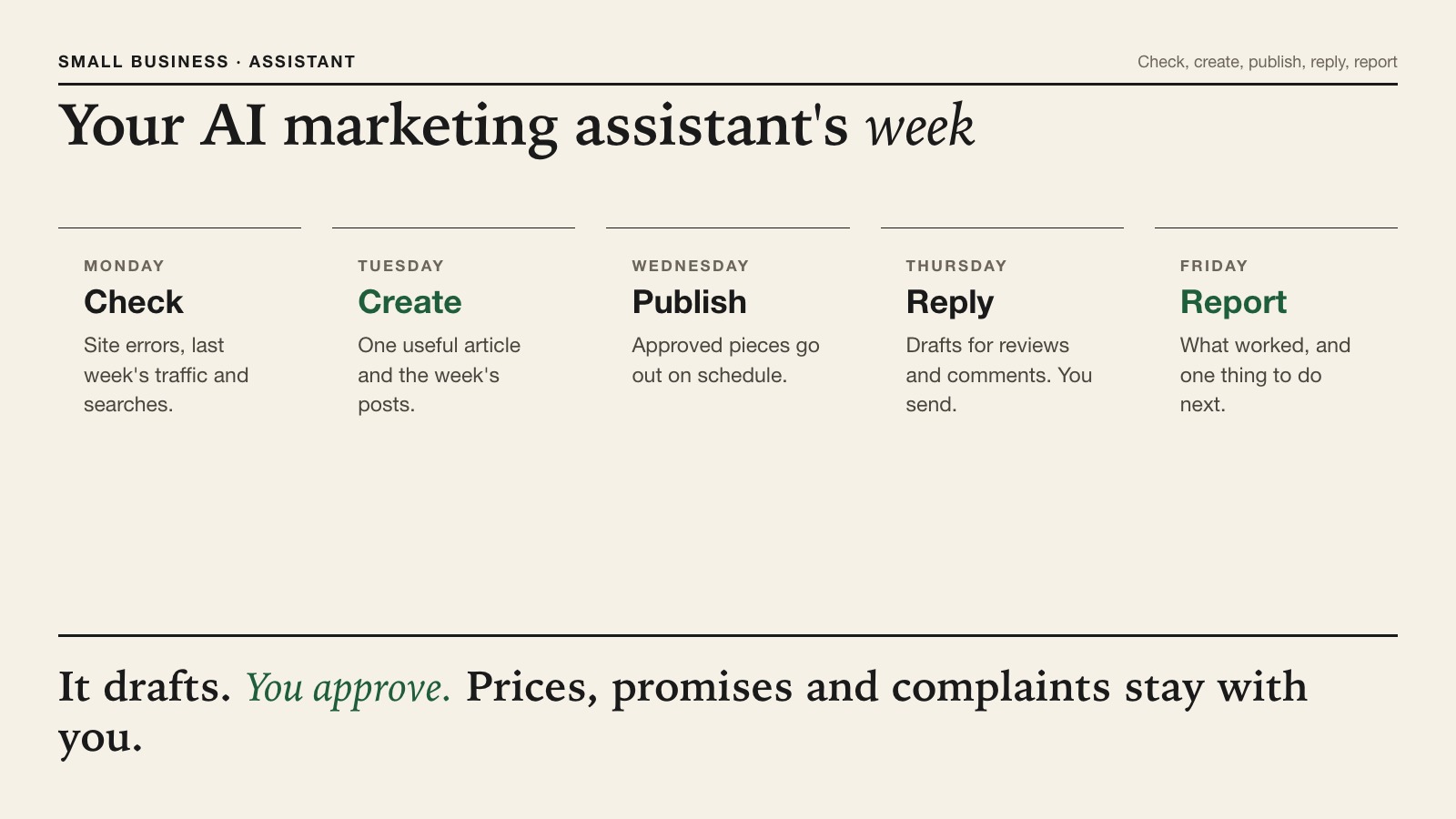
- A good weekly routine: check on Monday, create on Tuesday, publish on Wednesday, reply on Thursday, report on Friday.
- Brief it once with six facts: customers, offer, voice, proof, claims to avoid and this month's priority.
- It drafts; you approve. Prices, promises, complaints and anything legal stay with you.
- Judge it by results: visits, enquiries and sales, not the number of drafts.
AI Marketing Assistant for Small Business: What It Is
An AI marketing assistant is software that does recurring marketing work for you: it reads your website and analytics, drafts content and replies, keeps a calendar and reports results, with you approving the output. Think of it as the junior marketer most small businesses can't afford, working from your instructions.
Plenty of owners have already tried AI in some form. The U.S. Chamber of Commerce found 58% of small businesses use generative AI, yet the Census Bureau found fewer than 20% of firms with one to four employees use AI in their operations. The difference between those numbers is mostly the difference between a chatbot and an assistant.
AI Chatbot vs AI Marketing Assistant
A chatbot is a blank page that answers questions; an AI marketing assistant is set up around your business and works without being asked.
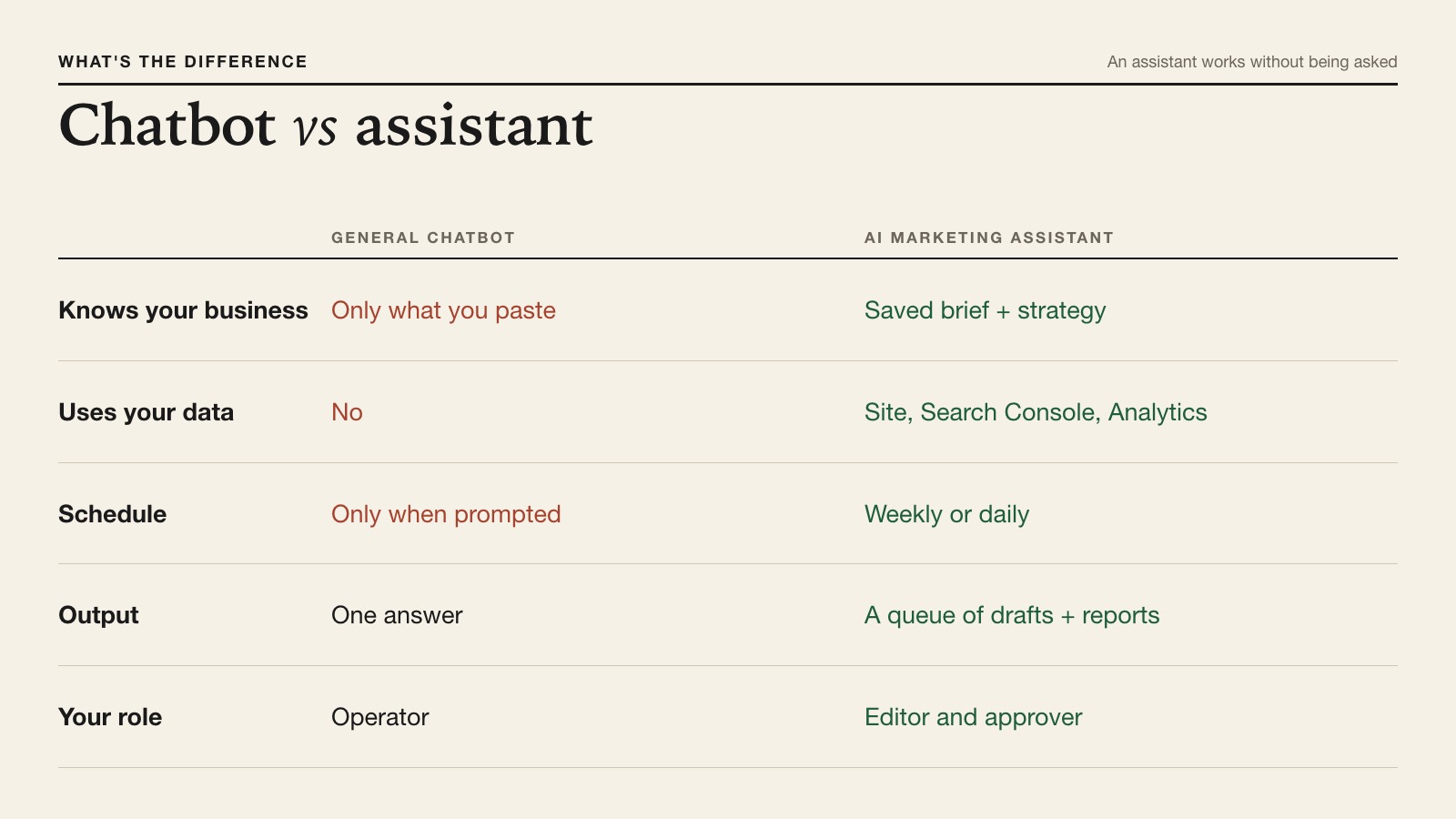
| Factor | General chatbot | AI marketing assistant |
|---|---|---|
| Knows your business | Only what you paste in | A saved brief and your strategy |
| Uses your data | No, unless you upload it | Reads your site, Search Console and Analytics |
| Works on a schedule | No, only when prompted | Yes, weekly or daily |
| Output | One answer at a time | A queue of drafts, alerts and reports |
| Your role | Operator | Editor and approver |
At CMO Owls, the assistant's memory lives in a shared Knowledge Base that every agent reads, so posts, articles and audits all start from the same facts about your business.
What an AI Marketing Assistant Can Do Each Week
Give your AI marketing assistant a fixed weekly rhythm so nothing slips. A realistic week for a small business:
- Monday: check. Crawl the site for broken pages and errors, and review last week's traffic in Google Analytics and search performance in Search Console.
- Tuesday: create. Draft one useful article or page update from real search questions, plus the week's posts. LinkedIn Owl and X Owl draft posts grounded in your positioning and findings.
- Wednesday: publish. Approved pieces go out on schedule.
- Thursday: reply and engage. Draft replies to new reviews and comments for you to send. Google notes that replying shows customers you value their feedback.
- Friday: report. A short summary of what worked, what didn't and the one thing to do next week.
Video and creators can join the routine as you grow: Owl Cam produces UGC-style video ads through scripting, editing and QA, and Owl Match is a marketplace for hiring creators with real rate cards. To decide which steps run fully on their own, read small business marketing automation.
How to Brief Your AI Marketing Assistant
Brief your assistant once, in writing, with six facts, and its drafts will sound like your business instead of a template.
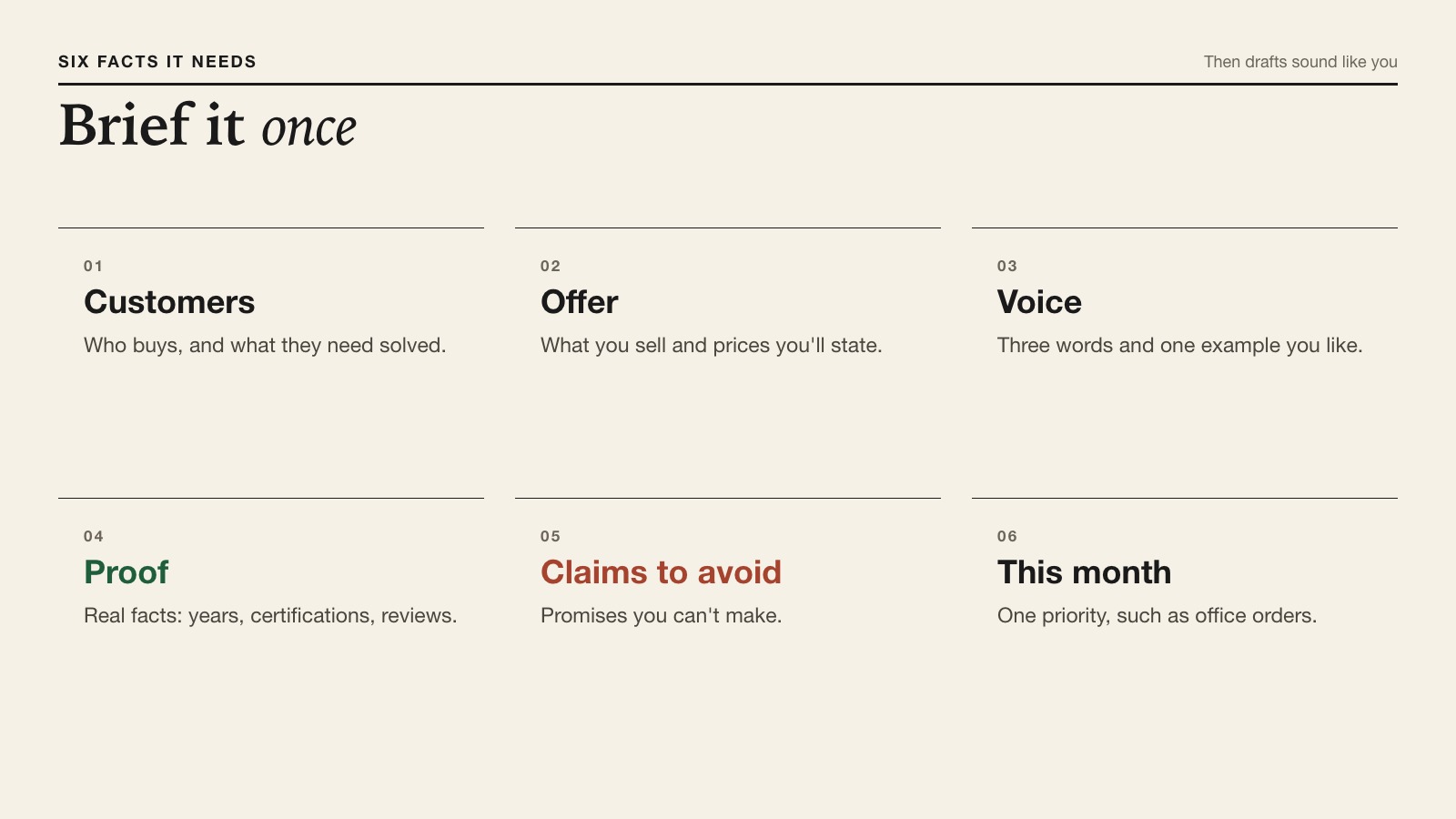
- Customers: who buys from you, and what they're trying to solve.
- Offer: what you sell, prices you're happy to state, and what makes you different.
- Voice: three words for your tone, plus one example of writing you like.
- Proof: real facts you can stand behind: years in business, certifications, real reviews.
- Claims to avoid: anything you can't promise, legal no-go areas, competitors not to mention.
- This month's priority: one goal, such as more bookings for a new service.
Worked example. A bakery at example.com might brief: Customers are local families and offices ordering cakes for events. We sell custom cakes from a stated starting price, with two days' notice. Voice: warm, simple, a little playful. Proof: 12 years in business, real reviews on our Google profile. Never promise same-day delivery. This month: more office orders for December. Every post, article and reply now has the facts it needs.
A Sample Week, Worked Through
Continuing the bakery example, here's what one week with an AI marketing assistant looks like in practice.
- Monday: the assistant reports that the custom-cakes page lost visits last week and that one menu link is broken. The owner approves the link fix.
- Tuesday: it drafts an article answering a real search question, how far in advance to order a birthday cake, plus three posts about December office orders, all using the brief.
- Wednesday: the owner edits one sentence, removes a line that hinted at same-day delivery (a banned claim), and approves the rest.
- Thursday: two new Google reviews arrive. The assistant drafts thank-you replies; the owner personalises one with the customer's cake order and sends both.
- Friday: the report shows which posts drew visits and lists one priority for next week: a page for office catering.
The owner spent about an hour in total, mostly reading and approving, and every published word was checked by a person.
Common Mistakes When Using an AI Marketing Assistant
- Skipping the brief. Without it, drafts sound generic and guess at facts.
- Approving without reading. The review step only protects you if you use it.
- Judging by volume. Fifty drafts a month mean nothing if visits and enquiries don't move.
- Never updating the brief. New prices, services or seasons need to go into the brief, or the assistant keeps writing about last month.
- Using it for everything. Some jobs, such as an upset customer or a big decision, are better done by you from the start.
What Your Assistant Shouldn't Do on Its Own
An AI marketing assistant should draft and recommend, not decide. Keep these with a person:
- Anything with a price, deadline or promise. AI can state wrong details with confidence. Google advises fact-checking AI output before publishing.
- Replies to complaints. Let it draft; you read and send.
- Brand-new claims. If it isn't in your brief, it doesn't go out.
- Big strategy calls. When you need a second opinion, CMO Owls offers 1:1 calls with real marketing experts.
When to Move From a Chatbot to an AI Marketing Assistant
Move from a chatbot to an assistant when you're copying the same context into prompts every week. That's the sign the work has become a routine that software should run. Other signals:
- You keep forgetting a step, such as checking reviews or the site, because nothing reminds you.
- Your posts stop when you get busy, so your channels go quiet in your best-selling weeks.
- You can't say what worked last month, because nobody pulls the numbers together.
- You're pasting analytics into a chatbot to ask what to do next.
If two or more of these sound familiar, a scheduled assistant with your brief and data will save more time than another round of prompting. If none do, a free chatbot is still fine for now.
Keeping Customer Data Safe
Share only what the assistant needs, and check how each tool handles data. Use your analytics and site data, not private customer details. Read each tool's privacy and training settings before connecting accounts, and limit access to the people who need it. The FTC's guide to protecting personal information is a practical checklist for any small business.
How to Measure Your AI Marketing Assistant
Measure the assistant by business results: visits, enquiries, bookings and sales. Compare month over month in Google Analytics and Search Console. Watch AI search too: Pew found that people who saw a Google AI summary clicked a regular result in 8% of visits, against 15% without one, so being cited in AI answers increasingly matters. The free AI Visibility Checker shows whether AI crawlers can read your site at all.
If your assistant is producing lots of drafts but the numbers don't move after two months, change the brief or the channels, not just the volume. And if you're still choosing the software itself, see AI marketing tools for small business.
FAQ
What is an AI marketing assistant for small business?
It's software that handles recurring marketing work, such as checking your site, drafting posts and replies, and reporting results, from your own data. You approve what goes out.
How is an AI marketing assistant different from ChatGPT?
ChatGPT answers when you ask and only knows what you paste in. An AI marketing assistant keeps a brief, reads your data and works on a schedule.
Can an AI marketing assistant replace a virtual assistant?
For drafting, scheduling and reporting, often yes. For phone calls, judgment calls and relationships, a person is still better.
How long does it take to set up an AI marketing assistant?
About an afternoon for the brief and data connections. Expect a few weeks of editing before the drafts consistently sound like you.
What should I put in my AI marketing assistant's brief?
Six facts: your customers, your offer, your voice, real proof, claims to avoid and this month's priority. Update it when anything changes.
Will my posts sound robotic?
Not if the brief includes your voice and an example of writing you like. Editing the first few weeks of drafts teaches you what to adjust.
Is it safe to connect my analytics to an AI assistant?
Usually, if you check the tool's privacy and access settings first. Avoid sharing private customer details the assistant doesn't need.
How do I know my AI marketing assistant is working?
Track visits, enquiries and sales month over month. Drafts are activity; those numbers are results.
The Verdict
An AI marketing assistant for small business pays off when it has a clear brief, a weekly routine and a person approving the work. Set it up once, keep it on a rhythm, and judge it by results. For the full picture, read the hub guide to AI marketing for small business.
Sources
- U.S. Chamber of Commerce, Empowering Small Business, August 18, 2025.
- U.S. Census Bureau, AI use by business size, May 26, 2026.
- Pew Research Center, clicks with AI summaries, July 22, 2025.
- Google Search Central, using generative AI content.
- Google Business Profile Help, reading and replying to reviews.
- Google Search Console Help, About Search Console.
- Google Analytics Help, How Google Analytics works.
- FTC, Protecting Personal Information: A Guide for Business.
- CMO Owls pricing, checked October 7, 2026.