Most businesses still market the traditional way: hire a marketing lead, retain an agency, or build a small in-house team. In 2026 there's a fourth option, the AI CMO, and the question has shifted from "should we use AI?" to "AI CMO vs traditional marketing: which one should run our growth?" This guide answers that with real salary and budget data, a task-by-task split, a 10-point scorecard and a 30-day plan to switch. If the help you need is SEO specifically, our guide to what an SEO consultant does covers how to hire one well.
Key Takeaways
- AI CMO vs traditional marketing comes down to operating model. Traditional marketing sells people's hours; an AI CMO runs specialist agents from your real data, every day, with you approving the work.
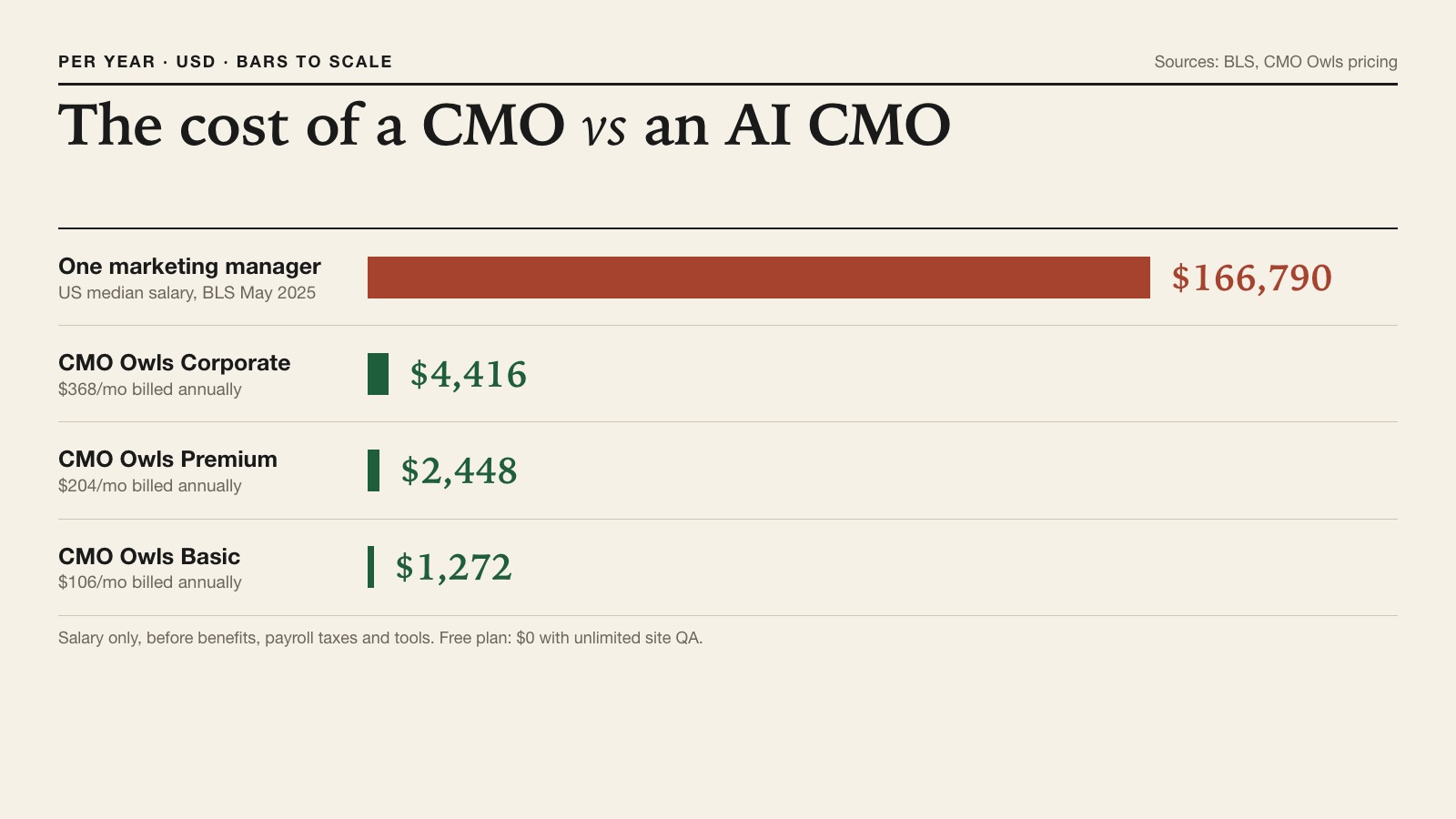
- Cost gap: one US marketing manager earns a median $166,790 a year. A year of an AI CMO plan billed annually costs $1,272 to $4,416.
- Speed gap: traditional work moves through briefs, kickoffs and revision rounds. An AI CMO produces its first audit and drafts the same day you connect your site.
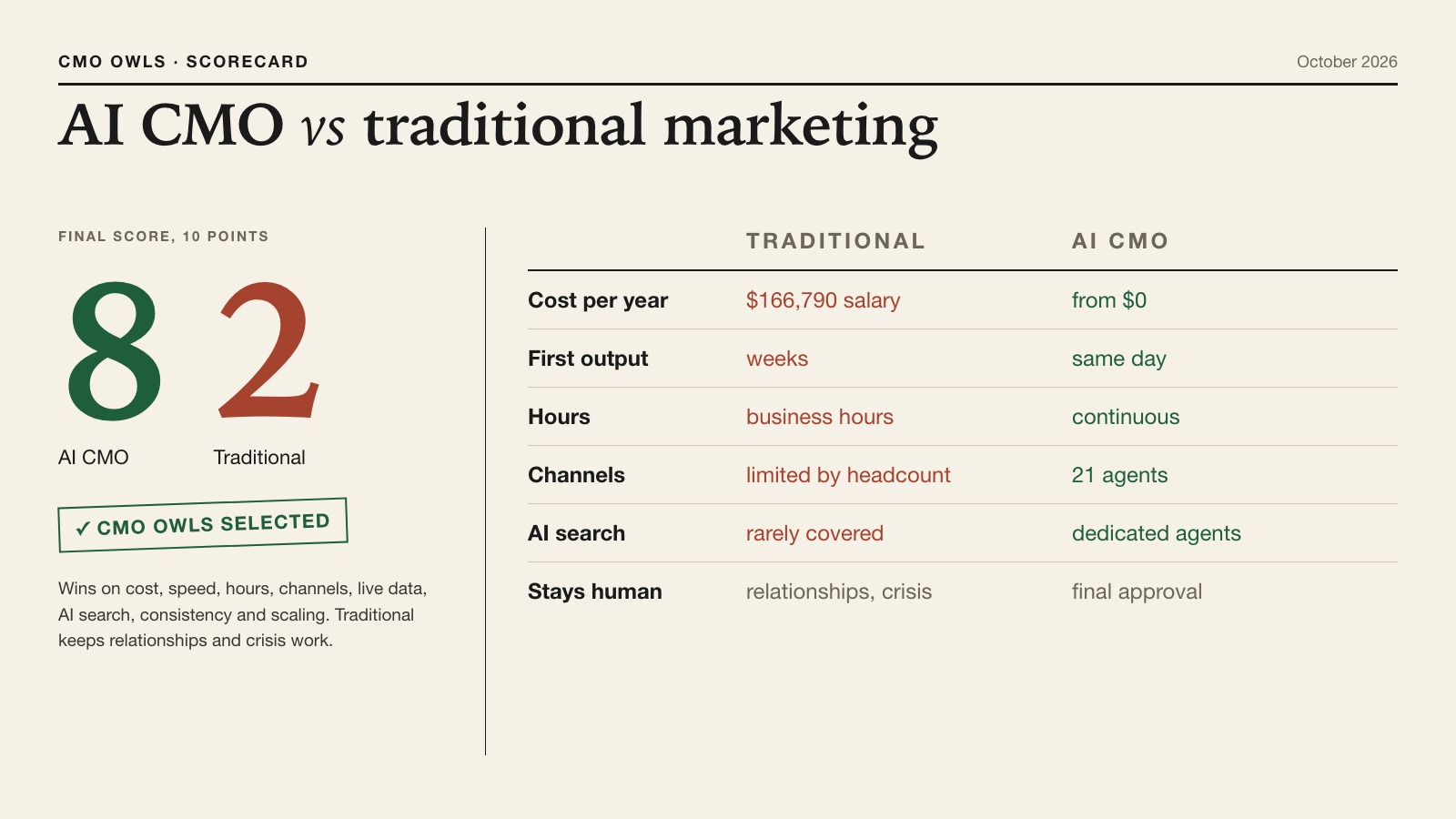
- Scorecard: the AI CMO wins 8 of 10 points. Traditional marketing keeps two narrow edges: in-person relationships and one-off, high-stakes brand moments.
- Best setup for most small and mid-sized businesses: an AI CMO such as CMO Owls for execution, with a human owner making the final calls.
AI CMO vs Traditional Marketing: The Short Answer
For most small and mid-sized businesses, an AI CMO beats traditional marketing on cost, speed, consistency and channel coverage, and it's the only model built for AI search. Traditional marketing still wins where a human in the room matters, such as events, key partnerships and a crisis. The practical answer is to let an AI CMO run the daily work and keep a person accountable for direction.
The pressure is real inside big companies too. Gartner's 2025 CMO Spend Survey found marketing budgets flat at 7.7% of company revenue, with 59% of CMOs saying they don't have enough budget to execute their strategy. In the same survey, 39% planned to cut labour costs, 39% planned to cut agency budgets, and 22% said generative AI had already reduced their reliance on external agencies.
What "Traditional Marketing" Means Here
In this comparison, traditional marketing means any setup where people do the planning and execution by hand. That usually takes one of three shapes:
- A hired CMO or marketing manager: one senior person who owns strategy and either does the work or manages others who do.
- A marketing agency: an outside firm on a monthly retainer or project fee, with account managers, writers, designers and specialists billing hours.
- An in-house team: salaried marketers (content, social, SEO, paid) inside your company, usually with tools layered on top.
"Traditional" here doesn't mean print ads and billboards. A team running Google Ads and Instagram by hand is still traditional in this sense: the output is limited by how many hours its people have.
What an AI CMO Is (in One Paragraph)
An AI CMO is a coordinated team of AI agents that audits, plans, creates and measures your marketing from your real data, while you approve what goes live. It is not a chatbot you prompt all day. At CMO Owls, 21 agents share one strategy in a shared Knowledge Base: one crawls your site, one writes articles, one watches competitors, one tracks traffic changes. For the full definition and a comparison of the main tools, see our pillar guide, Best AI CMO in 2026.
AI CMO vs Traditional Marketing: Side-by-Side Comparison
The AI CMO leads on most operating measures because it isn't limited by human hours. Here's how the four options compare on the things that decide results:
| Factor | AI CMO (e.g. CMO Owls) | Hired CMO / manager | Agency | In-house team |
|---|---|---|---|---|
| Yearly cost | $0 to $4,416 (plans billed annually) | Median $166,790 salary, before benefits | Retainer plus project fees | Several salaries plus tools |
| Time to first output | Same day | Weeks to months to hire and ramp | Weeks of onboarding | Depends on hiring |
| Working hours | Runs continuously | One person's week | Billed hours | Office hours |
| Channels covered | Site QA, SEO, content, social, Reddit, HN, video, AI search | What one person can manage | What the retainer scopes | What the team's skills cover |
| Uses your live data | Built in: Search Console, GA4, site crawls | If they pull reports | Monthly reports | If someone builds dashboards |
| AI search visibility | Dedicated agents and free checker | Rarely a skill set | Rarely in scope | Rarely a skill set |
| Consistency | Same checklist every run | Varies with workload | Varies with account staff | Varies with turnover |
| Scaling up | Move up a plan | Hire more people | Pay a bigger retainer | Hire more people |
The Real Cost of a CMO, an Agency and an AI CMO
A single marketing hire costs more per year than a decade of an AI CMO plan. The US Bureau of Labor Statistics puts the median pay of marketing managers at $166,790 a year (May 2025), and advertising and promotions managers at $133,660. Those are salaries only, before benefits, payroll taxes, tools and the team they manage.
Worked example: one year of marketing capacity
- Traditional, minimum: one marketing manager at the median salary, $166,790, plus whatever tools and freelancers they need.
- AI CMO, Basic: $106 a month billed annually, or $1,272 a year, for 15 articles a month, a full SEO/GEO/competitor audit, 12 X posts and unlimited site QA.
- AI CMO, Premium: $204 a month billed annually, or $2,448 a year, for 30 articles a month plus X, LinkedIn, Reddit and Hacker News posts and 8 UGC or ad videos. That's about 1.5% of one median marketing salary.
Agencies sit in between and vary too much by scope to quote one honest number, which is part of the problem: you often learn the real cost after the scope grows. Our pricing page lists the going monthly rates for each role an AI CMO covers, so you can run the comparison for your own market.
Cost isn't the only test, but it changes the question. With traditional marketing you decide which few channels you can afford. With an AI CMO the budget stops being the limit, and the limit becomes how much work you can review.
Speed: From Brief to Published
An AI CMO turns a brief into reviewable work in hours, while traditional marketing measures the same cycle in weeks. The difference is handoffs. A traditional brief passes from you to an account lead, to a strategist, to a writer, back for revisions, then to approval. Every handoff adds a queue.
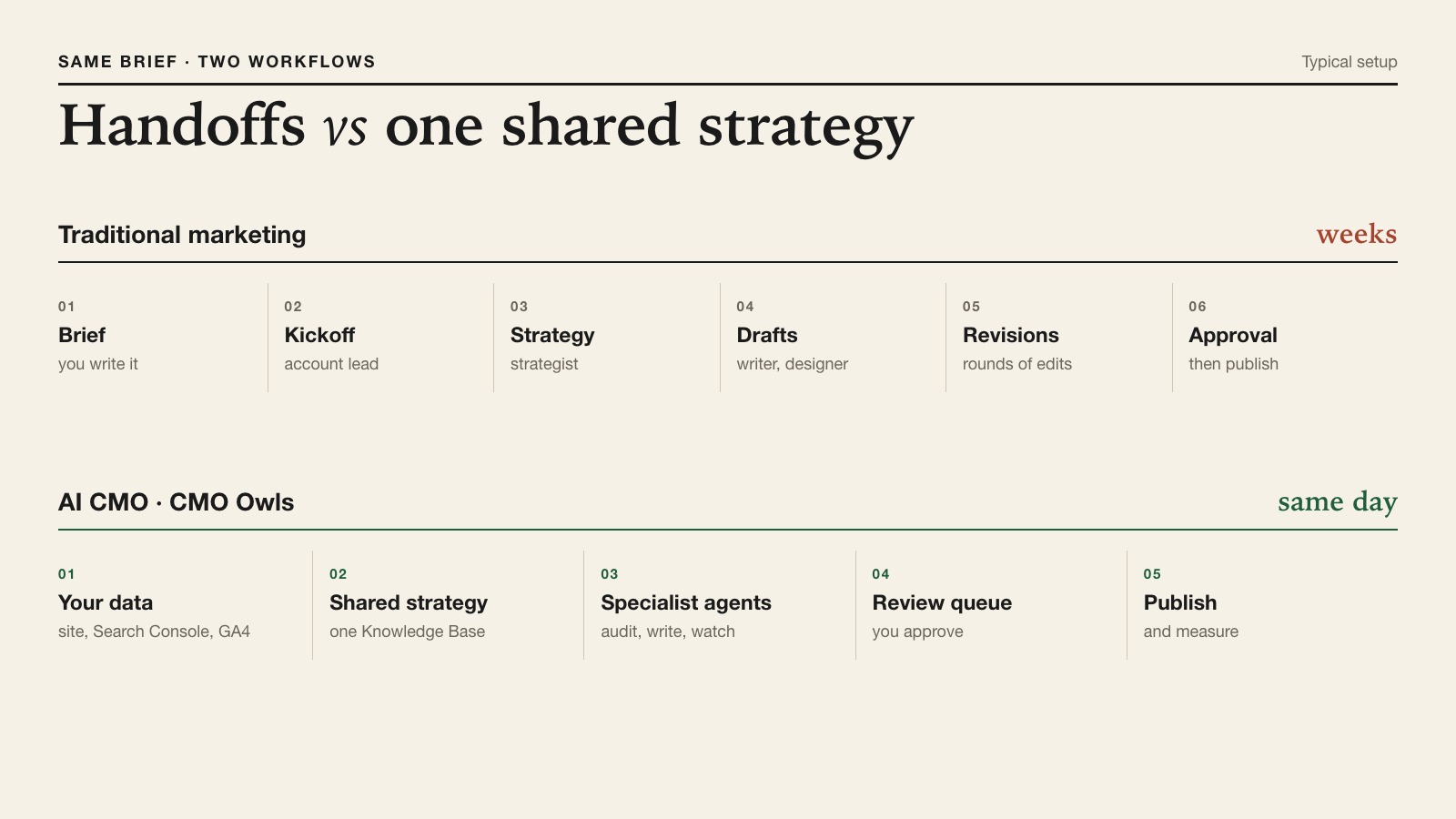
In an AI CMO, the strategy lives in one place and every agent reads it. When you connect your site, Watch Owl crawls it for broken links, failing forms and errors, Owlthor drafts keyword articles from your real search data, and everything lands in a review queue. You approve, edit or reject, and you aren't waiting on anyone's calendar.
Speed also matters after launch. Traditional reporting is usually monthly, so a traffic drop on day three gets noticed on day thirty. Cash Cow Stalker checks your top pages for traffic changes every five days, and Spy Owl watches competitors continuously.
The Channel Traditional Marketing Can't Reach: AI Search
AI search is the clearest win for an AI CMO, because traditional marketing teams were built for ranked links, not AI answers. Google now shows AI Overviews and AI Mode in search, and people ask ChatGPT, Claude and Perplexity for recommendations directly.
That changes clicks. In a Pew Research Center study of real browsing data, users who saw a Google AI summary clicked a traditional result in 8% of visits, against 15% when no summary appeared. About 18% of the searches studied produced an AI summary. If your marketing only aims at blue links, a growing share of attention is happening somewhere your plan doesn't cover.
Showing up in AI answers needs specific work: crawlers that can reach your pages, content structured so a passage can be quoted, consistent brand facts, schema, and independent mentions. It's rarely a skill set inside a traditional team or a line item in an agency retainer. An AI CMO treats it as a channel: Generative Engine Owl checks schema and brand consistency, Reddit Owl finds threads where your answer helps, and the free AI Visibility Checker shows in seconds whether AI crawlers can read your site. Our guide on how to check your AI visibility covers both layers.
Which Tasks Move to AI and Which Stay Human
AI CMO vs human CMO isn't either-or: execution moves to agents, and accountable judgment stays with a person. This table shows where each task belongs in a modern setup:
| Task | Best owner | Why |
|---|---|---|
| Site audits and technical QA | AI CMO | Repetitive, checklist-driven, best run often |
| Keyword research and content briefs | AI CMO | Works from live search and Search Console data |
| Article and social drafts | AI CMO, human review | Volume plus a final check for accuracy and voice |
| Competitor and traffic monitoring | AI CMO | Needs constant attention no person can give |
| Reporting and prioritising fixes | AI CMO | Ranks findings by impact automatically |
| AI search visibility | AI CMO | Specialist checks most teams don't run |
| Positioning and brand promise | Human | A judgment about who you are and who you serve |
| Budget and final approval | Human | Accountability has to sit with a person |
| Partnerships, events, PR relationships | Human | Trust built face to face |
| Crisis response | Human | High stakes, no room for a wrong tone |
Google's own guidance supports this split. It allows AI-generated content that helps people, warns that generating many pages without adding value can count as scaled content abuse, and says AI output should be fact-checked before publishing. That's why good AI CMOs queue work for your approval instead of publishing on their own, and why Google's advice on helpful, people-first content applies however the draft was made.
Where Traditional Marketing Still Has a Small Edge
Traditional marketing keeps two narrow advantages, and neither is daily execution.
- Relationships in the room. Trade shows, partner dinners and investor-facing brand work rely on a person people already trust. Software can prepare the material, but it can't shake the hand.
- One-off, high-stakes brand moments. A full rebrand or a public crisis needs senior human judgment and a carefully chosen tone, often with an experienced agency.
Both are occasional. Neither justifies paying traditional rates for the everyday work of audits, content, posting, monitoring and reporting. Most businesses get the best of both by running an AI CMO and bringing in a person for these moments. CMO Owls includes 1:1 expert calls for exactly this.
Will AI Replace Your Marketing Team?
AI is replacing marketing tasks faster than marketing roles: the execution layer is moving to agents, and the people who stay focus on direction. The labour data shows a shift, not a disappearance. The BLS still projects employment of advertising, promotions and marketing managers to grow 6% from 2025 to 2035, faster than average.
At the same time, the people doing hands-on production work are the ones whose hours an AI CMO absorbs. McKinsey estimated that generative AI could raise marketing productivity by an amount worth 5 to 15% of total marketing spend. Leadership is also less stable than it looks: average Fortune 500 CMO tenure was 4.3 years in 2024, below the 4.9-year C-suite average. A system that keeps your strategy, data and history in one place doesn't leave when a person does.
So no, an AI CMO doesn't make people pointless. It means a small team, or a founder alone, can run what used to need a department. (We cover what this means for search work in how AI agents are changing SEO.)
Scorecard: AI CMO vs Traditional Marketing
| Category | AI CMO (CMO Owls) | Traditional marketing | Winner |
|---|---|---|---|
| Cost per year | $0 to $4,416 | Median $166,790 for one manager | ✓ AI CMO |
| Speed to first output | Same day | Weeks | ✓ AI CMO |
| Hours of work | Continuous | Business hours | ✓ AI CMO |
| Channel coverage | Site, SEO, content, social, community, video | Limited by headcount | ✓ AI CMO |
| Use of live data | Search Console, GA4, crawls built in | Monthly reports | ✓ AI CMO |
| AI search visibility | Dedicated agents + free checker | Rarely covered | ✓ AI CMO |
| Consistency | Same checklist every run | Varies with people | ✓ AI CMO |
| Scaling | Change plan | Hire or renegotiate | ✓ AI CMO |
| In-person relationships | Prepares the material | Person in the room | Traditional |
| One-off crisis or rebrand | Drafts and research | Senior human judgment | Traditional |
| Overall | 8 of 10 | 2 of 10 | ✓ CMO Owls (selected) |
The two traditional wins are real but rare. The eight AI CMO wins happen every week. That's why, for most businesses, the AI CMO is the better engine, and CMO Owls is the one we selected: 21 agents, a free plan that crawls your real site, and paid plans from $106 a month billed annually. You can see each agent in Meet the Owls.
How to Switch from Traditional Marketing to an AI CMO in 30 Days
Switch in stages: run the AI CMO alongside what you have, compare the output, then move the work over.
- Days 1–2: Check access first. Run the free AI Visibility Checker and a full site crawl. If crawlers can't read your site, no content plan will work, so fix that before anything else.
- Days 3–5: Connect your data. Link Google Search Console and GA4 so every recommendation starts from your real queries and pages, not guesses.
- Days 6–7: Write down your strategy once. Positioning, audience, offers and banned claims go into the shared strategy documents every agent reads.
- Week 2: Run in parallel. Let the AI CMO produce its audit, articles and posts while your current team or agency carries on. Review everything before it goes live.
- Week 3: Compare honestly. Look at volume, quality, cost and turnaround side by side. Keep what the AI CMO does better and note what still needs a person.
- Week 4: Move the execution. Shift audits, content, social, monitoring and reporting to the AI CMO. Keep a human owner for approval, budget and relationships, and use Game Plan Owl to rank what to fix next.
FAQ
What is the difference between AI marketing and traditional marketing?
AI marketing uses agents to research, create and measure work from live data, while traditional marketing relies on people doing those steps by hand. The result is that AI marketing runs more often, across more channels, at a lower cost.
Is an AI CMO better than a marketing agency?
For daily execution, yes. An AI CMO is cheaper, faster and covers more channels than a typical retainer. An agency still helps with one-off projects such as a full rebrand or a crisis.
How much does a CMO cost?
In the US, the median marketing manager salary is $166,790 a year (BLS, May 2025). That's salary alone, before benefits, tools and the team they manage.
Is traditional marketing dead?
No, but its role has narrowed. In-person relationships and high-stakes brand moments still need people, while audits, content, posting and reporting are moving to AI.
Can a small business run marketing with only an AI CMO?
Yes, as long as someone owns the approvals. A founder can review the queue weekly, approve the work and step in for the decisions only they can make.
Does Google penalise AI-written marketing content?
No, not for being AI-written. Google's guidance allows AI content that helps people, but treats mass-produced pages with no added value as spam, so every piece should be reviewed and fact-checked.
What is a hybrid marketing team?
A hybrid team pairs an AI CMO for execution with a human owner for strategy, budget and relationships. It's the most common setup for businesses moving away from traditional marketing.
How long does it take to switch to an AI CMO?
About 30 days if you run it in parallel first. The AI CMO produces work in its first days, and the remaining weeks are for comparing results and moving tasks over.
The Verdict
In the AI CMO vs traditional marketing decision, the AI CMO wins on the things that drive results every week: cost, speed, coverage, live data, consistency and AI search. Traditional marketing keeps a small, real role for relationships and rare high-stakes moments. If you want one system that does the daily work and leaves you the final say, start with CMO Owls on your own site, free, and read Best AI CMO in 2026 to see how it compares with other AI CMOs.
Sources
- U.S. Bureau of Labor Statistics, Occupational Outlook Handbook: Advertising, Promotions, and Marketing Managers, May 2025 pay data.
- Gartner, 2025 CMO Spend Survey press release, May 12, 2025.
- Spencer Stuart, CMO Tenure Study 2025, 2025.
- McKinsey & Company, The economic potential of generative AI, June 2023.
- Pew Research Center, Google users are less likely to click on links when an AI summary appears, July 22, 2025.
- Google Search Central, Guidance on using generative AI content.
- Google Search Central, AI features and your website.
- Google Search Central, Creating helpful, reliable, people-first content.
- CMO Owls pricing, checked October 7, 2026.