What You'll Come Away With
- SEO competitor analysis means studying the sites that rank for your searches, to find the topics, pages and links they have that you don't.
- Your search competitors are whoever ranks, which often includes blogs, directories and big retailers, not just the businesses you'd name.
- The core of it is a keyword gap analysis: searches they rank for and you don't, and searches where you both rank but they win.
- Don't copy them. Find out why their page wins, then make a page that answers the search better.
- End with five gaps you'll actually close this month, not a list of five hundred keywords.
Who Are You Really Competing With in Google?
Ask a business owner who their competitors are and they'll name the shop down the road. Ask Google and you get a different list. Take example-bikes.com, a made-up online bike shop. Its owner named two other independent shops. But for the searches that actually bring in buyers, "gravel bike under 1000" and "what size bike do I need", the sites on page one were a national retailer, a cycling magazine and a sizing calculator built by a brand.
Start by writing down five to ten searches that bring customers to you, in the words customers use. Search each one in a private browser window and note the top ten results. The domains that appear again and again are your search competitors. Group them:
| Type | Example | How to treat them |
|---|---|---|
| Direct competitor | Another online bike shop | Compare page by page; your closest benchmark |
| Content competitor | A cycling magazine or blog | They win informational searches; out-answer them |
| Marketplace or big retailer | A national chain, Amazon | Hard to beat on head terms; win the specific searches |
| Tool or calculator | A brand's bike size calculator | A useful tool can win; consider building one |
Keep three to five to analyze in depth. More than that and you'll drown in data.
What Do They Rank For That You Don't?
This is the keyword gap analysis, and it's where most of the value is. You're looking for two kinds of gap:
- Missing: searches a competitor ranks for and you don't rank for at all. Usually a page you don't have.
- Weak: searches you both rank for, where they're well ahead. Usually a page you have that doesn't answer the search as well.
With paid SEO tools
Keyword research tools such as Semrush and Ahrefs have a gap or "content gap" report: enter your domain and up to a few competitors, and they list searches the others rank for and you don't. These figures are estimates from each tool's own data, not Google's, so treat the volumes as directional.
For free
- Search Console first. Your own Performance report shows the searches you already appear for, with your real position. Any query at positions 8 to 30 is a "weak" candidate.
- The site: operator. Searching
site:competitor.com gravel bikeshows which of their pages Google returns for a topic. Google's site: documentation notes it won't necessarily show every indexed page, but it's enough to see what they've written. - Their sitemap and navigation.
/sitemap.xmland the main menu show the topics they've invested in. - Keyword Planner. Google's Keyword Planner can suggest keywords from a competitor's URL, with rough volume ranges.
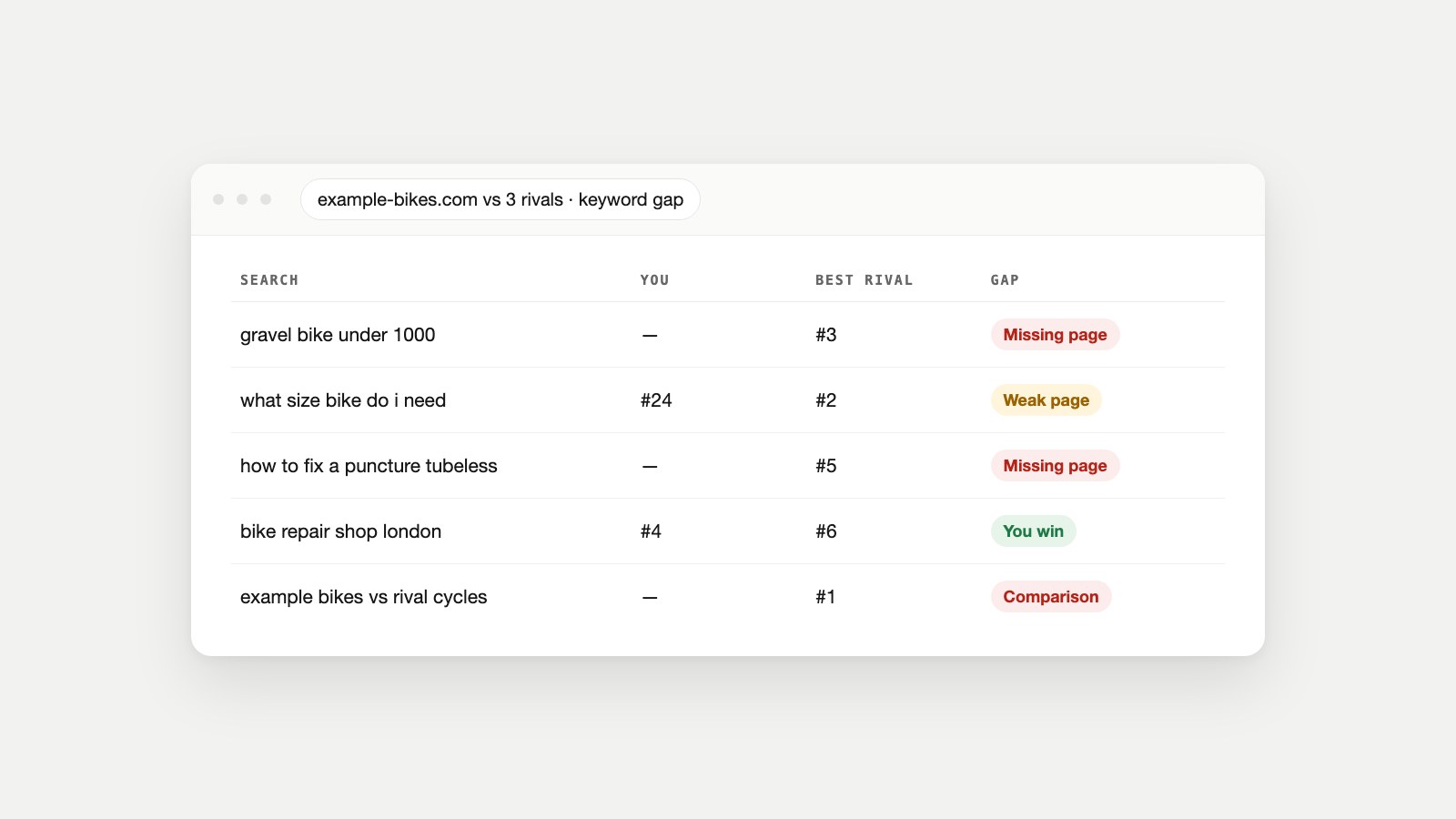
For the bike shop, the gap list included "gravel bike under 1000" (missing, rival at #3), "what size bike do I need" (weak, shop at #24, rival at #2) and "how to fix a puncture tubeless" (missing, rival at #5). It also showed one search the shop already won: "bike repair shop london" at #4.
Where Do They Beat You on the Same Search?
For each "weak" search, open both pages side by side and compare them the way a searcher would. The answer is usually one of these:
- They answer the question; you sell around it. The rival's sizing page had a chart and a calculator. The shop's page was a product category with one line about sizes.
- Their title and snippet match the search better. Check both with the Meta Tag Checker, then see how to write a meta title and description.
- Their page is deeper or fresher: more examples, current prices, a year in the title that's actually true.
- They have rich results such as FAQ, product or review markup. Check their structured data with the Schema Markup Checker.
Google's guidance on helpful, people-first content is the yardstick: does the page provide original information, a substantial answer, more than what's already out there? You won't win by copying the rival's headings. You win by answering the search better than they do.
Who Links to Them?
Links from other sites still help pages get found and trusted. Look at which pages of a competitor's site earn links, and from whom: local news, cycling clubs, industry directories, a supplier's "where to buy" page. Those are often places that would link to you too, for the same reason.
Backlink tools show competitors' link profiles. For your own site, Search Console's Links report shows your top linked pages and linking sites, though Google notes it's a sample, not a complete list. One practical win: competitors' broken pages that still have links. If a rival's old guide now returns a 404, the sites linking to it may happily link to your working version instead. Our guide to broken links explains how to find them.
Stay inside Google's spam policies: buying links or exchanging them for rankings is link spam. Earn links by having the page worth linking to.
What Are They Paying For?
If a competitor pays to appear for a search month after month, it's probably making them money. Google's Ads Transparency Center shows the ads an advertiser has run, and that's a free look at which products, offers and messages they think are worth paying for. Searches they buy ads for but don't rank for organically are often worth a page of your own.
The Wayback Machine adds history: how a competitor's key pages looked a year or two ago, and what they changed before they started ranking.
The Worksheet: From Gaps to Five Pages
Pull everything into one table. This is the seo competitor analysis template we'd use:
| Search | You | Best rival | Gap type | Why they win | Your move |
|---|---|---|---|---|---|
| gravel bike under 1000 | — | #3 | Missing | Buying guide with 8 bikes compared | New guide with our own test rides |
| what size bike do i need | #24 | #2 | Weak | Chart + calculator | Add a size chart and calculator to our page |
| how to fix a puncture tubeless | — | #5 | Missing | Step-by-step with photos | Workshop video + written steps |
| example bikes vs rival cycles | — | #1 | Missing | Their comparison page names us | Our own fair comparison page |
| bike repair shop london | #4 | #6 | We win | — | Protect: keep the page current |
Then pick five rows for this month, favoring searches close to what you sell and gaps you can close with knowledge competitors don't have. Each one becomes either a new page or a better page. Put them on your calendar (our guide to building a content calendar shows how), and check the same searches again in a month.
Notice the comparison row. When a rival publishes "them vs you" and you don't, they're answering your buyers' question in their own words. Growth Hacker finds the comparisons your site is missing and writes each one as a full article. Our own Okara vs CMO Owls comparison is an example of the format.
Where Competitor Analysis Goes Wrong
- Benchmarking against the wrong sites. A national retailer ranking for "bikes" isn't a useful target for a small shop. Compare yourself with the sites that win the specific searches you can realistically win.
- Chasing their biggest keywords. High-volume head terms are usually the hardest and the least likely to convert. The gaps worth closing are specific searches close to what you sell.
- Ignoring intent. If the results for a search are all guides, a product page won't rank there, however good it is. Match the kind of page Google already shows.
- Copying their structure. The same headings in the same order give Google no reason to prefer you. Add what only you know: your own testing, prices, photos or advice.
- Doing it once. Rankings shift, and new competitors appear. A quick monthly look at your top searches catches changes before they cost traffic.
For local businesses, do the same exercise with the map results: who appears for "bike repair near me," how many reviews they have, and how complete their business profiles are.
Doing This Every Month Without Losing a Week
A manual competitor analysis takes a day or two, which is why most businesses do it once and never again. Spy Owl runs it in one research pass: it finds your real competitors from your own site, live search results and comparison searches, groups them by the kind of threat they are, shows real ranking positions, and reports who links to whom, with every number labelled as index-backed or sampled so you know how solid it is. Its keyword gaps feed Game Plan Owl's monthly roadmap, and Owlthor can write the articles.
And don't forget AI answers. If ChatGPT or Perplexity recommends a competitor when someone asks about your category, that's a gap too. Generative Engine Owl records what AI assistants actually say, and our guide to checking your AI visibility shows how to test it yourself.
Common Questions
How do I find out what keywords my competitors rank for?
Use a keyword tool's gap report for estimates, or do it free: search your main topics in a private window, use the site: operator on their domain, read their sitemap, and ask Keyword Planner for ideas from their URL.
What is a keyword gap analysis?
It's a comparison of the searches your competitors rank for against the ones you rank for. The gaps are searches where they appear and you don't, or where you both appear and they're well ahead.
How many competitors should I analyze?
Three to five in depth. Choose the domains that appear most often on page one for the searches that bring you customers.
How often should I do an SEO competitor analysis?
A full one every quarter, and a quick check of your most important searches every month. New competitors appear and rankings shift faster than most people expect.
Can I do competitor analysis for SEO for free?
Yes. Search Console, Google's site: operator, Keyword Planner, the Ads Transparency Center and the Wayback Machine are all free. Paid tools mainly save time and add estimated volumes.
Should I copy what my competitors do?
No. Copying gets you a page that's as good as theirs at best. Use their page to understand what the searcher wants, then answer it better with your own knowledge, data or examples.
What's the difference between SEO competitor analysis and a regular competitor analysis?
A business competitor analysis compares products, prices and positioning. SEO competitor analysis compares who wins the searches your customers make, which is often a different list of sites.
Before You Go
Pick your five searches today, find who ranks for them, and fill in the worksheet's first column. That alone usually reveals the two or three pages you should have had all along. If the gaps look bigger than you can handle alone, start with an SEO audit of your own site, or read what an SEO consultant does to see when outside help is worth it. Every free check mentioned here is also on our free tools page.
Sources
- Performance report (Search results) and Links report, Search Console Help.
- site: search operator, Google Search Central.
- Use Keyword Planner, Google Ads Help.
- Ads Transparency Center, Google.
- Wayback Machine, Internet Archive.
- Creating helpful, reliable, people-first content, Google Search Central.
- Spam policies for Google web search, Google Search Central.