If You Only Read One Thing
- An SEO consultant diagnoses why a site isn't getting the search traffic it should, decides what to fix first, and guides the people who make the changes. Some also do the work themselves.
- They usually charge by the hour, per project (such as an audit) or as a monthly retainer. Rates vary widely, so compare what's included, not just the price.
- Google publishes its own list of questions to ask an SEO, and says plainly: no one can guarantee a #1 ranking.
- Give a new consultant read-only access first, and judge them by whether they explain their reasoning in plain words.
What an SEO Consultant Actually Does
Strip away the jargon and the job has four parts. A good consultant spends most of their time on the first two, which is also the part that's hardest to see from outside.
- Diagnose. They find out why the site is where it is: pages Google can't index, pages competing with each other, content that doesn't answer what people search, a migration that broke redirects. This usually starts as an audit; our guide to doing an SEO audit shows what one covers.
- Prioritize. A site can have hundreds of issues. The value is knowing which five matter for your business this quarter, and which can be ignored.
- Plan. They turn the priorities into work: which pages to fix, which to merge, which to create, and which searches to go after. That often includes an SEO competitor analysis and a content plan.
- Guide and check. They brief your developer, writer or agency, review the changes, and measure the results in Search Console.
What they don't do, if they're good: promise rankings, hide what they're changing, or measure success by a report full of numbers that never connects to your sales.
Consultant, Agency, Freelancer or In-House?
These overlap, and many people use the words interchangeably. The practical difference is who does the work and how much of it.
| Option | Usually best for | Watch out for |
|---|---|---|
| SEO consultant | Strategy, audits, fixing a specific problem, guiding your team | You still need someone to make the changes |
| Freelance SEO | Hands-on work on a small site at a lower cost | One person's skills and availability |
| SEO agency | Ongoing execution across content, technical work and links | Juniors doing the work; long contracts |
| In-house SEO | Larger sites where SEO is a constant job | Cost of a salary; one perspective |
| AI agents + a human for judgment | Small businesses that need the work done and a person for the hard calls | Still needs someone to approve and decide |
For a small business, the most common good setup is a consultant for strategy and a few hours a month of review, with the routine work done by your own team, a freelancer or software. Our comparison of AI CMOs and traditional marketing looks at that trade-off in more detail.
How SEO Consultants Charge
There's no standard price. Rates depend on experience, location, the size of the site and how much hands-on work is included, so the honest answer to "how much does an SEO consultant cost?" is: compare scopes, not hourly numbers. The three common models:
| Model | What you pay for | Good when |
|---|---|---|
| Hourly | Time spent, often in blocks | You have a specific question or a small, defined job |
| Project | A fixed deliverable, such as an audit or a migration plan | You want a clear scope and a clear end |
| Monthly retainer | Ongoing strategy, reviews and reporting | You're making changes every month and want someone accountable |
Whatever the model, ask for the scope in writing: what's delivered, what's measured, how often you'll meet and how either side can end it. A project audit should end in a prioritized list of changes, not a generic export from a tool.
Before the First Call
- Write down one sentence about the problem. "Bookings from Google dropped after our redesign" is far more useful than "we need SEO."
- Gather the evidence: a few numbers from Search Console's Performance report, the pages that matter most, and any recent changes to the site.
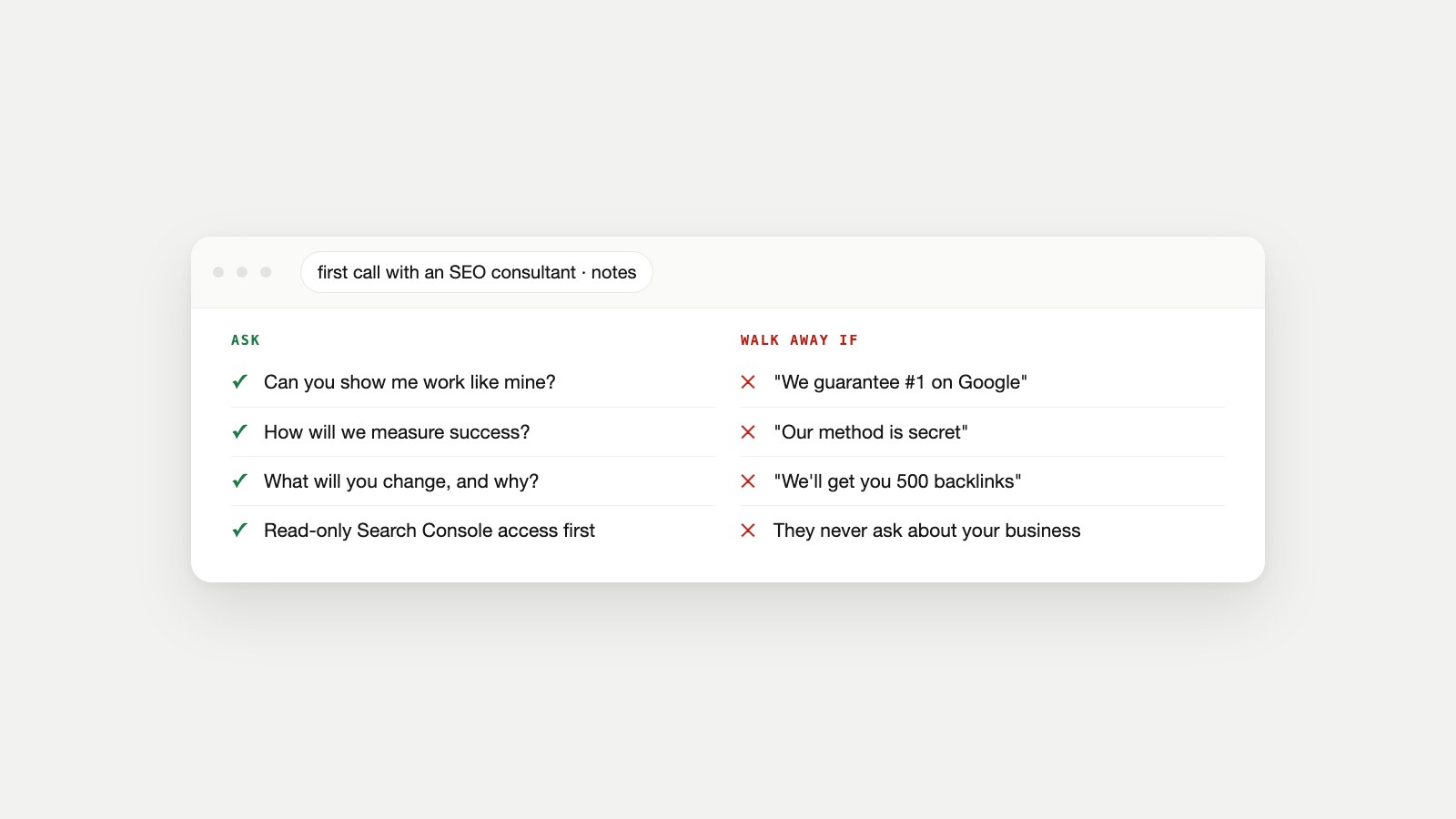
- Prepare access, but don't hand it over yet. Google's advice is to grant read-only access to Search Console at first. Search Console lets you add users with restricted permissions, and Google Analytics lets you give a Viewer role.
- Check the basics yourself. Ten minutes with the Indexability Checker and our guide to why a page isn't indexed can rule out the obvious, so the call is spent on the hard part.
A Brief You Can Send
Sending a short brief before the first call saves an hour of it. Copy this and fill it in:
Business: what we sell, to whom, and where.
The problem: one sentence (e.g. "Bookings from Google fell 30% after our redesign in March").
What we've checked: Search Console shows ... ; these pages matter most: ...
What we want from you: a diagnosis and a ranked plan / hands-on fixes / a monthly review.
Who will make the changes: our developer / our writer / you.
How we'll judge success: e.g. organic bookings, not rankings.
Budget and timeframe: ...
A consultant who reads this and replies with sharper questions is a good sign. One who replies with a standard package price before asking anything is not.
The Questions Worth Asking
Google's own guide to hiring an SEO suggests questions like these. The answers matter less than how clearly they're explained:
- Can you show me examples of your previous work and share some success stories?
- Do you follow Google Search Essentials?
- What kind of results do you expect to see, and in what timeframe? How do you measure your success?
- What's your experience in my industry, and in my country or city?
- How long have you been in business, and how can I expect to communicate with you? Will you share all the changes you make to my site, with the reasoning behind them?
Pay attention to what they ask you, too. Google notes that a good SEO should ask what makes your business unique, who your competitors are and how your customers find you. And check references: ask a past client whether the work was useful and whether the consultant was easy to work with.
Questions a Good Consultant Will Ask You
The first call is an interview in both directions. Expect a good consultant to ask:
- What do you sell, who buys it, and what's a customer worth to you?
- How do customers find you today, and which of those channels matters most?
- Who are your competitors, in your view, and who do you lose deals to?
- What changed on the site recently: a redesign, a new platform, new pages, removed pages?
- Who will make the changes, and how quickly can they?
- What would success look like in six months, in numbers you already track?
If the conversation never gets to your business, only to their packages and tools, that tells you how the work will go.
Red Flags
Most bad SEO looks the same, and Google describes it directly:
- Guaranteed rankings. In Google's words: "No one can guarantee a #1 ranking on Google." Be wary of anyone who claims a "special relationship" with Google or offers "priority submit."
- Secrecy. If they won't explain what they'll change and why, find someone who will.
- Buying or swapping links. Exchanging money or links to manipulate rankings is link spam under Google's policies, and it can get a site demoted.
- Mass-produced pages. Hundreds of near-identical location or keyword pages are doorway and scaled content abuse, not a strategy.
- Unsolicited emails promising page one. Google suggests the same scepticism you'd give any too-good-to-be-true offer.
- Reports that never connect to the business. Rankings for searches nobody makes aren't progress.
If you've been deceived, Google suggests reporting it to the FTC in the US, or internationally through econsumer.gov.
What a Good First 90 Days Looks Like
Expectations vary with the site, but a sound engagement usually follows this shape:
- Weeks 1–3: access (read-only), an audit, and a conversation about what the business actually needs from search.
- Weeks 3–4: a prioritized plan: the handful of changes that matter, who makes each one, and how they'll be measured.
- Months 2–3: the fixes go live, starting with anything blocking indexing or breaking key pages, followed by content and internal links. Content work lands on a schedule; see our guide to building a content calendar.
- End of month 3: a review against the measures agreed at the start, in Search Console data you can see yourself.
Changes take time to show: Google has to recrawl pages, and rankings move gradually. A consultant who's honest about that is worth more than one who promises fast results.
When You Don't Need a Consultant (Yet)
If your site is small and the questions are basic (is my site indexed, why is this page slow, what should I write next?), you can often answer them yourself with Search Console, Google's SEO Starter Guide and free tools. Much of the routine work is also what software does well now. Owl-gorithm Hacker runs an SEO audit layer by layer and ranks the results by what to fix first, Watch Owl checks every page for broken links and errors, Game Plan Owl builds the monthly content roadmap, and Opportunity Owl turns findings into specific fixes.
Where a person still matters is judgment: a traffic drop with no obvious cause, choosing between two content directions, whether a redesign will hurt rankings. For those, a single focused call is often enough. Talk to an Expert lets you read real profiles, pick an open time from the expert's own calendar and say what the call is about, with your audit and roadmap already in hand.
Before You Hire
What does an SEO consultant do day to day?
They audit sites, decide which problems matter most, plan fixes and content, brief the people making changes, and track results in Search Console. Good ones spend more time explaining and prioritizing than producing reports.
How much does an SEO consultant cost?
It varies widely with experience, location and scope. Compare what's included in an hourly, project or retainer arrangement, and ask for the scope in writing before comparing prices.
Is an SEO consultant worth it for a small business?
It can be, for a specific problem such as a traffic drop or a migration, or for a strategy you'll carry out yourself. For routine checks, free tools and software often cover what you need.
What's the difference between an SEO consultant and an SEO agency?
A consultant usually advises and guides, while an agency usually does ongoing work with a team. Many consultants also do hands-on work, and many agencies offer consulting, so ask exactly who does what.
Can an SEO consultant guarantee first-page rankings?
No. Google states that no one can guarantee a #1 ranking, and treats guarantees as a warning sign when hiring an SEO.
How long before SEO work shows results?
Technical fixes can show within weeks once pages are recrawled; content and authority usually take months. A good consultant agrees measures and a timeframe with you at the start.
Should I hire a local SEO consultant?
Only if local knowledge matters to the work, such as local search results, the language your customers use or regional regulations. Much SEO consulting is done remotely, so experience with businesses like yours usually matters more than distance.
What access should I give an SEO consultant?
Start with read-only access to Search Console and a Viewer role in Google Analytics. Grant more only once you trust them and know what they'll change.
Sources
- Do you need an SEO?, Google Search Central.
- SEO Starter Guide, Google Search Central.
- Performance report (Search results), Search Console Help.
- Spam policies for Google web search, Google Search Central.
- Google Search Essentials, Google Search Central.
- Managing owners, users, and permissions, Search Console Help.
- Add, edit, and delete Analytics users and user groups, Analytics Help.
- eConsumer.gov, International Consumer Protection and Enforcement Network.