Key Takeaways
- Results as a Service (RaaS) is a business model where you pay for a finished outcome, such as a resolved support ticket, rather than for software access or hours of work.
- It's already here: Intercom's Fin charges $0.99 per resolution, Zendesk bills AI agents per automated resolution, and Sierra says it gets paid "only when we complete a task".
- AI agents make RaaS possible, because software can now do the work instead of just helping a person do it.
- RaaS shifts risk to the vendor, but only works when the outcome is clearly defined, measurable and agreed up front.
What Is Results as a Service?
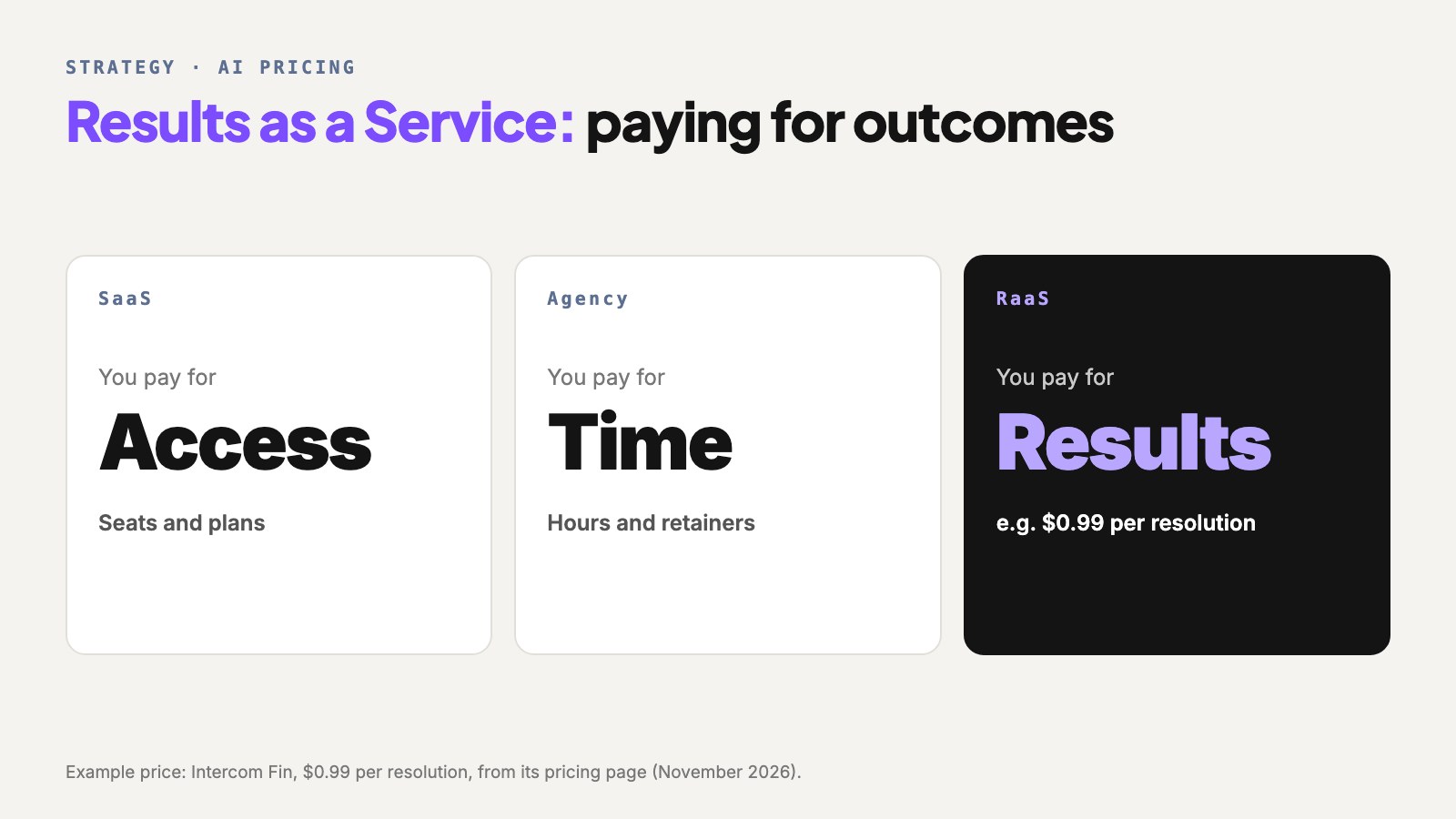
Results as a Service means the customer pays for a result, not for the tool or the time used to produce it. You don't buy seats in a support platform; you pay each time a customer's question is resolved. You don't pay an agency's monthly retainer; you pay for the outcome you agreed.
The idea isn't new. Rolls-Royce has long sold engine maintenance through its TotalCare agreements, described as "power-by-the-hour": airlines pay a fixed amount per flying hour, so, in Rolls-Royce's words, "we are only rewarded for engines that perform." What's new is that AI agents now let software companies offer the same deal for knowledge work.
You'll also see the terms outcome-based pricing, which describes how the vendor charges, and service as software, which describes what the vendor sells: a service delivered by software rather than by people.
RaaS vs SaaS vs Agencies
The difference is who carries the risk if nothing useful happens.
| Category | SaaS | Agency or freelancer | Results as a Service |
|---|---|---|---|
| You pay for | Access (seats, plans, usage) | Time (hours or a retainer) | Outcomes (resolutions, tasks completed) |
| Who does the work | Your team, using the tool | The agency's people | The vendor's AI agents, with human checks |
| If nothing improves | You still pay | You still pay | You pay little or nothing |
| Cost scales with | Team size | Hours worked | Results delivered |
| Main risk | Paying for unused seats | Paying for slow progress | Disputes over what counts as a result |
SaaS made software cheaper by selling a tool to many customers. RaaS goes a step further: the software does the job, so the vendor can charge for the job itself.
Real Examples of Outcome-Based Pricing
Customer support is where RaaS is most established, because a resolved ticket is easy to define and count. These prices come from each vendor's own pricing page.
| Vendor | What you pay for | Published price |
|---|---|---|
| Intercom (Fin) | A resolution: "No further help is requested after Fin's last answer" | $0.99 per resolution |
| Zendesk | Automated resolutions by its AI agents | $1.50 committed or $2.00 pay-as-you-go |
| Sierra | Resolved conversations, saved cancellations, upsells and cross-sells | Agreed per customer |
| Salesforce (Agentforce) | Conversations and actions (a usage model, not purely outcomes) | $2 per conversation, or credits per action |
Sources: Fin pricing, Zendesk pricing, Sierra's post on outcome-based pricing and Agentforce pricing. Zendesk states that its AI agents are priced "based on the successful outcomes they deliver".
Notice the spectrum. Intercom, Zendesk and Sierra charge for outcomes. Salesforce mostly charges per conversation or action, which is consumption pricing: you pay whether or not the conversation succeeded. Sierra itself uses a blended approach for simple tasks like routing, where an "outcome" is hard to define. Many vendors will mix the two.
Why RaaS Is Happening Now
AI agents can now complete whole tasks, so vendors can sell the task instead of the tool.
- Agents do the work, not just assist with it. A support agent that answers and closes a ticket has delivered a result that can be counted.
- The market is far bigger than software. Foundation Capital estimates the opportunity for AI-delivered services at about $4.6 trillion, roughly half in salaries for jobs like sales, marketing and software engineering and half in outsourced services. Vendors that charge for work can address that spending, not just software budgets.
- Buyers are tired of paying for unused seats. Outcome pricing ties cost to value, which is easier to justify to a finance team.
- Vendors with confidence can win deals. As Sierra puts it, outcome pricing means the vendor keeps improving the agent after launch, because its revenue depends on results.
The Risks and Limits of RaaS
RaaS only works when everyone agrees what a result is, and can measure it the same way.
- Definitions get gamed. If a "resolution" means the customer didn't reply, a vendor could benefit from customers giving up. Read the definition carefully.
- Attribution is hard outside support. In marketing, a sale might come from an article, an ad and a friend's recommendation. Paying per sale invites arguments about who caused it.
- Costs are harder to forecast. If the agent succeeds more, you pay more. That's usually good news, but budget for it with a cap.
- Quality can slip at the edges. An agent paid per resolution should still escalate hard cases to people. Check that escalations aren't counted as failures you pay for, or quietly avoided.
- Not everything is countable. Brand trust, positioning and relationships matter but don't fit a per-unit price.
What RaaS Means for Marketing
Marketing is moving towards results-based pricing, but only for the parts that can be measured cleanly. Traffic, rankings and published work are easier to count than revenue.
Traditionally, small businesses paid for marketing by the hour or by the month, whether or not anything changed. Our guide to what SEO costs shows how wide those retainers range. AI agents change the economics: when an agent can write a sourced article, find and fix a broken page or publish a post on schedule, each of those is a countable result.
| Work | Countable result | Fit for RaaS |
|---|---|---|
| Site fixes | Issue found, fixed and verified | Strong |
| Content production | Article published to an agreed standard | Strong |
| Search visibility | Ranking or impressions for agreed keywords | Medium: slow and affected by competitors |
| Leads | Qualified signup or enquiry | Medium: needs clear attribution |
| Revenue | Sale | Weak: too many causes |
| Brand and strategy | None that's fair | Poor |
This is the direction we're building in at CMO Owls. Our agents are measured on finished work: Watch Owl reports each issue as found, fixed and re-checked, and Owlthor delivers a finished, sourced article rather than a draft. Our own new website SEO case study shows why rankings make a poor short-term unit: impressions came within weeks, clicks much later. For the bigger picture of agents replacing traditional marketing work, see AI CMO vs traditional marketing.
The Four Pricing Models Behind "RaaS"
Not everything sold as results-based is priced on results. Vendors usually mix four models, and knowing which one you're buying tells you who carries the risk.
| Model | You pay | Who carries the risk | Best for |
|---|---|---|---|
| Per seat | A fixed fee per user | You | Tools your team uses daily |
| Per use (consumption) | Per conversation, action or credit | Mostly you | Tasks with no clear success point, like routing |
| Per outcome | Per resolved ticket, completed task or saved customer | Mostly the vendor | Tasks with a clear, countable finish |
| Base fee plus success fee | A smaller fixed fee and a bonus per result | Shared | Slower results such as rankings or leads |
Per-use pricing is often described as "pay for what you use", which sounds like paying for results but isn't: a conversation that fails still counts. Per-outcome pricing only charges when the agreed result happens. The hybrid model is common for marketing, because results such as search rankings take months and depend partly on competitors, so neither side wants to carry all of the risk.
When a vendor says it offers outcome-based pricing, ask one question: "If your agent tries and fails, what do I pay?" The answer tells you which of the four models you're really buying.
How RaaS Changes the Vendor's Incentives
Under RaaS, the vendor only earns when the agent works, so improving the agent becomes the vendor's job rather than yours. That's the biggest practical difference for buyers.
With seat-based software, the vendor is paid the same whether or not you get value. Improving outcomes is your team's job: configuring the tool, training staff and checking the results. With outcome pricing, every failed task is lost revenue for the vendor. Sierra describes exactly this: because it is paid on results, it keeps optimising agents after they launch.
This has two consequences. First, RaaS vendors tend to be more selective about which tasks they'll take on, because tasks they can't complete cost them money. Second, their margins depend on the cost of running AI models. As models get cheaper, outcome pricing becomes possible for more kinds of work, which is part of why the model is spreading from support into sales and marketing.
Is Results as a Service Right for Your Business?
RaaS fits best when you have a high volume of similar tasks with a clear finish line. It fits poorly when the work is rare, creative or hard to judge.
- Good fit: answering common support questions, fixing known website issues, producing content to an agreed standard, qualifying inbound leads against clear criteria.
- Possible fit, with care: improving search visibility or generating leads, where a base fee plus a success fee shares the risk fairly.
- Poor fit: brand strategy, positioning, partnerships and anything where success is a judgement call.
Small businesses often benefit most, because they can't afford to pay for seats or retainers that sit unused in quiet months. Paying only when work is completed matches cost to cash flow. If you run the business alone, our guide to solo founder marketing shows how to split work between yourself and AI agents.
How to Buy RaaS Well
Treat a RaaS contract like any performance deal: define, measure, cap and review.
- Define the outcome in one sentence, including what doesn't count.
- Agree who measures it and in which system, so there's one source of truth. For search results, that's usually your own Google Search Console data, not the vendor's dashboard.
- Ask about escalations. What happens when the agent can't finish, and do you pay?
- Set a monthly cap while you learn how many results to expect.
- Audit a sample of results every month to check quality, not just quantity.
- Keep strategic work in-house or on a fixed fee, since it doesn't fit a per-unit price.
If you sell software yourself, the same thinking applies from the other side. Our SaaS marketing strategy guide covers pricing alongside the rest of the plan, and Y Combinator's Startup Pricing 101 is a good primer on pricing basics.
CMO Owls: Marketing Delivered as Finished Work
CMO Owls is built around the same idea as RaaS: each agent delivers a finished, checkable piece of work rather than a tool you have to operate. You can see exactly what was done, and judge it on the result.
| Result | Agent | How you can check it |
|---|---|---|
| A site issue found and fixed | Watch Owl | Each finding is listed, fixed where possible and re-checked |
| A published article | Owlthor | A researched article with sources, sent to WordPress or your CMS |
| A missing comparison page written | Growth Hacker | A full article for each comparison gap it finds |
| An SEO opportunity closed | Opportunity Owl | Each opportunity becomes a precise fix or a new article, checked before it's sent |
| A ranking drop caught early | Cash Cow Stalker | An alert with the real numbers when clicks or rankings fall |
| A clear view of AI answers | Generative Engine Owl | What AI assistants say about your brand, and why they skip you |
Revenue and brand trust stay where the risks section above says they belong: with you, because no tool can honestly claim the credit for them. Everything that can be counted, the Owls deliver as finished work you can review.
Mind Map: Results as a Service
Frequently Asked Questions
What does RaaS stand for in business?
In this context, RaaS stands for Results as a Service: paying a vendor for completed outcomes rather than software access or hours. The abbreviation is also used for other things, such as Robotics as a Service, so check the context.
How is Results as a Service different from SaaS?
With SaaS you pay for access to a tool and your team does the work. With RaaS the vendor's AI agents do the work and you pay for each result.
What is an example of outcome-based pricing?
Intercom's Fin AI agent charges $0.99 per resolution, where a resolution means no further help was requested after Fin's last answer. Zendesk similarly bills its AI agents per automated resolution.
Is outcome-based pricing cheaper?
Not always. It's fairer, because you pay only when something useful happens, but a successful agent can cost more in total. Set a cap while you learn.
Can marketing be bought as Results as a Service?
Parts of it can. Site fixes and finished content are easy to count, while revenue and brand building are too hard to attribute fairly for per-unit pricing.
What is service as software?
It's the idea that AI delivers services traditionally done by people, such as support, bookkeeping or marketing, as software. Results as a Service is one way of charging for it.
What should I check before signing a RaaS contract?
Check the exact outcome definition, who measures it, what happens with escalations and whether there's a spending cap. Then audit a sample of results each month.
The Next Step
List the marketing work you pay for today and mark which items have a clear, countable result. Those are the ones to move to results-based tools first. To see what finished marketing work from AI agents looks like, meet the Owls or start free.
Sources
- TotalCare: power by the hour, Rolls-Royce, 2017.
- Fin pricing, Intercom, 2026.
- Zendesk pricing, Zendesk, 2026.
- Outcome-based pricing for AI agents, Sierra, 2024.
- Agentforce pricing, Salesforce, 2026.
- AI leads a service as software paradigm shift, Foundation Capital, 2026.
- Startup pricing 101, Y Combinator, 2026.
- Performance report (Search results), Search Console Help, Google, 2026.