Key Takeaways
- A SaaS marketing strategy for an early startup should cover three jobs: being found when buyers search, convincing them you're the right choice and keeping the users you win.
- Before product-market fit, founders should do the selling and talking themselves. AI agents are best at the repeatable work around it: research, articles, comparison pages, site checks and posting.
- The highest-leverage SaaS assets are free tools, comparison pages, problem-led articles and documentation, because they match how software buyers actually search, including in AI assistants.
- A 90-day plan with one channel, one weekly routine and a few honest metrics beats a long list of half-run campaigns.
What Makes SaaS Marketing Different
SaaS buyers research alone, compare options and try before they buy, so the marketing has to answer their questions before they ever talk to you. That's the core difference from marketing a local service or a physical product.
Three features shape every SaaS marketing strategy:
- Buyers search for problems, not brands. Nobody searches for a startup they haven't heard of. They search "how to track brand mentions in ChatGPT" or "alternative to [tool they already know]".
- The product can do the marketing. A free trial, a free plan or a free tool lets the buyer experience the value directly.
- Revenue is recurring, so retention is marketing. A customer who leaves after one month costs you the acquisition spend and the referrals they would have made.
This guide is written for software startups. If you run a local or service business, our guide to AI marketing for small businesses fits better.
Match the Strategy to Your Stage
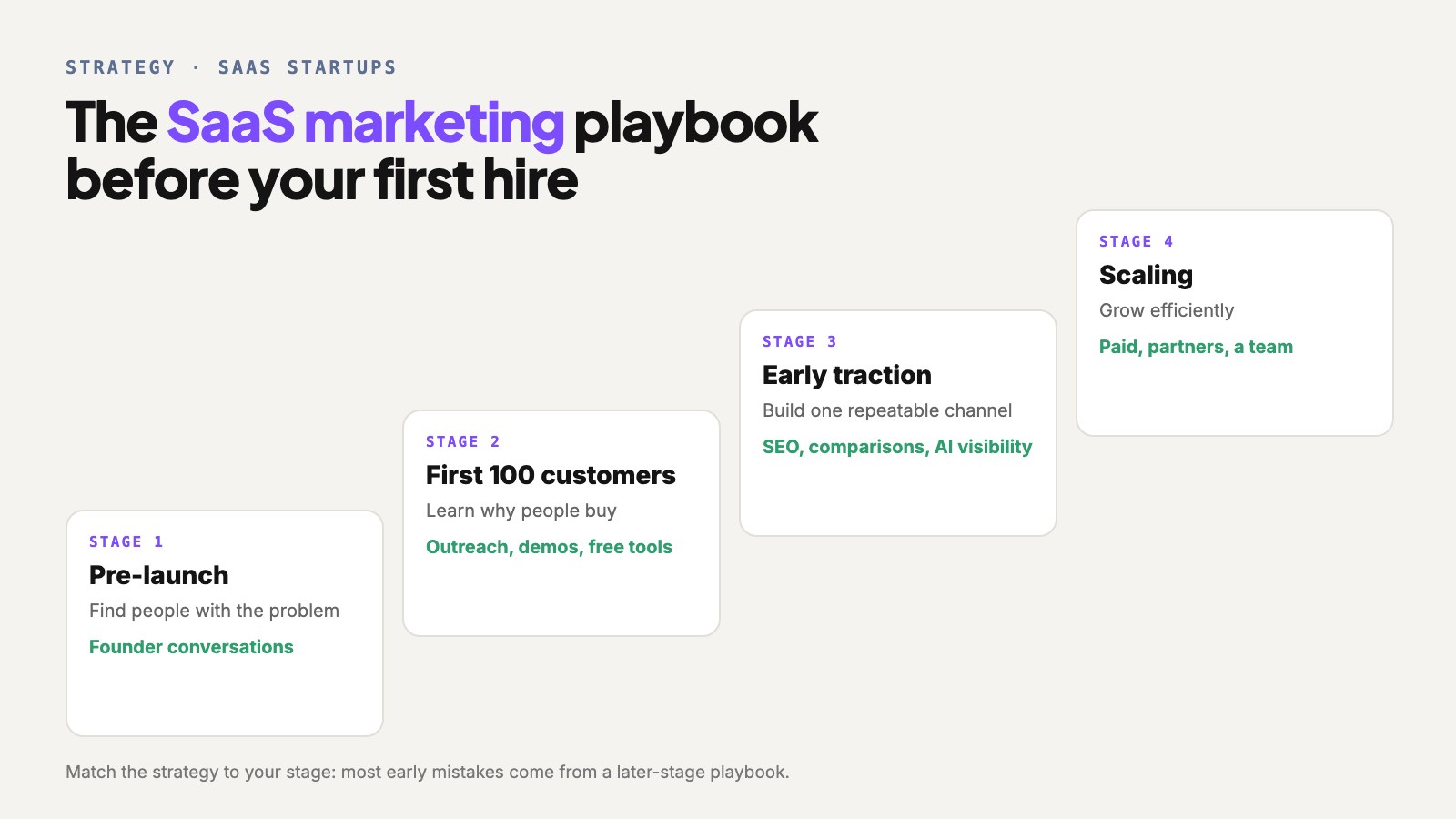
What works depends on whether you've found product-market fit. Most early SaaS marketing mistakes come from running a later-stage playbook too early.
| Stage | Main goal | What works | What to avoid |
|---|---|---|---|
| Pre-launch | Find people with the problem | Founder conversations, communities, a waitlist page | Paid ads, broad content |
| First 10 to 100 customers | Learn why people buy | Manual outreach, demos, problem-led articles, free tools | Scaling any channel before it works |
| Early traction | Build repeatable acquisition | SEO, comparison pages, AI visibility, lifecycle email | Spreading across too many channels |
| Scaling | Grow efficiently | Paid channels, partnerships, a marketing team | Losing the founder's voice |
At the earliest stages, Paul Graham's advice still holds: "The most common unscalable thing founders have to do at the start is to recruit users manually." No tool or agent replaces those first conversations, because they tell you what to say in all the marketing that follows.
Once you have users, growth becomes the measure. In Startup = Growth, Graham writes that "a good growth rate during YC is 5-7% a week." You don't need to hit that, but measuring weekly keeps the team honest about which activities move the numbers.
Write Your Positioning in One Sentence First
Before any channel or content, write one sentence that says who the product is for, what problem it solves and why it beats the alternative. Every page, post and comparison will repeat it in different words.
A useful format is: "For [specific customer] who [specific problem], [product] is the [category] that [key benefit], unlike [main alternative], which [limitation]." Fill it in using the words customers used in your conversations, not your own internal vocabulary.
Two tests tell you whether the sentence works. First, a stranger in your target market should understand it without explanation. Second, it should rule some people out. "For everyone who wants to grow" attracts nobody, while "for small software teams with no marketer" tells the right reader they're in the right place.
This sentence also matters for AI assistants. They describe products using what they find across the web, so a consistent one-line description on your homepage, docs, profiles and directory listings helps them describe you accurately. Our own competitive intelligence guide shows how to find the alternatives your buyers compare you with.
The Four SaaS Assets That Compound
The best SaaS marketing assets keep bringing in buyers long after you publish them. These four match how software is researched in both Google and AI assistants.
1. Free tools
A small free tool that solves part of the problem your product solves attracts exactly the right visitors. It earns links naturally and proves the product's quality. Our own site has 26 free tools, from an AI visibility checker to a broken link checker, each one a working sample of what the paid agents do. Browse them on the free tools page for ideas.
2. Comparison and alternative pages
Buyers who search "[competitor] alternative" are close to a decision. An honest comparison page that admits where the competitor is stronger converts better than a one-sided one, and it's more likely to be trusted and cited. Spy Owl finds which competitors your buyers compare, and our guide to SEO competitor analysis shows how to find their keywords.
3. Problem-led articles
Write about the problem before the product: how to do the task, what goes wrong and how to measure it. These articles reach buyers earlier and build the topical depth search engines look for. Google's helpful content guidance asks whether content shows first-hand expertise, and a SaaS team that has built a product for the problem usually has it.
4. Documentation and help pages
Public docs are marketing. They answer detailed questions, rank for long-tail searches and are exactly the kind of clear, factual text AI assistants quote. Keep them public, crawlable and up to date.
Add SoftwareApplication structured data to your product pages, so search engines understand that the page describes software, along with its category and operating system. The full vocabulary is on Schema.org.
AI Visibility Is Now Part of SaaS Marketing
Software buyers increasingly ask AI assistants for recommendations, so your site has to be readable by them. If ChatGPT can't load your pages, it can't recommend you.
OpenAI runs a separate crawler, OAI-SearchBot, to find pages for ChatGPT search, distinct from GPTBot, which collects training data. Many SaaS sites block one or both by accident through firewall settings or JavaScript-only pages. Our AI visibility case study shows the exact setup we use, and our guide to GEO vs SEO explains how the two disciplines overlap.
The practical rule is simple: everything that helps search engines understand you, such as clear text, structured data and consistent descriptions, also helps AI assistants. Generative engine optimisation adds the off-site layer, so being mentioned in reviews, communities and comparisons matters more than ever.
What to Hand to AI Agents, and What to Keep
Give AI agents the repeatable, research-heavy work, and keep the work that needs judgement, relationships and taste.
| Task | AI agents | Founder or team |
|---|---|---|
| Customer conversations and demos | Keep: this is where you learn | |
| Positioning and pricing | Research input | Decide |
| Keyword and competitor research | Run it | Review the shortlist |
| Articles and comparison pages | Draft with sources | Edit and add experience |
| Social posts | Draft and schedule | Approve, reply to comments |
| Site health and AI visibility checks | Run on a schedule | Fix what needs a developer |
| Community answers (Reddit, Hacker News) | Suggest where to help | Write and post yourself |
Google states that using AI to help create content is fine, but mass-producing pages without adding value can break its spam policies. The workflow that works is AI drafting and a human adding the experience, data and opinions only your team has.
Communities need the most care. On sites like Hacker News, promotional posts get flagged quickly, so write as a builder sharing something useful. Our guide on how to use Hacker News covers the etiquette.
A 90-Day SaaS Marketing Plan
Pick one main acquisition channel, run it every week for 90 days, and measure it honestly. For most early SaaS products, organic search plus AI visibility is the best fit, because it compounds and costs time rather than ad spend.
| Weeks | Focus | Output |
|---|---|---|
| 1 to 2 | Foundations | Positioning statement, competitor list, keyword map, technical and AI-access check |
| 3 to 4 | First assets | One free tool or calculator, two comparison pages |
| 5 to 8 | Content engine | Two problem-led articles a week, each with sources and a clear next step |
| 9 to 10 | Distribution | Founder posts on LinkedIn or X, helpful community answers, outreach to partners |
| 11 to 12 | Review | Search Console and signup data; double down on what worked, drop what didn't |
Our Game Plan Owl turns your site and competitors into a plan like this, Owlthor drafts the articles and LinkedIn Owl drafts founder posts. A content calendar keeps the weekly rhythm visible.
How to Run It Each Week
- Monday: review last week's numbers in Search Console and your signup data.
- Tuesday: approve or edit two article drafts and publish one.
- Wednesday: talk to at least two users or prospects, and note the exact words they use.
- Thursday: schedule the week's posts and answer community questions.
- Friday: check site health and fix anything broken.
This takes three to five hours a week when agents do the drafting and checking. If you're the only person in the company, our guide to solo founder marketing shows how to fit it around building the product.
Metrics That Matter Early
Measure whether the right people find you and try the product, not vanity numbers.
- Search impressions and positions for your target keywords, in Google Search Console.
- Signups by source, so you know which pages and channels bring users.
- Activation rate: the share of signups who reach the first moment of value.
- Month-one retention: whether new users come back.
- Brand searches: people searching your name is a sign the rest is working.
Review these weekly but judge them monthly. Weekly numbers for a young product swing wildly, because a single community post or one large customer can double a week. A month smooths out the noise enough to see whether a channel is really improving. Write down what you changed each week, so when a number moves you know what might have caused it.
Expect search to start slowly. Our own new website SEO case study shows what the first ten weeks look like with real numbers.
Common SaaS Marketing Mistakes
- Scaling before product-market fit. More traffic to a product people don't keep only speeds up churn.
- Writing about features instead of problems. Buyers don't search for your feature names.
- Hiding pricing and docs behind forms. Buyers and AI assistants can't recommend what they can't read.
- Publishing unedited AI content. It reads generic and adds no first-hand value.
- Running five channels at half effort. One channel done well beats five done badly.
Pricing is part of marketing too. Y Combinator's Startup Pricing 101 is a useful starting point, and some AI products now charge per outcome rather than per seat, which we explain in our guide to Results as a Service.
Your 90-Day Plan, Run by CMO Owls
CMO Owls is built to be the marketing team a SaaS startup doesn't have yet. Each part of the 90-day plan above maps to an agent, and they share one strategy and one knowledge base about your product.
| Weeks | Agent | What you get |
|---|---|---|
| 1 to 2 | Owl-gorithm Hacker, Spy Owl | A technical SEO audit and your real competitors, with what they rank for and who links to them |
| 1 to 2 | Game Plan Owl | A monthly content roadmap built from the audit, competitors and Search Console |
| 3 to 4 | Growth Hacker | The comparison pages your site is missing, written as full articles |
| 5 to 8 | Owlthor, Buzz Creator Owl | Problem-led articles with sources, plus answers to the questions buyers ask AI |
| 9 to 10 | LinkedIn Owl, X Owl, Hacker News Owl | Founder posts, threads and community replies, drafted for you to approve |
| Every week | Scheduler Owl, Watch Owl | One calendar for everything, and a site that stays free of broken pages |
| 11 to 12 | Generative Engine Owl, Cash Cow Stalker | AI visibility tracking and alerts when a page's clicks or rankings fall |
The Knowledge Base holds two short documents about your product and tone, so every draft sounds like your company rather than a template. Your part stays the same as in the plan above: customer conversations, positioning and the final edit.
Mind Map: SaaS Marketing Strategy
Frequently Asked Questions
What is a SaaS marketing strategy?
It's a plan for how a software company gets found, wins trust and keeps customers. For startups it usually centres on organic search, free tools, comparison pages and founder-led selling.
When should a SaaS startup hire its first marketer?
Usually after you've found a channel that works and need someone to scale it. Before that, founders learn more by doing the marketing themselves with AI support.
Which marketing channel is best for an early SaaS startup?
Organic search with AI visibility suits most products, because buyers research software online and the results compound. Choose based on where your buyers already look for solutions.
Can AI agents replace a SaaS marketing team?
They can handle much of the research, drafting, posting and checking. They can't replace customer conversations, positioning decisions or the experience that makes content credible.
Are comparison pages worth it for small SaaS companies?
Yes, if they're honest. People searching for alternatives are close to buying, and a fair comparison builds trust with readers and AI assistants alike.
How long does SaaS SEO take to work?
Impressions often arrive within weeks, but steady signups from search usually take several months. Narrow, specific pages tend to rank first.
Do free tools really help SaaS marketing?
Good ones do. A free tool that solves part of your product's problem attracts the right visitors, earns links and shows what your product can do.
The Next Step
Write down your one main channel for the next 90 days and block three hours a week for it. If you want AI agents doing the research, drafting and checking, you can start free and let the Owls build your first plan.
Sources
- Do Things that Don't Scale, Paul Graham, 2013.
- Startup = Growth, Paul Graham, 2012.
- Creating helpful, reliable, people-first content, Google Search Central, 2026.
- Google Search's guidance on using generative AI content, Google Search Central, 2026.
- Software App (SoftwareApplication) structured data, Google Search Central, 2026.
- SoftwareApplication, Schema.org, 2026.
- Overview of OpenAI crawlers, OpenAI, 2026.
- Performance report (Search results), Search Console Help, Google, 2026.
- Startup pricing 101, Y Combinator, 2026.