Key Takeaways
- Solo founder marketing fails for one main reason: it competes for time with building, selling and support, so it happens in bursts and then stops.
- The fix is structure: one main channel, one fixed weekly routine of about five hours, and AI agents doing the repeatable work in between.
- Keep the work only you can do: talking to customers, making decisions, writing with your own experience and replying to people. Hand off research, drafting, scheduling and site checks.
- Pick your channel by where your buyers already look: search for problems people research, communities for builders, local search for local services, and social for audiences that follow people.
Why Marketing Is the Hardest Job for a Solo Founder
Marketing is the job that never feels urgent until it's too late. Bugs and customer emails demand attention today. Marketing pays off in months, so it's always the thing that slips.
Most solo founders cycle through the same pattern: a burst of posting at launch, a few weeks of silence while building, then another burst when signups dry up. Search engines, social algorithms and audiences all reward consistency, so the bursts barely add up.
Hiring an agency rarely fixes it at this stage. Retainers are expensive, and an agency still needs your time for briefs, approvals and knowledge of the customer. The realistic option for a one-person company is a routine you can keep, with AI agents doing most of the repetitive work.
The Rule: You Do the Founder Work, Agents Do the Rest
Anything that needs your judgement, your relationships or your experience stays with you. Anything repeatable goes to an agent.
| Job | You | AI agents |
|---|---|---|
| Talking to customers | Always | Summarise the notes |
| Deciding positioning and the main channel | Always | |
| Keyword and competitor research | Pick from the shortlist | Do the research |
| Articles and guides | Add stories, data and opinions | Draft with sources |
| Social posts | Approve, reply to comments | Draft and schedule |
| Community answers | Write and post yourself | Find threads worth answering |
| Site checks and fixes | Approve fixes | Scan, report and fix simple issues |
| Reporting | Read it, decide | Pull the numbers each week |
The early, unscalable work matters most. Paul Graham's essay Do Things that Don't Scale puts it plainly: "You can't wait for users to come to you. You have to go out and get them." Agents can't have those conversations for you, but they can free up the hours to have more of them.
A word on AI-written content: Google says AI help is fine, but you should review it for accuracy and avoid mass-producing pages that add nothing. Your own experience is the one ingredient an agent can't supply, and it's what makes content worth reading. Google's helpful content guidance explicitly looks for first-hand experience.
Choose One Channel, Based on Where Your Buyers Look
One channel, run every week, beats five channels run occasionally. Choose by your buyer's habits, not by what's fashionable.
| If your buyers… | Main channel | Why it fits a solo founder |
|---|---|---|
| Search for how to solve a problem | Search and AI visibility (articles, free tools) | Compounds; pages keep working while you build |
| Are builders or developers | Communities (Hacker News, Reddit, forums) | High trust if you're genuinely helpful |
| Are local customers | Google Business Profile and local search | Quick wins; customers search nearby |
| Follow people in their industry | LinkedIn or X founder posts | Your voice is the differentiator |
| Read long-form opinion | Medium or a newsletter | Builds an audience you own |
Search and AI visibility
Write problem-led articles and build a small free tool or two. It's slow to start, as our new website SEO case study shows with real numbers, but it compounds. If you sell software, our SaaS marketing strategy guide goes deeper on this channel.
Communities
Communities reward help and punish promotion. Hacker News asks users, in its guidelines, "Please don't use HN primarily for promotion." Reddit's rules ask people to "participate authentically in communities where you have a personal interest, and do not spam". Answer questions in your area of expertise, and mention your product only when it genuinely answers the question. Our guide on how to use Hacker News covers the etiquette, and Reddit Owl finds threads where you can help.
Local search
If your customers are nearby, your Google Business Profile matters more than your blog. Google says local results are mainly based on relevance, distance and popularity, and its guidelines for representing your business explain what's allowed. Our local SEO audit guide walks through the checks.
Founder posts
On LinkedIn and X, people follow people. Share what you're learning, building and seeing in customer conversations. Our guide to formatting LinkedIn posts helps the posts read well, and LinkedIn Owl drafts them from your notes.
The Five-Hour Weekly Routine
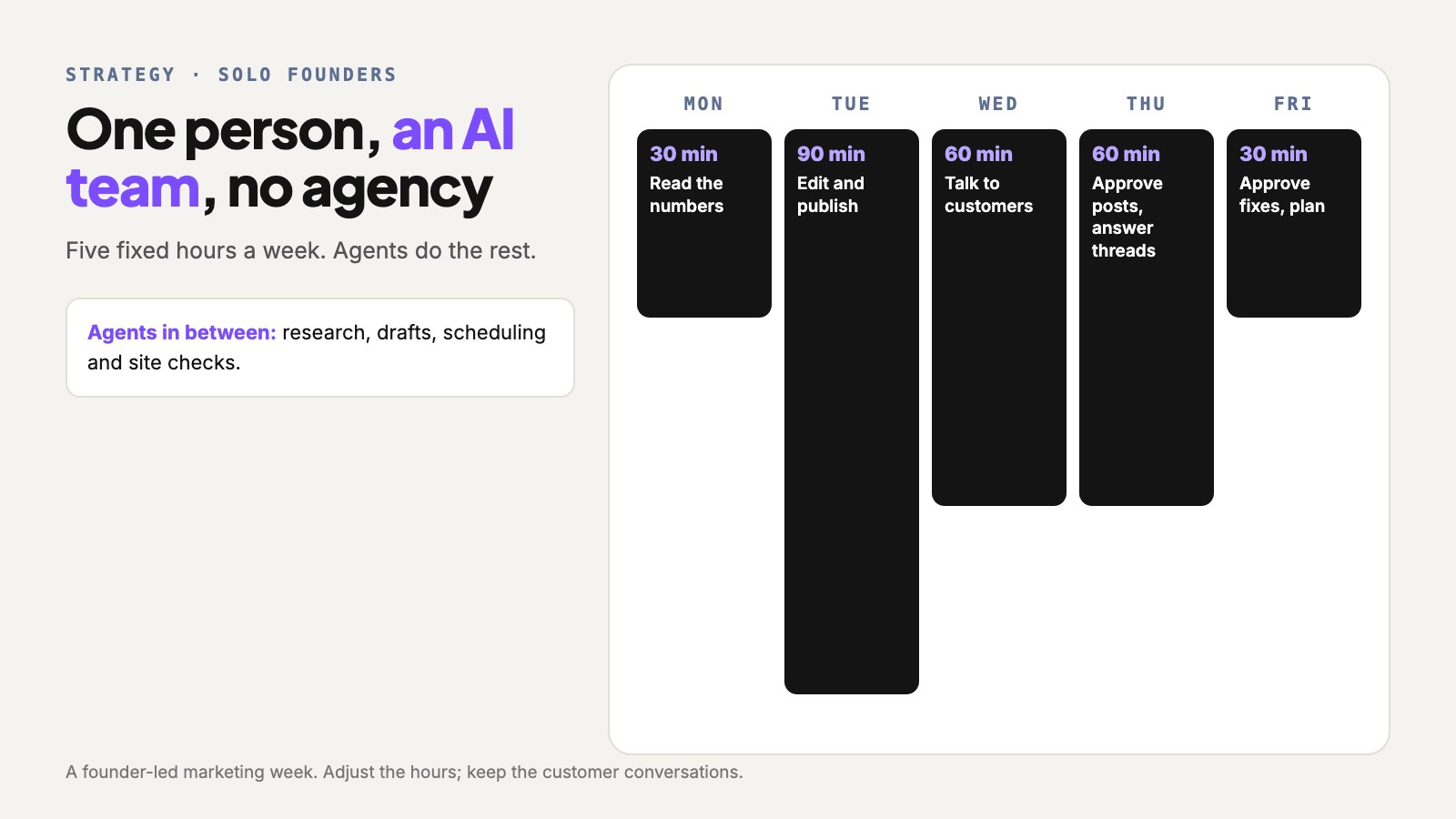
Block the same hours every week and treat them like a customer meeting. Agents work in the background between sessions.
| When | Time | What you do | What agents prepared |
|---|---|---|---|
| Monday | 30 min | Read the weekly numbers, choose this week's focus | Search Console and signup summary |
| Tuesday | 90 min | Edit and publish one article, adding your own experience | A sourced draft |
| Wednesday | 60 min | Talk to two customers or prospects | Notes from last week's calls |
| Thursday | 60 min | Approve posts, answer two community threads | Drafted posts, a list of threads |
| Friday | 30 min | Approve site fixes, plan next week | Site health report |
If five hours is too much, cut the article to every other week, never the customer conversations. A social media calendar template keeps the plan visible. Write your schedule down; a routine you can see is a routine you keep.
Your First 30 Days
Spend the first month setting up the routine, not chasing results. Results come from the weeks after it.
| Week | Goal | Done when |
|---|---|---|
| 1 | Know your buyer's words | You've had five customer or prospect conversations and written down the phrases they used |
| 2 | Choose the channel | You've picked one main channel and written why in two sentences |
| 3 | Set up the machine | Search Console is connected, your site has been checked, and agents know your product and tone |
| 4 | Run the first full week | One article published, posts scheduled, two community answers posted, numbers recorded |
Week one matters most. The exact words customers use to describe their problem become your headlines, your article topics and the phrases you rank for. Founders who skip this step end up writing about their product in their own vocabulary, which nobody searches for.
By the end of week four you should have a baseline: how many people saw your work, how many visited and how many signed up. Every later decision compares against that baseline, so record it somewhere you'll see it.
How to Put Your Experience Into AI Drafts
An AI draft gives you structure and sources. Your edit gives it the reason to exist. Spend your editing time adding the things only you know, not polishing sentences.
- A real example: a customer conversation, a mistake you made, or a number from your own product.
- An opinion: what you'd do and why, including where you disagree with common advice.
- A limit: where your advice doesn't apply. Readers trust writers who say what they don't know.
- Your voice: cut any sentence you wouldn't say out loud to a customer.
Ten minutes of this per article is the difference between content that sounds like everyone else's and content people share. It's also what search engines mean by first-hand experience.
Your Solo Founder Marketing Stack
Organise your stack by job, not by brand, and use as few tools as possible. Every extra tool is another login, another bill and another thing to check.
| Job | What you need | Free or built-in option |
|---|---|---|
| Measure search | Search performance by page and query | Google Search Console |
| Measure signups | Where users come from | Your analytics tool or signup form |
| Research | Keywords, questions and competitors | Search results, communities, your customers' words |
| Create | Drafts with sources you can edit | An AI writing agent plus your own edits |
| Publish and schedule | Posts going out without you | A scheduler |
| Keep the site healthy | Broken pages and errors caught early | A site audit tool |
| Remember context | Product facts, tone and customer notes in one place | A shared document or knowledge base |
CMO Owls was built to cover that whole table in one place: Owlthor researches and drafts articles, Scheduler Owl publishes, Watch Owl checks the site, Spy Owl watches competitors, and the Knowledge Base keeps your product facts and tone, so every draft sounds like you. Whatever you use, the principle is the same: fewer tools, one routine.
When to Bring In Human Help
Hire help when one channel is clearly working and your time, not your ideas, is the limit. Before that, extra people mostly add coordination.
Three signals tell you it's time. Your main channel produces signups every week and you can see which activities drive them. You're turning down opportunities, such as guest posts, partnerships or podcast invitations, because there's no time. And customer conversations are being squeezed out by marketing tasks, which is the one trade you should never make.
When you do hire, start with a specialist for the bottleneck rather than a generalist head of marketing. A freelance editor who turns agent drafts into finished articles, or a part-time community manager, usually adds more than a senior hire at this stage. Keep the routine and the agents in place, so the new person improves a working system instead of building one from scratch.
Common Solo Founder Marketing Mistakes
- Marketing only at launch. A launch is one day. Distribution is every week.
- Spreading across every channel. Five channels at 10% effort produce nothing measurable.
- Letting AI publish unedited. Readers and search engines can tell when nobody with experience touched the page.
- Skipping customer conversations to write content. Without them, you don't know what to write.
- Measuring followers instead of signups. Track the numbers that pay the bills.
- Hiding behind the product. People buy from founders they can see. Put your name and face on your work.
If you're weighing an agency against AI tools, our guide to Results as a Service explains why more vendors now charge for outcomes instead of hours, and what to check before you pay for either.
A Solo Founder's Week With CMO Owls
CMO Owls was designed for exactly this situation: one person, no marketing team, and a few hours a week. The agents prepare everything between your sessions, so each session is deciding and approving rather than starting from a blank page.
| Session | What's waiting for you | Prepared by |
|---|---|---|
| Monday: numbers | Pages losing clicks or rankings, with the real numbers | Cash Cow Stalker |
| Tuesday: publish | A researched article draft with sources, ready for your experience | Owlthor |
| Wednesday: customers | Your product facts and tone, kept in one place for every draft | Knowledge Base |
| Thursday: posts and replies | LinkedIn posts, X threads and drafted replies to real Reddit threads | LinkedIn Owl, X Owl, Reddit Owl |
| Friday: fixes and plan | A fix list for your site, worst first, and next month's calendar | Watch Owl, Scheduler Owl |
When you need a second opinion, Talk to an Expert lets you book a call with an SEO specialist about one specific question, instead of paying an agency retainer. And if video is your channel, Owl Cam turns a short note into a 15-second vertical video with the script written for you.
Mind Map: Solo Founder Marketing
Frequently Asked Questions
How much time should a solo founder spend on marketing?
About five hours a week is sustainable for most founders when AI agents handle the drafting and checking. Consistency matters more than the exact number.
What is the best marketing channel for a solo founder?
The one where your buyers already look for solutions. For most software and online services that's search and AI visibility; for local businesses it's Google Business Profile; for developer tools it's communities.
Can a solo founder market a startup without an agency?
Yes. At the early stage an agency often slows you down, because it still needs your time for briefs and approvals. AI agents plus a fixed routine cover most of the same work.
Should a solo founder use AI to write content?
Yes, for research and first drafts, but always edit and add your own experience before publishing. That experience is what makes the content credible.
How do I promote my product on Reddit or Hacker News without spamming?
Help first and promote rarely. Answer questions in your area, follow each community's rules and mention your product only when it genuinely answers the question.
What should a solo founder never hand off to AI?
Customer conversations, positioning decisions and replies to real people. Those build the trust and insight that everything else depends on.
How do I know if my marketing is working?
Track signups by source and search impressions for your target topics each week. If neither moves after three months on one channel, change the angle before you change the channel.
The Next Step
Pick your one channel today and put five hours in your calendar for next week. If you'd like AI agents preparing the drafts, research and checks before each session, meet the Owls or start free.
Sources
- Do Things that Don't Scale, Paul Graham, 2013.
- Google Search's guidance on using generative AI content, Google Search Central, 2026.
- Creating helpful, reliable, people-first content, Google Search Central, 2026.
- Hacker News Guidelines, Y Combinator, 2026.
- Reddit Rules, Reddit, 2026.
- Tips to improve your local ranking on Google, Google Business Profile Help, 2026.
- Guidelines for representing your business on Google, Google Business Profile Help, 2026.
- Performance report (Search results), Search Console Help, Google, 2026.