Key Takeaways
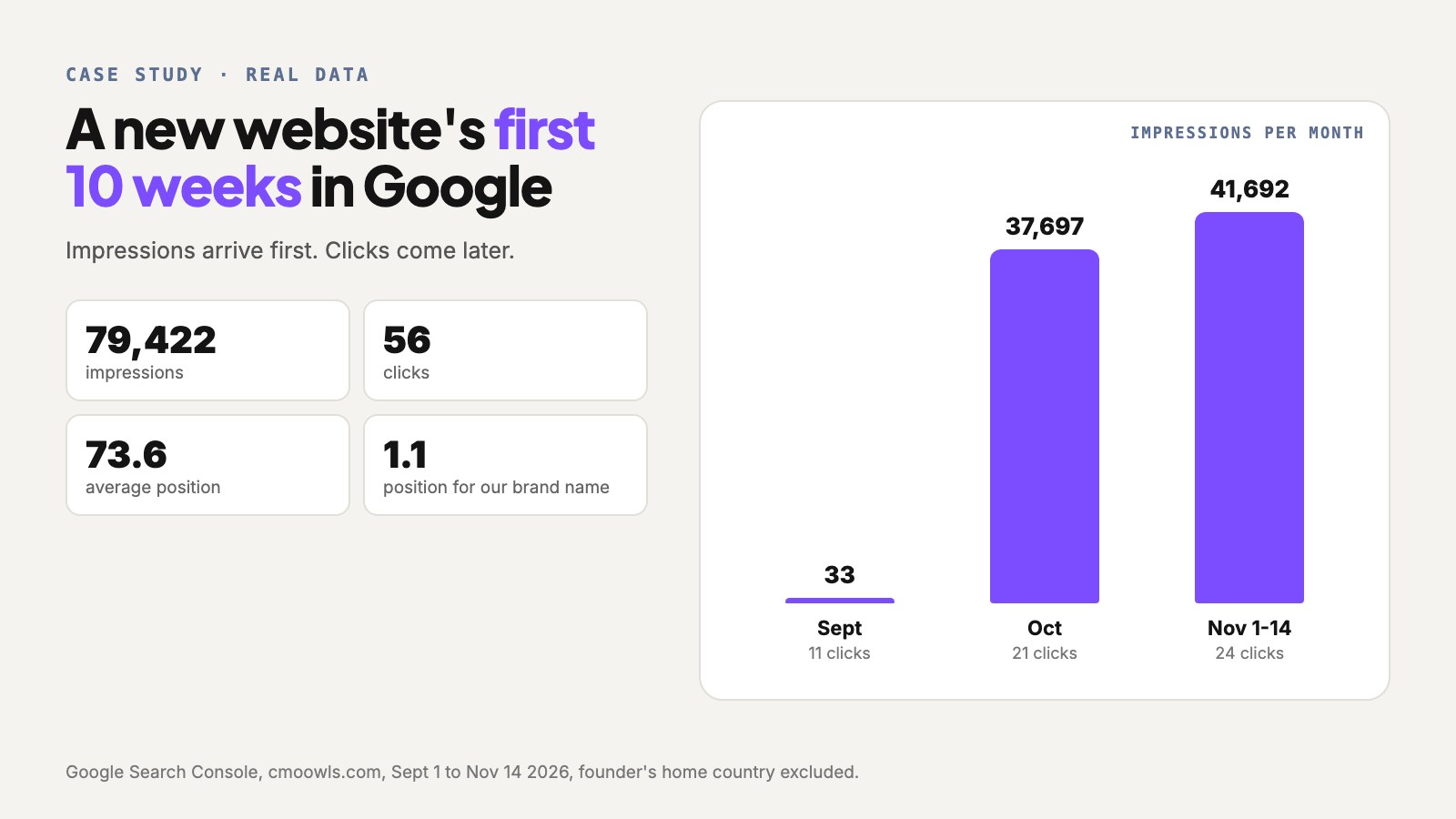
- In its first ten weeks of search data (September 1 to November 14, 2026), cmoowls.com earned 79,422 impressions and 56 clicks in Google, excluding the founder's home country.
- Impressions grew from 33 in September to 41,692 in the first half of November. Clicks barely moved, because most pages ranked around position 70, on page seven.
- Branded searches and a few agent pages already rank on page one. Broad commercial topics show up a lot but rank far too low to be clicked.
- The lesson for any new website: impressions arrive first, clicks come later, and the gap between them tells you exactly which pages to improve next.
Why We're Publishing Our Own Numbers
Most SEO case studies show the winning graph and skip the months before it. This one is the months before it. We're a new site, ten weeks into Google's data, and we're publishing every number so that anyone launching a website knows what normal looks like.
A new website SEO case study is only useful if the data is real and complete. Ours comes straight from Google Search Console, the free tool Google gives every site owner. We removed one country, Pakistan, because almost all of that traffic is the founder checking the site, and it would make the click numbers look better than they are.
CMO Owls is an AI marketing team for small businesses, so we used our own agents to do most of the work. That makes this a test of the product as well as a test of the strategy, and we'll be honest about both.
What We Launched
In ten weeks we published a full site rather than a few pages. By mid-November the main sitemap listed 124 URLs. Our own Watch Owl crawl found 142 live pages once the careers section was included.
| Page type | Count | Purpose |
|---|---|---|
| Blog articles | 60+ | Guides, comparisons and country pages |
| Free tools | 26 | Checkers and generators people can use without signing up |
| Agent pages | 21 | One page per AI agent, explaining what it does |
| Core pages | About 10 | Home, product overview, about, contact and legal pages |
Every article was planned around a keyword nobody else on the site owned, so our pages never compete with each other. Articles were researched and drafted by Owlthor, our keyword article agent, then checked and edited by a person before publishing. Google's guidance is clear that AI-assisted content is fine as long as it is reviewed and genuinely helpful, and that mass-producing pages without adding value breaks its spam policies. We took that seriously: every article cites primary sources, and none were published unedited.
On the technical side we submitted the sitemap to Google and Bing, explicitly allowed the main AI crawlers in robots.txt, published an llms.txt file and added structured data to every article. We cover that setup in detail in our AI visibility case study.
The Numbers, Month by Month
Impressions grew more than a thousandfold in two months, while clicks went from 11 to about 24 a month. That gap is the main story of this case study.
| Period | Clicks | Impressions | What was happening |
|---|---|---|---|
| September 2026 | 11 | 33 | Site indexed, almost only branded searches |
| October 2026 | 21 | 37,697 | Blog and tool pages start appearing for broad topics |
| November 1 to 14, 2026 | 24 | 41,692 | More impressions in two weeks than all of October |
| Total (Sept 1 to Nov 14) | 56 | 79,422 | Average position 73.6 |
An impression means your page appeared in a search result a person loaded, even if they never scrolled down to it. Average position is where your page usually appeared, and 73.6 means page seven or eight. Google explains both in its Performance report guide. So the 79,422 impressions are real, but most of them happened on pages almost nobody reaches.
Where the impressions came from also matters. The United States produced about 46,000 of them, the United Kingdom about 7,000, and the Netherlands and Germany about 2,800 each. That matches who we write for, which is a useful sanity check: Google understood the audience correctly.
What Worked
Three things already work in ten weeks: branded search, specific product pages and one breakout article.
Branded search ranks first
People who search "cmo owls" find us at an average position of 1.1, and that query alone produced 12 of our 56 clicks. The homepage earned 14 clicks at position 6.1. This is the easiest win for any new business: make sure your name, one-line description and homepage title are consistent everywhere, so Google connects the brand to the site quickly.
Narrow pages rank on page one
Our Spy Owl agent page sits at position 6.6, and the about page at 3.9. These pages target specific, low-competition phrases. A new site can rank for narrow terms long before it can rank for broad ones, which is why specific pages are the fastest way to earn your first clicks.
One article pulled most of the impressions
Our guide to AI search visibility tools collected 15,316 impressions, nearly a fifth of the total, at an average position of 72.9. Google clearly sees the page as relevant to a high-volume topic. It just doesn't trust a ten-week-old site enough to rank it high yet.
What Didn't Work (Yet)
The honest result: a 0.07% click-through rate. Of every 10,000 times we appeared in Google, about seven people clicked.
- Broad topics rank too low to matter. Guides such as how to do an SEO audit appear for searches like "how to do a seo audit" at position 94.8. Being found on page ten is effectively not being found.
- Odd queries inflate impressions. Some impressions come from automated or unusual searches, such as long prompts with dozens of search operators. They count as impressions but will never become customers.
- Comparison pages need authority we don't have yet. Pages comparing us with bigger tools appear for those tools' names, but well below the established review sites.
None of this is a surprise. Google warns that a new site should expect improvements to take time, and it suggests asking any SEO "What kind of results do you expect to see, and in what timeframe?" in its guide to hiring an SEO. Our data shows the timeframe in practice: impressions in weeks, clicks in months.
Two Mistakes We Corrected Along the Way
We got two things wrong in the first ten weeks, and fixing them shaped everything after.
Our first tool pages were too thin
Our early free-tool pages had a working tool and around 1,400 words of explanation, with no external sources. In mid-October we rewrote them to the same standard as our articles: more than 2,000 words of genuinely useful guidance, inline links to primary sources and a clear next step. A tool alone rarely ranks. A tool plus the best explanation of the problem it solves has a chance.
Some of our articles competed with each other
In early October we noticed several articles targeting overlapping phrases. When two pages on the same site chase the same search, Google has to pick one, and often ranks neither well. We now give every keyword exactly one owner page and check new articles against every published one for shared keywords, headings and FAQ questions before publishing. This article was checked the same way.
Neither mistake was visible in the data at the time, because ten-week-old sites don't have enough clicks to show patterns. That's the point: early on, you have to follow sound principles rather than wait for the numbers to tell you.
How to Read the Gap Between Impressions and Clicks
High impressions with low clicks means Google finds you relevant but not yet trustworthy enough to rank near the top. It's a positive early sign, as long as you act on it. The most reliable way to build that trust is earning links from other sites; our guide to getting backlinks for a new website lists nine safe ways.
| Pattern | What it usually means | What to do |
|---|---|---|
| No impressions at all | Page isn't indexed or targets a phrase nobody searches | Check indexing; pick a real search phrase |
| Impressions, position 50+ | Relevant, but not trusted for this topic yet | Deepen the page, add internal links, earn mentions |
| Impressions, position 5 to 15, low clicks | Visible, but the result isn't compelling | Rewrite the title and meta description |
| Position 1 to 3, good clicks | Working | Keep it fresh and link to newer pages from it |
If a page has no impressions at all after a month, start with our guide on why a page isn't indexed. If it ranks between 5 and 15 but few people click, the title is usually the problem, and our guide to writing a meta title and description covers how to fix it.
What We're Changing Next
We're putting effort into the pages Google already shows, not into publishing more. Here is the plan, in order:
- Strengthen the top-impression pages. The visibility tools guide gets fresher data, a clearer comparison table and links from five related articles.
- Improve titles on page-one pages. Agent pages ranking between positions 4 and 10 get titles that answer the searcher's question directly.
- Earn independent mentions. Founder videos, community answers and guest articles build the off-site trust a new domain lacks. Google's helpful content guidance points to the same thing: demonstrated experience and trust.
- Ping search engines when pages change. We submit updated URLs through IndexNow, which Bing and other engines use, and through our free IndexNow Submitter.
- Check the whole site every month. Broken pages quietly waste crawl visits, so Watch Owl scans the site on a schedule. The first full scan is written up in our website audit case study.
Lessons for Anyone Launching a New Website
Treat the first three months as a data-gathering phase, not a traffic phase. These lessons apply to any new site, whether or not you use AI to build it.
- Expect impressions first. If your impressions are climbing, Google is testing your pages. That's progress even when clicks are flat.
- Win your brand name in week one. It's the only query you can realistically own immediately.
- Start narrow. Specific pages for specific problems rank years before broad guides do.
- Never let pages compete. One keyword, one page. Two half-ranking pages are worse than one strong one, and thin near-duplicates can fall foul of Google's spam policies.
- Measure without your own visits. Filter out your own country or office, or you'll overestimate progress.
- Keep the site technically clean. Follow the basics in Google's SEO Starter Guide, submit the sitemap to Google and Bing Webmaster Tools, and check it with a sitemap checker.
If you're doing this alone, our guide to solo founder marketing shows how to fit the routine into a few hours a week.
The Owls Behind These Numbers
CMO Owls is the AI marketing team we built for small businesses, and every job in this case study is one of its agents' jobs. Our articles were drafted by Owlthor and every page was checked by Watch Owl; here is which agent handles each part of launching a new site.
| Job | Agent | What it does |
|---|---|---|
| Find what to write | Spy Owl and Growth Hacker | Finds your real competitors and the comparison pages your site is missing |
| Plan the months | Game Plan Owl | Turns the audit, competitors and Search Console into a monthly content roadmap |
| Write the articles | Owlthor | Researches what ranks for each keyword and writes the article with sources, mind maps and FAQ |
| Keep the site clean | Watch Owl | Crawls every page in a real browser and lists problems, worst first |
| Check AI answers | Generative Engine Owl | Measures what AI assistants say about your brand and why they skip you |
| Watch for drops | Cash Cow Stalker | Checks the top pages every five days and alerts when clicks or rankings fall |
The person's job is the part agents can't do: choosing which opportunities to chase, adding first-hand experience to every draft and approving each page before it went live. If you're launching a new site, the same split gets you from an empty sitemap to a full one without hiring a team, and the numbers above show what to expect from Google while you wait.
Mind Map: A New Website's First 10 Weeks
Frequently Asked Questions
How long does it take a new website to get traffic from Google?
Impressions usually start within weeks of indexing, but meaningful clicks often take several months. Our site went from 33 impressions in its first month to over 40,000 in the third, while clicks stayed under 25 a month.
Why do I have impressions but no clicks?
Your pages are appearing, but too far down for people to see them. At an average position of 70, a page is on page seven, so the fix is to strengthen the page and its links, not to change the title.
Should a new website publish a lot of content quickly?
Only if every page is useful and targets a different search. Google's spam policies treat mass-produced pages that add no value as scaled content abuse, whether a person or an AI wrote them.
Is AI-written content bad for SEO?
No, not by itself. Google says it rewards helpful content however it's produced, but you should review AI drafts for accuracy and add real experience before publishing.
What is a good click-through rate for a new website?
There's no universal benchmark, because it depends mostly on position. Compare your own pages over time, and focus on titles only for pages already ranking on page one or two.
Why exclude your own country from the data?
Because founders and teams visit their own site constantly. Our home-country clicks would have made the results look better than they are, so we removed them.
What should I check first if my new site gets no impressions?
Check that the pages are indexed in Search Console's Pages report, that robots.txt isn't blocking Google and that your sitemap is submitted. Then confirm each page targets a phrase people actually search.
The Next Step
Open Search Console, set the date range to the last three months, and sort your pages by impressions. The pages with the most impressions and the lowest positions are your best opportunities. If you want help with the work after that, Owlthor writes the articles and Watch Owl keeps the site clean. You can start free.
Sources
- Performance report (Search results), Search Console Help, Google, 2026.
- Google Search's guidance on using generative AI content, Google Search Central, 2026.
- Creating helpful, reliable, people-first content, Google Search Central, 2026.
- Do you need an SEO?, Google Search Central, 2026.
- Spam policies for Google web search, Google Search Central, 2026.
- SEO Starter Guide, Google Search Central, 2026.
- IndexNow documentation, IndexNow.org, 2026.
- Bing Webmaster Tools, Microsoft, 2026.