Key Takeaways
- A backlink is a link from another website to yours. Search engines read links as signs of trust; Google even says how many sites link to a business is part of how prominent it is in local results.
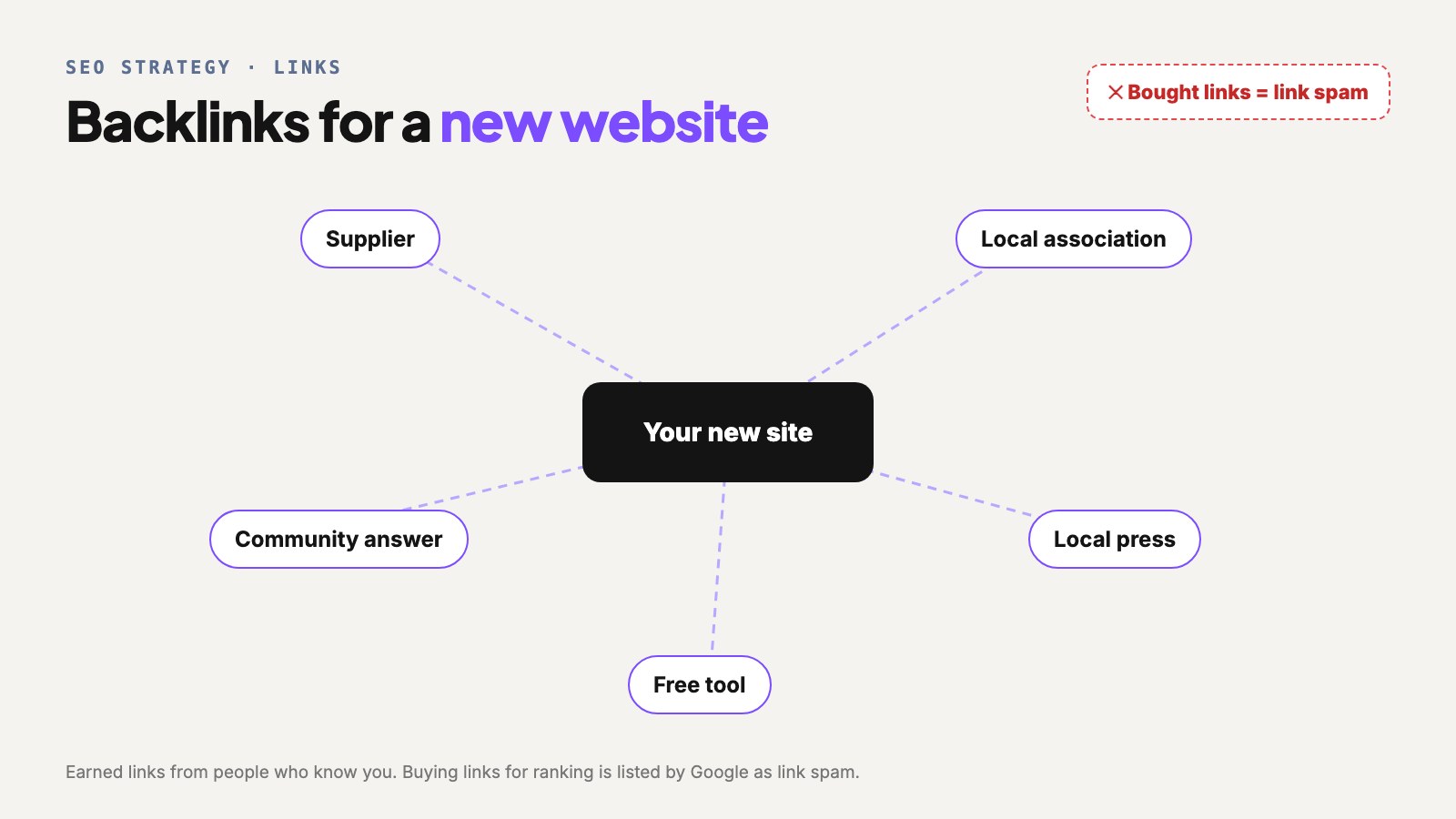
- New websites get links by being useful to someone else's audience: suppliers, partners, local organisations, community answers, original data and free tools.
- Buying links for ranking is link spam under Google's rules, as are excessive link swaps, automated links and keyword-stuffed guest posts. Paid links are only fine when marked sponsored or nofollow.
- A handful of relevant links beats hundreds of random ones. Start with the people who already know your business.
Why Links Matter for a New Website
A new website starts with no reputation, and links from other sites are one of the main ways search engines learn to trust it. Our own new website SEO case study shows the result of a site with plenty of content but little authority: tens of thousands of impressions in Google, at an average position around 73, page seven, mostly for want of trust.
Google's own documents point the same way. Its guide to local ranking says prominence is based partly on how many sites link to your business. Its link best practices explain that links help Google find pages and understand them, through the link's anchor text. And its SEO Starter Guide describes promoting your site to people who'd find it useful.
Links matter for AI search too. Assistants like ChatGPT and Copilot recommend brands the web talks about, and a link usually comes with a mention. Our guide on how to get recommended by ChatGPT covers that side.
What Google Counts as Link Spam
Before building a single link, know where the line is. Google's spam policies define link spam as links created mainly to manipulate rankings, with these examples:
| Practice | Verdict | Why |
|---|---|---|
| Buying or selling links that pass ranking credit | Spam | Google's first example of link spam |
| Excessive link exchanges ("link to me and I'll link to you") | Spam | Named in Google's policy |
| Automated programs or services creating links | Spam | Named in Google's policy |
| Guest posts or press releases stuffed with keyword anchors | Spam | Keyword-rich anchors distributed on other sites |
| Low-quality directory or bookmark links, forum signatures | Spam | Named in Google's policy |
| Paid placements or sponsorships marked sponsored or nofollow | Allowed | Google says paid links are fine when qualified |
| Links earned because someone found you useful | Allowed and valuable | This is what links are meant to be |
Google's guide to qualifying outbound links explains the attributes: rel="sponsored" for ads and paid placements, rel="ugc" for user-generated content like comments, and rel="nofollow" when neither fits. A sponsored link can still bring customers; it just isn't meant to pass ranking credit.
Nine Ways to Earn Backlinks for a New Website
Start with the people who already know you, then create reasons for strangers to link.
1. Suppliers, manufacturers and partners
Many suppliers list their stockists, installers or partners. Ask to be added. It's one email, and the link is relevant by definition.
2. Local organisations and associations
Chambers of commerce, trade associations, business improvement districts and local business networks usually list members on their websites. Membership often pays for itself in that one link plus the contacts.
3. Customers who are businesses
If you serve other businesses, a case study or testimonial on their site, with a link back, is natural and useful to both sides.
4. Genuine business directories and platforms
A few relevant, curated directories in your industry or city are worth it; mass submission to hundreds of low-quality ones is exactly what Google calls spam. Our free list of backlink sites groups trustworthy options by type.
5. A free tool or useful resource
A calculator, checklist, template or free checker solves part of your customers' problem and earns links from people who share it. It's why we built our own free tools: each is useful by itself and a natural thing to link to.
6. Original data
Google's guidance on helpful, people-first content asks whether content provides original information or research; that's also what makes it linkable. Journalists and bloggers link to numbers they can't get elsewhere. Even a small survey of your customers or a summary of your own anonymised data can earn links for years.
7. Helpful answers in communities
Answering questions on Reddit, Hacker News and industry forums builds reputation and sometimes links, but only if you help first. Reddit's rules ask people not to spam, and Hacker News' guidelines say not to use the site primarily for promotion. Our guide on how to use Hacker News explains the etiquette.
8. Local press and podcasts
Local news sites and niche podcasts need stories and guests. A new business, an unusual project or useful expertise is a story. Pitch the angle, not your company.
9. Reclaim the links you already have
Sites may already mention your brand without linking, or link to pages you've moved. Ask for a link on unlinked mentions, and redirect old addresses that other sites still point to; our guide to broken links covers reclaiming them.
An Outreach Email That Gets Replies
Short, specific and useful to the reader beats long and flattering. Most link requests fail because they're about you, not them. Adapt this for suppliers and partners:
"Hi [name], we've stocked [product] since [month] and our customers love it. I noticed your [stockists / partners] page lists retailers in [area]. Could you add us? Here are our details: [business name, address, website]. Happy to share photos or a quote from a customer for your page too. Thanks, [your name]."
For a journalist or blogger, lead with the story or data, not the request: what's new, why their readers care, and one number or quote they can use. Send one polite follow-up after a week, then move on.
Which Links Are Worth Your Time
Judge a link by whether real customers might click it, not by a score.
| Question | Good sign | Warning sign |
|---|---|---|
| Is the site relevant to your business or area? | Same industry, city or audience | Unrelated topics |
| Would a real person click it? | It's in useful content | Buried in a list of hundreds |
| Is it earned or bought? | Earned, or paid and marked sponsored | Paid to pass ranking credit |
| Does the site have real readers? | Active, updated, people comment | Thin pages built only to host links |
| Is the anchor text natural? | Your brand or a plain description | Exact keywords repeated everywhere |
A good sign of where to look: who links to your competitors. If a local association or supplier links to three of your competitors, it would probably link to you too. Our guide to SEO competitor analysis shows how to find those links.
Mistakes New Websites Make With Links
- Buying a cheap package of hundreds of links. It's link spam and can do more harm than good.
- Chasing links before the site is worth linking to. A thin site with three pages has nothing for others to recommend.
- Using the same keyword anchor text everywhere. Natural links mostly use your brand name or the page title.
- Ignoring local and supplier links in favour of hard-to-get national ones.
- Giving up after a month. Links build slowly; the early ones are the hardest.
How CMO Owls Earns Links the Right Way for You
Link building fails for most small businesses for two reasons: they don't know where to look, and they don't have time to create things worth linking to. CMO Owls solves both: it shows you exactly where your competitors get their links, and it creates the content and community presence that earns them.
| Category | Doing it yourself | Buying a link package | CMO Owls |
|---|---|---|---|
| Finds where competitors get links | Hours of manual digging | No | Yes: Spy Owl shows who links to them |
| Creates content worth linking to | You write it | No | Yes: Owlthor and Buzz Creator Owl |
| Finds real community conversations | Manual searching | No | Yes: Reddit Owl and Hacker News Owl |
| Safe under Google's rules | Yes, if done right | No: paid links for ranking are link spam | Yes: earned links only, replies you post yourself |
| Keeps the site link-worthy | No | No | Yes: Watch Owl keeps pages working |
| Tracks the effect | Manual | No | Yes: Cash Cow Stalker alerts on ranking changes |
- Spy Owl finds your real competitors online, what they rank for that you don't and who links to them, and labels where every number came from.
- Owlthor researches what ranks for your keywords and writes articles with mind maps and charts, the kind of resource people link to. Buzz Creator Owl answers the questions people ask AI about products like yours.
- Reddit Owl and Hacker News Owl find real discussions about what you do and draft one genuinely useful reply each time, for you to post yourself, which keeps you on the right side of each community's rules.
- Watch Owl keeps every page working, so the links you earn never lead to errors.
When you add your website, the Overview shows your competitors checked side by side, article ideas and the Reddit and Hacker News conversations worth joining, all within minutes. That's your first month of link-earning work, planned. If you also want to be found on Bing and Copilot, see our guide to Bing Webmaster Tools.
Mind Map: Backlinks for a New Website
Frequently Asked Questions
How can a new website get backlinks fast?
Start with people who already know you: suppliers, partners, local associations and business customers. Those links are relevant, quick to ask for and safe.
Is buying backlinks safe?
No, if the links are meant to pass ranking credit. Google lists buying or selling links for ranking as link spam. Paid placements are fine only when marked sponsored or nofollow.
How many backlinks does a new website need?
There's no fixed number. A handful of relevant links from real businesses and organisations is worth more than hundreds of random ones.
What is the difference between nofollow and dofollow links?
A nofollow, sponsored or ugc link tells Google not to treat the link as an endorsement for ranking. A normal link without these attributes can pass ranking credit. Both can bring visitors.
Do backlinks help with AI search?
Indirectly. AI assistants recommend brands that the web talks about, and links usually come with mentions, reviews and coverage that AI tools can read.
Are directory links good for SEO?
A few relevant, curated directories in your industry or area are useful. Mass submission to low-quality directories is listed by Google as link spam.
Are guest posts still a good way to get backlinks?
Writing genuinely useful articles for relevant sites is fine. Guest posting campaigns built mainly to place keyword-rich links are listed by Google as link spam.
How long do backlinks take to work?
Search engines need to find and recrawl the linking pages first, so effects usually build over weeks to months rather than days.
The Next Step
Write down five businesses or organisations that already know you, such as suppliers, partners, associations and business customers, and email each one this week asking to be listed. Then add your website to CMO Owls to see who links to your competitors and get the content and community replies that earn links month after month. Running an online shop? Our guide to Shopify SEO for AI search covers product-page links too.
Sources
- Spam policies for Google web search, Google Search Central, 2026.
- Qualify your outbound links to Google, Google Search Central, 2026.
- Link best practices for Google, Google Search Central, 2026.
- Tips to improve your local ranking on Google, Google Business Profile Help, 2026.
- SEO Starter Guide, Google Search Central, 2026.
- Reddit Rules, Reddit, 2026.
- Hacker News Guidelines, Y Combinator, 2026.
- Creating helpful, reliable, people-first content, Google Search Central, 2026.