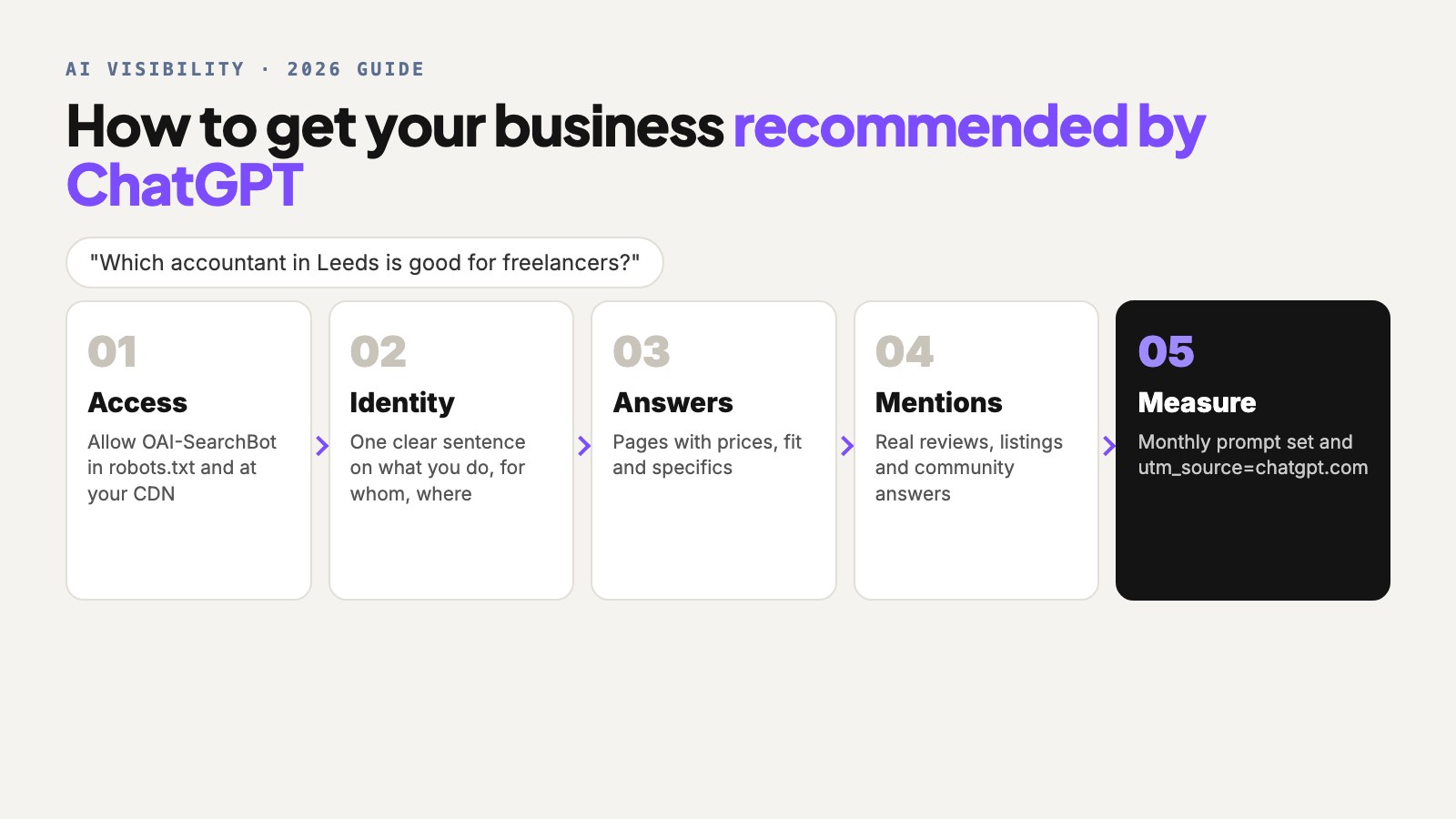
A customer types "which accountant in Leeds is good for freelancers?" into ChatGPT and gets three names back. If yours isn't one of them, you never get the chance to compete. This guide explains how to get your business recommended by ChatGPT: what the assistant looks at, the access setting that quietly keeps many sites out, and the work that makes you the business it names.
Nobody can promise a placement, and OpenAI says so itself. What you can do is remove the reasons ChatGPT skips you and give it clear, checkable reasons to include you.
Key Takeaways
- ChatGPT search only shows sites that OAI-SearchBot is allowed to crawl. Blocking it in robots.txt or at your CDN keeps you out of its answers.
- GPTBot is separate. You can block training and still appear in ChatGPT search, because OpenAI treats each bot setting independently.
- ChatGPT names businesses it can describe with confidence: a clear one-line description, consistent facts across the web and pages that answer buyers' real questions.
- Outside mentions matter: genuine reviews, directory listings and helpful community answers give it independent evidence.
- Track it: ChatGPT adds utm_source=chatgpt.com to links it sends, so the visits show up in Google Analytics.
How ChatGPT Decides Which Businesses to Name
ChatGPT answers from two places: what its model learned in training, and what it finds when it searches the web for your question. For anything local, recent or commercial, such as "best", "near me" or "how much", it usually searches. That's the part you can influence most directly.
When it searches, OpenAI's Publishers and Developers FAQ says ChatGPT ranks results "using multiple factors intended to help users find relevant, reliable information" and that "placement is not guaranteed." In practice, three things decide whether you're named:
- Can it read your site? If its search crawler is blocked, you're out before the question is asked.
- Can it tell what you do, for whom, and where? Vague pages lose to specific ones.
- Do other sources agree? A business mentioned in reviews, directories and articles is a safer recommendation than one that only praises itself.
Training data matters too, but it's slow: the model only learns about you in its next training run, from content that was public long before. Search is where a new or small business can show up this month.
The Access Check Most Sites Skip
OpenAI runs three different bots, and only one of them decides whether you appear in ChatGPT search. Mixing them up is the most common reason a site that ranks in Google never shows up in ChatGPT. Here is what each does, from OpenAI's crawler documentation:
| User agent | What it does | If you block it |
|---|---|---|
| OAI-SearchBot | Crawls pages so they can appear in ChatGPT search answers | You won't be shown in ChatGPT search answers (you may still appear as a plain navigational link) |
| GPTBot | Collects content that may be used to train OpenAI's models | Your content isn't used for training; ChatGPT search is not affected |
| ChatGPT-User | Visits a page when a user's request needs it | OpenAI says robots.txt rules may not apply, and it's not used to decide search inclusion |
Two details trip people up. First, OpenAI says "each setting is independent of the others," so you can block GPTBot to opt out of training while allowing OAI-SearchBot. Second, robots.txt isn't the only gate: the FAQ says your host or CDN must also allow traffic from OpenAI's published search-bot IP addresses. Some firewall and bot-protection settings block AI crawlers by default.
Changes aren't instant either. OpenAI says it "can take ~24 hours" after a robots.txt update for its systems to adjust. Run our free AI Crawler Access Test to see what your robots.txt and server actually return to OAI-SearchBot, and read what an AI crawler is if the bot names are new to you. Bing matters here too: Microsoft announced it as ChatGPT's default search experience in 2023, and our guide to Bing Webmaster Tools shows the 15-minute setup.
A Nine-Step Plan to Become the Answer
Work through these in order: access first, then identity, then content, then outside proof, then measurement. Each step builds on the one before.
- Allow OAI-SearchBot. Check robots.txt for any rule that blocks it or blocks all bots, and check your CDN's bot settings. Our robots.txt generator writes a file that allows search bots and can still block training bots if you want.
- Put your key content in the HTML. If prices, services or opening hours only appear after JavaScript runs or behind a login, a crawler may never see them. View the page source and search for your main service names.
- Write one sentence that says what you are. For example: "A Leeds accounting firm for freelancers and small limited companies." Use the same sentence on your homepage, About page, social profiles and directory listings, so every source describes you the same way.
- Add Organization schema with sameAs links. Google's Organization structured data guide shows how to mark up your name, logo, address and contact details. The sameAs property lists your official profiles, which helps machines connect them to you. Check it with our Schema Markup Checker.
- Build pages that answer "best for" questions honestly. People ask ChatGPT things like "best CRM for a five-person agency." A page that states who your product is for, who it isn't for, and what it costs gives the assistant something specific to quote.
- State your prices and limits. Answers about cost are common, and an assistant can't recommend you on price if your price is hidden. If you can't publish exact prices, publish a range and what changes it.
- Earn mentions on sites ChatGPT reads. Ask real customers for reviews, keep directory listings accurate, and answer questions in communities where you have real expertise, following each community's rules on self-promotion. Never buy or write fake reviews: the US Federal Trade Commission's final rule on fake reviews bans them, including AI-generated ones.
- Keep facts fresh. Update prices, team, locations and product names everywhere when they change. Old, conflicting facts make you a riskier recommendation.
- Measure every month with a fixed set of prompts and your analytics (covered below), then fix whatever the answers get wrong.
What Makes a Page Easy to Recommend
Pages that get quoted answer one question directly in their first two sentences, then back it up with specifics. The research behind generative engine optimization supports this. In the GEO study by Pranjal Aggarwal and colleagues (KDD 2024), adding quotations, statistics and source citations raised a page's visibility in AI answers by up to 40%, while keyword stuffing did worse than doing nothing.
Compare two versions of the same service page:
| Category | Vague version | Specific version |
|---|---|---|
| Opening line | "We offer tailored financial solutions for growing businesses." | "We do bookkeeping, VAT returns and year-end accounts for freelancers and limited companies in Leeds." |
| Price | "Contact us for a quote" | "From £95 a month for sole traders; limited companies from £180" (EXAMPLE) |
| Proof | "Trusted by hundreds of clients" | Link to the firm's public review profile and its professional body membership |
| Fit | Not stated | "Not a fit for companies needing a full audit" |
The specific version gives ChatGPT a service, a location, a price, evidence and a boundary. Those are the facts it needs to say "for a freelancer in Leeds, try this firm." Google's guidance on helpful, people-first content pushes in the same direction, so this work helps your normal search rankings too.
Worked Example: A Leeds Accounting Firm
Here's how a small firm might apply the plan over a month. The firm and numbers are an EXAMPLE, not a real client.
- Week 1: the access test shows the firm's security plugin blocks unknown bots, including OAI-SearchBot. They allow it and confirm robots.txt doesn't block it either.
- Week 2: they rewrite the homepage opening to one clear sentence, add Organization schema with links to their LinkedIn and directory profiles, and publish a pricing page with ranges.
- Week 3: they add three answer pages: "Accountant for freelancers in Leeds", "Do I need an accountant as a sole trader?" and "Limited company vs sole trader: costs compared".
- Week 4: they email recent clients asking for honest reviews and fix an old directory listing with a wrong address.
Then they test ten prompts in ChatGPT and record whether they're named, with which facts, and which other firms appear. That list becomes next month's to-do.
How to Tell If It's Working
Measure two things: whether ChatGPT names you, and whether those mentions send visitors. Neither shows up in a normal ranking report.
- A prompt set. Write 10 to 20 questions your customers really ask, with your service and location. Ask them monthly and note whether you're named, what's said about you and who else appears. Our guide on how to check your AI visibility walks through the method.
- Referral traffic. OpenAI's FAQ says ChatGPT adds utm_source=chatgpt.com to links it sends, so visits appear under that source in Google Analytics. Google's traffic-source dimensions help explains where to find it.
- Accuracy. Check that prices, locations and services ChatGPT states are correct. Wrong facts usually trace back to an old page or listing you can fix.
- Other assistants. Bing Webmaster Tools' AI Performance report shows when Copilot and Bing's AI answers cite your pages, a useful second signal.
Doing this by hand gets slow. CMO Owls' Generative Engine Owl runs real prompts in ChatGPT, Gemini, Claude and Google AI Overviews as part of each paid audit, and reports where you're mentioned and where competitors are named instead. Its free plan doesn't include AI answer checks, but it does crawl your site for the technical problems in steps 1 and 2.
Myths That Waste Your Time
- "Blocking GPTBot hides me from ChatGPT." It doesn't. OpenAI says the bot settings are independent; OAI-SearchBot is the one that matters for search.
- "llms.txt gets me recommended." OpenAI's crawler documentation doesn't mention it. It's cheap to add, but treat it as optional. Our llms.txt guide covers what it can and can't do.
- "Repeat the keyword more." In the GEO study, keyword stuffing performed worse than leaving the page alone.
- "I can pay to be recommended." ChatGPT's organic answers aren't for sale. Put the money into the pages and reviews that earn a mention.
- "One test tells me where I stand." Answers vary between runs and users. Look at patterns across many prompts over several weeks.
Perplexity works differently: it searches live and shows numbered sources on every answer. Our guide on how to get cited by Perplexity covers its crawler and the trust signals it reviews.
ChatGPT Visibility Questions
How do I get my business recommended by ChatGPT?
Allow OAI-SearchBot to crawl your site, describe what you do clearly and consistently, publish pages that answer buyers' questions with prices and specifics, and earn genuine mentions elsewhere. OpenAI says placement isn't guaranteed, so measure monthly and keep improving.
Why doesn't ChatGPT mention my business?
The most common reasons are a blocked OAI-SearchBot, content that crawlers can't read, vague pages that don't say who you serve, or too few independent mentions. Start with an access test, then work through the plan above.
Does blocking GPTBot stop ChatGPT from recommending me?
No. GPTBot is for training, and OpenAI says each bot setting is independent. Only blocking OAI-SearchBot keeps you out of ChatGPT search answers.
How long does it take to show up in ChatGPT?
Access changes take about 24 hours to register, according to OpenAI. Being named in answers depends on content and outside mentions, which usually takes weeks to months, and there's no guaranteed timeline.
Does SEO help with ChatGPT?
Yes, much of it overlaps: crawlable pages, clear content and a trustworthy reputation help in both. ChatGPT also weighs how clearly you answer specific questions and what other sites say about you. Our GEO vs SEO guide explains the differences.
Can I see how much traffic ChatGPT sends me?
Yes. ChatGPT adds utm_source=chatgpt.com to the links it sends, so look for that source in Google Analytics. Tag your own shared links with our free UTM builder so you can tell them apart.
Do reviews affect ChatGPT recommendations?
They give it independent evidence about you, which matters for "best" and "recommended" questions. Only collect genuine reviews; fake ones are banned in the US and damage trust if found.
Start With the Access Test
Run the free AI Crawler Access Test today. If OAI-SearchBot is blocked, nothing else in this guide can work yet. Once access is clear, rewrite your one-line description and build your first answer page. If you want the whole process tracked for you, compare CMO Owls plans; for a wider view of tracking tools, see our AI search visibility tools roundup, and for Google's AI answers read how to rank in AI Overviews.
Sources
- Overview of OpenAI crawlers, OpenAI, 2026.
- Publishers and developers FAQ, OpenAI Help Center, 2026.
- GEO: Generative Engine Optimization, Aggarwal et al., KDD 2024.
- Organization structured data, Google Search Central, 2026.
- Final rule banning fake reviews and testimonials, US Federal Trade Commission, 2024.
- Traffic-source dimensions, manual tagging, and auto-tagging, Google Analytics Help, 2026.
- AI Performance, Bing Webmaster Tools Help, 2026.
- Creating helpful, reliable, people-first content, Google Search Central, 2026.