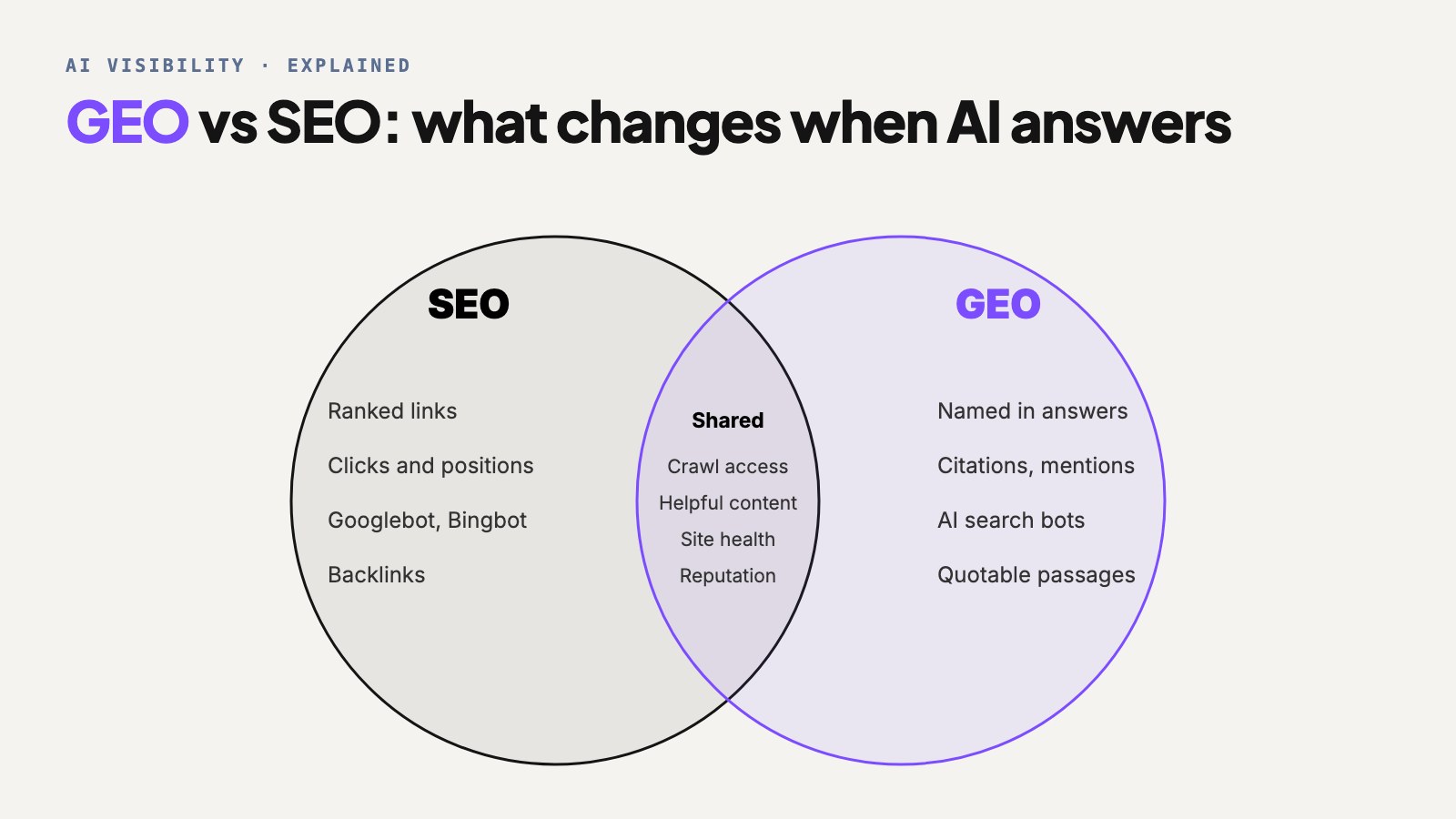
Every few months someone announces that SEO is dead and GEO has replaced it. Then you look closer and most of the GEO advice is SEO with a new name. The truth sits in between. This guide explains GEO vs SEO plainly: where they overlap, the handful of things that really are different when ChatGPT, Gemini, Claude or Google's AI writes the answer, and how a small team should split its time.
Key Takeaways
- SEO earns a ranked link; GEO earns a mention or citation inside an AI-written answer. Same audience, different shelf.
- Most foundations are shared: crawlable pages, helpful content and a good reputation. Google says no special optimization is needed for its AI features.
- What GEO adds: letting AI search bots in, writing passages that can be quoted, and earning mentions on other sites the AI trusts.
- Research backs a few tactics: in the GEO study, adding quotations, statistics and citations raised visibility by up to 40%; keyword stuffing made it worse.
- Measure them differently: SEO by rankings and clicks, GEO by how often AI answers name or cite you.
What GEO and SEO Mean
SEO (search engine optimization) is the work of ranking your pages in search results so people click through. GEO (generative engine optimization) is the work of getting your brand named or cited in answers written by AI systems. You'll also see AEO (answer engine optimization) and LLMO (large language model optimization); they describe roughly the same goal as GEO.
The term GEO comes from a 2023 research paper, "GEO: Generative Engine Optimization", by Pranjal Aggarwal and colleagues, later accepted at the KDD 2024 conference. It defined generative engines as systems that search the web and then write an answer from what they find, and tested ways content creators could improve their visibility in those answers.
GEO vs SEO Side by Side
The biggest difference is what "winning" looks like: a click on your link versus your name in someone else's answer.
| Category | SEO | GEO |
|---|---|---|
| Goal | Rank a page high in search results | Be named or cited in an AI-written answer |
| Where you appear | Google and Bing results pages | ChatGPT, Gemini, Claude, Perplexity, Copilot, Google AI Overviews and AI Mode |
| Unit that wins | A whole page | A passage, a fact or your brand name |
| Crawlers to allow | Googlebot, Bingbot | Those plus OAI-SearchBot, PerplexityBot, Claude-SearchBot |
| Off-site signals | Backlinks | Backlinks plus unlinked mentions, reviews and discussions |
| Main metric | Rankings, impressions, clicks | Mentions, citations, share of voice in answers |
| Main reporting tools | Search Console, Bing Webmaster Tools | Prompt testing, Bing's AI Performance report, AI visibility trackers |
What Stays Exactly the Same
If a search or AI system can't reach and understand your page, nothing else matters, and that part is identical for SEO and GEO. Google is direct about this for its own AI features: its page on AI features and your website says "there are no additional requirements to appear in AI Overviews or AI Mode, nor other special optimizations necessary."
So the classic foundations still carry most of the weight:
- Technical health: pages that load, are indexable and aren't blocked. Our SEO audit guide covers the checks.
- Helpful, original content written for people, as Google's SEO starter guide describes.
- Clear site structure and internal links, which Google lists as a best practice for its AI features too.
- A real reputation: links, reviews and mentions you earned.
Google's own AI search guidance repeats the point: "meeting the technical requirements covers you for search generally, including AI formats." Anyone selling GEO as a replacement for these basics is selling you a shortcut that doesn't exist.
What Actually Changes With GEO
Four things genuinely differ: which bots you allow, how you write passages, how much off-site mentions matter, and how you measure.
1. More bots to let in
Each AI company runs its own crawlers, and each separates search from training. OpenAI uses OAI-SearchBot for ChatGPT search and GPTBot for training. Perplexity says PerplexityBot helps sites appear in its results and isn't used to train AI models. Anthropic describes ClaudeBot (training), Claude-SearchBot (search quality) and Claude-User (fetching pages for users), and notes that blocking Claude-SearchBot may reduce your visibility in its search results. Our AI crawler guide lists the rest, and the AI Crawler Access Test shows which ones reach you.
2. Passages, not just pages
An AI answer quotes a sentence or a fact, not your whole page. Sections that open with a direct answer and make sense on their own are easier to use. This is good SEO practice too, but it matters more when a machine is choosing which lines to lift.
3. Mentions count, not only links
AI systems learn about brands from what the web says about them. Being discussed in reviews, communities, comparisons and articles gives them independent evidence, even when there's no link. Honest participation in communities such as Reddit helps here; Reddit Owl finds threads where you can genuinely answer.
4. New ways to measure
There's no ranking position for an AI answer. You measure by asking the assistants real questions and recording whether you're named. Bing's AI Performance report, in public preview since February 2026, shows how often Copilot and Bing's AI answers cite your pages, though it counts citations, not clicks. Google offers no equivalent report yet; its AI features traffic is folded into the normal Search Console totals.
What the Research Shows
The original GEO study found that some simple content changes raised visibility in AI answers by up to 40%, while keyword stuffing made things worse. The researchers built a benchmark of diverse queries, called GEO-bench, tested a set of content optimization methods on a generative engine, then repeated key tests on Perplexity.
| Method tested | What it means | Result |
|---|---|---|
| Quotation Addition | Adding relevant quotes from credible sources | Among the best performers |
| Statistics Addition | Adding specific numbers instead of vague claims | Among the best performers |
| Cite Sources | Citing credible sources in the text | Strong gains, especially for lower-ranked sites |
| Keyword Stuffing | Repeating the query's keywords | Performed worse than no change |
One finding matters for small businesses: the gains were largest for sources that ranked lower in the underlying search results. For sources in fifth position, citing sources raised visibility by 115.1%, while the top-ranked sources tended to lose share. In plain terms, well-evidenced content gives smaller sites a way to be quoted alongside bigger ones.
Keep the limits in mind. The tests used one benchmark and specific engines in 2023 and 2024, and AI systems change often. Treat the findings as direction, not a formula.
Is SEO Dead?
No. AI answers are built from web pages that search systems find and rank, so SEO is how you become a source in the first place. What has changed is how much traffic a top ranking delivers. Pew Research found that when Google showed an AI summary, people clicked a regular result in 8% of visits, compared with 15% without one.
That's a reason to add GEO to your SEO, not to drop SEO. Rankings still feed the AI answers, and the visitors who do click often arrive better informed. Our article on how AI agents are changing SEO looks at the wider shift.
GEO Myths Worth Ignoring
Most bad GEO advice promises a shortcut that skips the basics. These five come up often:
- "You need special schema for AI." Google says no special schema.org structured data is needed for AI Overviews or AI Mode. Normal, accurate structured data is enough.
- "Blocking AI training bots hides you from AI search." OpenAI says its bot settings are independent: you can block GPTBot and still allow OAI-SearchBot for ChatGPT search.
- "Write separate pages just for AI." Duplicate AI-only pages split your signals. One clear page that serves people works for both.
- "More keywords help AI find you." In the GEO study, keyword stuffing performed worse than making no change.
- "GEO results are guaranteed." No AI company guarantees placement. OpenAI says plainly that placement in ChatGPT search isn't guaranteed.
If a provider's GEO plan doesn't start with crawl access, content quality and reputation, it's skipping the parts that do the work.
How to Split Your Time
For most small businesses, spend most of your effort on the shared foundations, then add GEO-specific work in this order.
- Fix access: make sure Googlebot, Bingbot and the AI search bots can reach your pages.
- Fix the basics: indexing, speed, broken links and clear page structure.
- Rewrite key pages answer-first: a direct answer, then specifics, statistics and sources.
- Describe your business the same way everywhere: website, profiles and directories.
- Earn mentions: real reviews, community answers and coverage in your niche.
- Measure both: Search Console for SEO; a monthly prompt set and citation reports for GEO. Our guide on checking AI visibility explains the prompt method.
For specific engines, follow our step-by-step guides on getting recommended by ChatGPT and ranking in Google AI Overviews. An llms.txt file is optional and cheap, but it's no substitute for the steps above.
Doing Both Without Doubling the Work
The overlap is large enough that one workflow can cover both. CMO Owls runs SEO and GEO together: Owlgorithm Hacker audits technical SEO, Owlthor writes answer-first articles, and Generative Engine Owl checks how ChatGPT, Gemini, Claude and Google AI Overviews describe your brand in each paid audit. If you'd rather compare dedicated trackers, our AI search visibility tools roundup covers them. See the plans.
GEO and SEO Questions
What is the difference between GEO and SEO?
SEO aims to rank your pages in search results so people click. GEO aims to get your brand named or cited in answers written by AI systems such as ChatGPT or Google AI Overviews. Most of the foundations are shared.
Is GEO replacing SEO?
No. AI answers draw on pages that search systems find, so SEO remains the base. GEO adds bot access, quotable passages, mentions and new measurement on top.
What is AEO?
Answer engine optimization means making your content easy for answer engines and AI assistants to use. It overlaps heavily with GEO, and the terms are often used interchangeably.
Does GEO work?
The original GEO study found visibility gains of up to 40% from methods such as adding quotations, statistics and citations, tested on a benchmark and on Perplexity. Results vary by engine and topic, and nothing guarantees a mention.
Do I need different content for GEO and SEO?
Usually not. Answer-first, well-sourced, specific content works for both. The differences are in bot access, off-site mentions and measurement.
How do I measure GEO?
Ask AI assistants a fixed set of real customer questions each month and record whether you're named, cited and described correctly. Bing's AI Performance report adds citation data for Copilot and Bing's AI answers.
Is SEO dead in 2026?
No, but a top ranking sends fewer clicks when AI summaries appear. Pew found clicks on regular results fell from 15% to 8% of visits with a summary on the page.
A First Move for Both
Run the AI Crawler Access Test to confirm AI search bots can reach you, then pick three key pages to rewrite answer-first this month. Track ten real customer questions in ChatGPT and Google so you have a baseline. When you want SEO and GEO handled in one place, start CMO Owls free.
Sources
- GEO: Generative Engine Optimization, Aggarwal et al., KDD 2024.
- AI features and your website, Google Search Central, 2026.
- Top ways to ensure your content performs well in Google's AI experiences on Search, Google Search Central Blog, 2025.
- SEO starter guide, Google Search Central, 2026.
- Overview of OpenAI crawlers, OpenAI, 2026.
- Perplexity crawlers, Perplexity, 2026.
- Does Anthropic crawl data from the web, and how can site owners block the crawler?, Anthropic, 2026.
- AI Performance, Bing Webmaster Tools Help, 2026.
- Google users are less likely to click on links when an AI summary appears in the results, Pew Research Center, 2025.