The Short List
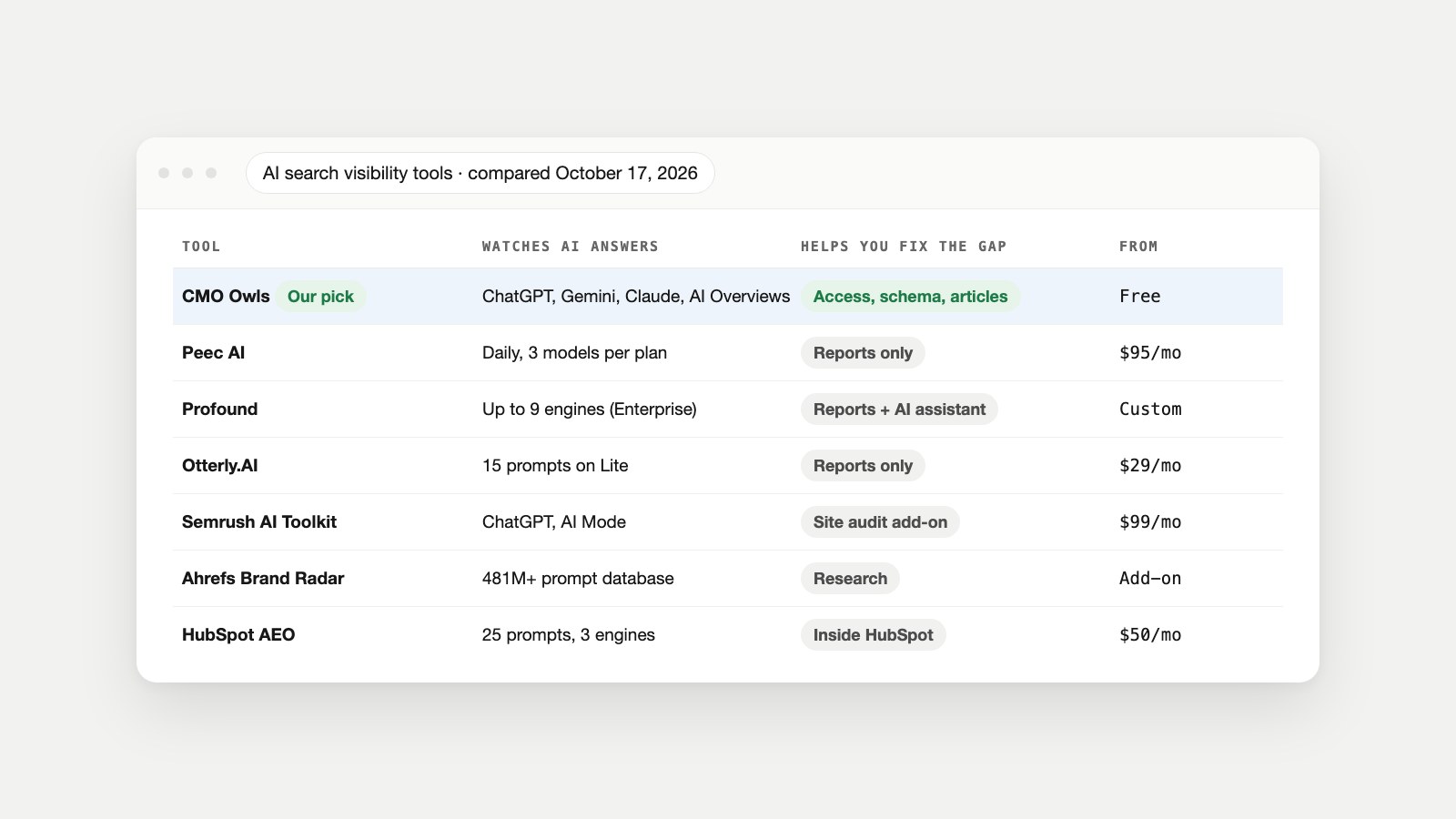
- Our pick: CMO Owls. It's the only tool here that checks whether AI crawlers can reach you, asks real AI engines about your market, explains why competitors get cited, and then writes the pages that close the gap. It starts free.
- Best dedicated tracker: Peec AI. Daily prompt tracking with unlimited users, from $95 a month for 50 prompts.
- Best for large brands: Profound. Up to nine answer engines on its custom Enterprise plan, with a free 7-day trial.
- Cheapest tracker: Otterly.AI, from $29 a month for 15 prompts. Already pay for Semrush, Ahrefs or HubSpot? Each now sells an AI visibility add-on, covered below.
- Every price and feature below was read on the vendor's own website on October 17, 2026. Prices change, so click through before you buy.
Two Jobs: Watching AI Answers and Changing Them
An AI search visibility tool measures how often, and how well, AI assistants such as ChatGPT, Gemini, Claude, Perplexity and Google's AI Overviews mention your brand when people ask questions in your category. You'll also see these called AI visibility trackers, LLM visibility tools or AI search monitoring tools. They all do some mix of two jobs.
Watching means sending the same set of questions (prompts) to AI engines on a schedule and recording which brands appear, in what position and with what tone. Over weeks, that becomes a share-of-voice chart. Fixing means finding out why you're missing and changing it: unblocking crawlers, clarifying who you are in your site's structured data, and publishing clear answers that AI systems can quote.
Most tools on the market are built for the first job. That's useful, but a chart that says "you appear in 12% of answers" doesn't tell a small business what to do on Monday. The comparison below scores both jobs.
How We Scored Them: 10 Points That Matter
We scored each tool on ten questions a marketing lead actually asks. Where a tool clearly leads on a point, it gets the win. This is our own assessment as the makers of CMO Owls, so we've linked every competitor fact to its source.
| Question | Who leads | Why |
|---|---|---|
| Can AI crawlers reach my site at all? | CMO Owls | A free check of 18 search, AI search and training crawlers, plus llms.txt and homepage signals. The trackers assume access. |
| What do real AI engines say about my market? | CMO Owls | Asks ChatGPT, Gemini and Claude directly and reports AI Overviews when Google shows one. |
| Does it admit what it couldn't check? | CMO Owls | Names any engine it couldn't reach and lists AI Mode, Copilot and Perplexity as manual checks, rather than guessing. |
| Why are competitors cited instead of me? | CMO Owls | Compares entity clarity, content structure and sources with identified competitors. |
| Does it check my structured data and technical setup? | CMO Owls | Part of the same audit, with the site-wide technical audit beside it. |
| Does it write the content that fixes the gap? | CMO Owls | Buzz Creator Owl answers the questions people ask AI about your brand; Growth Hacker writes comparison pages. |
| Is there a useful free option? | CMO Owls | The free checkers need no sign-up; the free plan adds unlimited site QA crawls. |
| Does it cover the rest of my marketing? | CMO Owls | SEO audits, articles, social posts and video sit in the same plan. |
| Daily prompt tracking with trend history | Peec AI, Profound | Built for it: prompts run every day, with share of voice charted over time. |
| Number of AI engines tracked | Profound, Peec AI | Up to 9 engines (Profound Enterprise) or up to 13 models (Peec AI Enterprise). |
The two points we don't win are real. If you need a daily share-of-voice chart across a dozen engines for a board report, a dedicated tracker does that better, and you can run one alongside CMO Owls.
The Seven Tools at a Glance
| Tool | AI engines named on its site | Entry price | Free option | Best for |
|---|---|---|---|---|
| CMO Owls | ChatGPT, Gemini, Claude, Google AI Overviews (AI Mode, Copilot, Perplexity flagged for a manual check) | Free plan; audit from $106/mo billed annually | Free checkers, no sign-up | Measuring and fixing, in one place |
| Peec AI | ChatGPT, Perplexity, Gemini and more; choose 3 models per plan | $95/mo (50 prompts) | No free plan listed | Daily tracking for SEO teams |
| Profound | Trial: ChatGPT, Gemini, AI Overviews. Enterprise: up to 9 engines | Custom | 7-day trial, 50 prompts | Large brands and enterprises |
| Otterly.AI | ChatGPT, AI Overviews, Perplexity, Copilot; Claude, AI Mode, Gemini as add-ons | From $29/mo (15 prompts) | Free trial | The lowest-cost tracker |
| Semrush AI Visibility Toolkit | ChatGPT and Google AI Mode named | $99/mo | No free trial | Existing Semrush users |
| Ahrefs Brand Radar | AI Overviews, AI Mode, ChatGPT, Perplexity, Gemini, Copilot | Paid add-on | None listed | Market research across millions of prompts |
| HubSpot AEO | ChatGPT, Gemini, Perplexity | $50/mo ($45 billed annually) | 28-day trial | Teams already on HubSpot |
1. CMO Owls: Best for Finding and Fixing the Gap
CMO Owls approaches AI visibility in the order things break. First, access: the free AI Visibility Checker tests your robots.txt against 18 crawlers, checks your llms.txt and looks for homepage signals such as a noindex or too little text without JavaScript. The AI Crawler Access Test goes one step further and requests your pages as each bot. If a crawler can't get in, no tracker score will move, so this comes first.
Then measurement. Generative Engine Owl runs a GEO audit that asks ChatGPT and Gemini through their official access (or their own web apps as a fallback), asks Claude directly, and records Google AI Overviews when a live search shows one. It reports what came back as it was. When an engine can't be reached, the report says so and why. Google AI Mode, Copilot and Perplexity can't be queried reliably from outside, so they're listed as checks to do by hand rather than filled in with a guess.
Then the fix, which is where it differs most from a tracker. The audit compares your entity clarity, content structure and sources with competitors to explain why they're cited instead of you. Buzz Creator Owl writes articles answering the questions people ask AI about brands like yours ("Is it legit?", "What's a good alternative?"), Growth Hacker writes head-to-head comparisons, and Game Plan Owl puts the fixes in order of impact.
Price: the free checkers need no sign-up, and the free plan includes unlimited site QA crawls. One full SEO, GEO and competitor audit a month comes with the Basic plan ($106/mo billed annually); the prioritized recommendations unlock on Premium ($204/mo billed annually), which also adds social posts and video. See current plans.
Limits: it measures AI answers once per audit, not every day, so it won't draw a daily share-of-voice line. Pair it with a tracker if you need that.
2. Peec AI: Best Dedicated Tracker for SEO Teams
Peec AI is a focused AI search analytics tool. Every plan includes unlimited users and daily tracking. Starter is $95 a month for 50 prompts across three models you choose, Pro is $245 for 150 prompts, and Advanced is $495 for 350 prompts with multi-country tracking and Looker Studio. Enterprise lets you choose from all models, up to 13 tracked.
Its reports cover visibility, position, sentiment and share of voice against competitors, plus the sources AI engines pulled from. Best for in-house SEO teams that want clean daily data. Limits: it shows you the gap; closing it is up to your team and your other tools.
3. Profound: Best for Enterprise Brands
Profound sells mainly through demos. Its free trial runs 50 prompts daily for 7 days on ChatGPT, Gemini and Google AI Overviews. The Enterprise plan is custom-priced and can track up to nine answer engines, including Perplexity, Google AI Mode, Copilot, Claude and DeepSeek, with SSO and SOC 2 compliance. It also includes an "AI Marketer" assistant that runs on credits, and agent analytics that track AI-sourced traffic through integrations such as Cloudflare, AWS and Google Analytics.
Best for large brands with a budget and a team to act on the data. Limits: no public price, and the full engine list is an Enterprise feature.
4. Otterly.AI: Best Low-Cost Tracker
Otterly.AI is the cheapest way into daily tracking. Its Lite plan covers 15 search prompts across ChatGPT, Google AI Overviews, Perplexity and Microsoft Copilot, listed from $29 a month (less when billed annually). Standard covers 100 prompts and Premium 400; Claude, Google AI Mode and Gemini are paid add-ons. A free trial is available.
Best for a small team that wants to watch a short list of important questions. Limits: 15 prompts is a narrow view of a market, and like the other trackers, it reports rather than fixes.
5. Semrush AI Visibility Toolkit: Best If You Already Use Semrush
Semrush's AI Visibility Toolkit costs $99 a month with no free trial. It covers brand performance, competitor research, prompt research, prompt tracking and an AI search site audit. Semrush names ChatGPT and Google AI Mode as monitored platforms. Extra domains or locations cost $99 each, and 50 more tracked prompts cost $60 a month.
Best for teams already living in Semrush who want AI data next to their keyword data. Limits: it's a paid add-on on top of a Semrush subscription for most users.
6. Ahrefs Brand Radar: Best for Market-Wide Research
Ahrefs Brand Radar takes a different approach: instead of only running your own prompts, it draws on a database of more than 481 million search-backed prompts across AI Overviews, AI Mode, ChatGPT, Perplexity, Gemini and Copilot, with Claude also listed. It also tracks brand mentions on YouTube and Reddit.
Best for researching a whole category: who AI mentions most, and for which kinds of questions. Limits: it's priced per AI index as an add-on to Ahrefs, so check current pricing for your region.
7. HubSpot AEO: Best Add-On for HubSpot Users
HubSpot now sells AEO tracking as an add-on: $50 a month, or $45 a month billed annually, for 25 prompts across ChatGPT, Gemini and Perplexity, run daily, with a 28-day trial. It sits inside HubSpot, next to your CRM and email data.
Best for marketing teams that already run on HubSpot. Limits: 25 prompts and three engines is a starter view, and the recommendations live inside HubSpot's own content tools.
How to Track Brand Mentions in AI Search Results by Hand
Before paying for any tracker, it's worth running a simple manual test. It shows you what the paid tools measure, and on a small budget it may be enough:
- Write 20 questions your buyers actually ask, in their words: "best [category] for [audience]", "[your brand] vs [competitor]", "is [your brand] legit", "how do I [problem you solve]".
- Ask each one in ChatGPT, Gemini, Claude, Perplexity and Google (check whether an AI Overview appears). Use a private window and stay signed out where you can, so your history doesn't shape the answer.
- Record three things per answer in a spreadsheet: were you mentioned, which competitors were, and which pages were cited as sources.
- Repeat the same questions monthly. AI engines generate each answer fresh, so one run is a snapshot, not a verdict. Trends across runs are what count.
- Check your analytics for AI referrals. In GA4, look for sessions from chatgpt.com, perplexity.ai, gemini.google.com and copilot.microsoft.com. Tag the links you share with the UTM Builder so your own campaigns don't blur the picture.
If the answers keep citing the same few pages and never yours, that's your fix list. Our guide on how to check AI visibility walks through both layers in more detail.
Which Tool Should You Choose?
| Your situation | Start with | Add later |
|---|---|---|
| Small business, no idea where you stand | CMO Owls free checkers, then a GEO audit | A tracker once you're being mentioned |
| SEO team that needs daily numbers | Peec AI or Otterly.AI | CMO Owls for the fixes and content |
| Enterprise brand, many markets | Profound or Peec AI Enterprise | CMO Owls audits per site |
| Already pay for Semrush, Ahrefs or HubSpot | That platform's AI add-on | CMO Owls to close the gaps it shows |
| Blocked crawlers or missing schema | CMO Owls AI Visibility Checker and Schema Checker | Nothing until access is fixed |
Whatever you pick, fix access first. A blocked crawler, a robots.txt mistake or schema that only loads with JavaScript will cap every score a tracker reports. Our guides to AI crawlers, llms.txt and schema markup cover each of those, and the AI marketing guide shows where AI visibility fits in the rest of your marketing.
Questions People Ask About AI Visibility Tracking
What is an AI search visibility tool?
It's software that measures how often and how accurately AI assistants such as ChatGPT, Gemini, Perplexity and Google's AI Overviews mention your brand. Most run a fixed set of prompts on a schedule; some also check whether AI crawlers can reach your site.
How do I track my brand's visibility in ChatGPT?
Ask ChatGPT the questions your buyers ask and record whether you're mentioned, or use a tool that does this on a schedule. CMO Owls, Peec AI, Profound, Otterly.AI, Semrush, Ahrefs and HubSpot all cover ChatGPT.
Which AI visibility tracker is the best?
For measuring and fixing in one place, CMO Owls. For daily tracking only, Peec AI for most teams, Otterly.AI on a tight budget and Profound for enterprises.
Are there free AI search visibility tools?
Yes. CMO Owls' AI Visibility Checker and AI Crawler Access Test are free with no sign-up. Profound, Otterly.AI and HubSpot offer free trials of their trackers.
How many prompts should I track?
Start with 20 to 50 questions that real buyers ask, split across your category, your brand and your competitors. More prompts give a steadier picture, but the right questions matter more than the count.
Why do AI answers about my brand change from day to day?
AI engines generate each answer fresh, and their sources and models change. That's why trackers repeat prompts over time and why one manual check isn't a verdict.
Can a tool guarantee that ChatGPT recommends my brand?
No. Nobody controls what an AI assistant says. Tools can show where you stand and help you publish clear, accurate answers that give AI systems something reliable to cite.
Do I need a tracker if I'm not mentioned at all yet?
Usually not yet. Fix access, structured data and missing content first, then start tracking once there's something to measure.
Where Every Price Came From
- Peec AI pricing, Peec AI, checked October 17, 2026.
- Profound pricing, Profound, checked October 17, 2026.
- OtterlyAI pricing, Otterly.AI, checked October 17, 2026.
- AI Visibility Toolkit, Semrush Knowledge Base, checked October 17, 2026.
- Brand Radar, Ahrefs, checked October 17, 2026.
- Marketing Hub pricing, including AEO, HubSpot, checked October 17, 2026.
- AI features and your website, Google Search Central.
- Overview of OpenAI crawlers, OpenAI.