In Short
AI marketing is the use of artificial intelligence to do marketing work: researching what customers search for, studying competitors, drafting articles and posts, making images and video, planning and scheduling, and measuring what worked. Done well, AI does the repetitive first 80% and a person does the judgment: what's true, what fits the brand, and what to publish.
It's also something marketing now has to account for from the other side. AI assistants such as ChatGPT, Perplexity and Google's AI Overviews answer questions your customers used to type into a search box, so being understood by AI is part of the job too.
Why I'm Writing This One
I build CMO Owls, a team of AI agents for marketing, so I'm not neutral, and I'll say so where it matters. This guide is the map for everything else we've written on the subject: each section links to the deeper guide for that part of the work. The aim is to explain the field honestly, including the parts AI does badly.
What Is AI Marketing, Exactly?
Strip away the buzzwords and artificial intelligence in marketing comes in three kinds, which are worth separating because they fail in different ways:
| Kind | What it does | Typical failure |
|---|---|---|
| Predictive AI | Finds patterns in data: who's likely to buy, which pages are losing traffic, which emails get opened | Confident predictions from too little data |
| Generative AI | Writes, draws and edits: articles, posts, images, video, ad variations | Fluent text that's wrong, generic or off-brand |
| AI agents | Chain steps together toward a goal: audit a site, then plan fixes, then draft the content | Doing the wrong thing efficiently if the brief is vague |
Most real-world AI marketing mixes all three. A content plan might start with predictive analysis of search demand, use generative AI for drafts, and run as an agent that schedules and reports. Our explainer on how AI agents are changing SEO goes deeper on the third kind.
What AI Does in Marketing, Job by Job
The simplest way to understand AI in marketing is to look at the jobs marketing already involves, and what AI changes in each:
| Job | What AI does well | Where a person stays essential | Our deeper guide |
|---|---|---|---|
| Search research | Groups thousands of searches by intent; spots gaps | Choosing which topics matter for the business | SEO competitor analysis |
| Competitor research | Collects and summarizes public moves quickly | Deciding what to do about them | Competitive intelligence |
| Site health | Crawls every page and ranks the problems | Deciding fix order with the developer | SEO audit |
| Writing | First drafts, outlines, rewrites, variations | Facts, first-hand experience, brand voice | AI marketing tools by job |
| Social media | Post drafts, repurposing, scheduling | Replies, tone, timing judgments | Content calendar |
| Video and images | Ad variations, product videos, resizing | Approving anything with a real person in it | Finding influencers |
| Routine operations | Follow-ups, alerts, weekly reports | Exceptions and complaints | Marketing automation |
| Being found by AI | Checking how assistants describe you | Fixing the facts at the source | Check AI visibility |
AI Marketing Examples
Four short scenes, the kind of AI marketing that's ordinary now. They're illustrations, not case studies:
The clinic that answers patients' questions
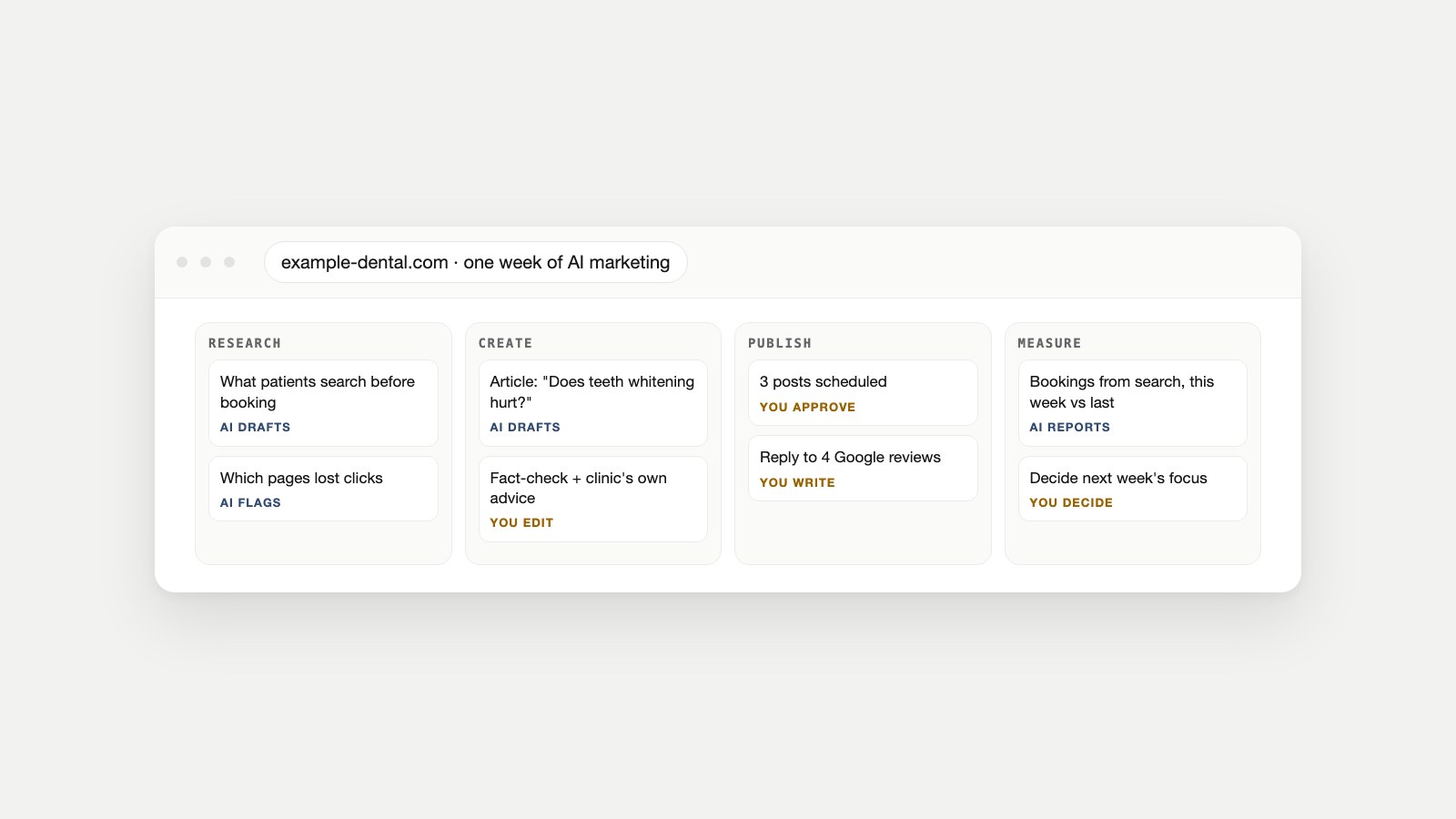
A dental clinic exports the questions patients ask at the front desk, and uses AI to match them against what people search before booking. It finds that "does teeth whitening hurt?" has steady searches and no good local answer. AI drafts the article; a dentist corrects it and adds the clinic's own advice. The hero image above is that week.
The shop that stopped guessing what to post
An online candle shop uses AI to turn one long article into a week of posts for three platforms, then reviews each one before it's scheduled. The owner spends an hour a week on social instead of an hour a day. Our guide to an AI marketing assistant shows that routine in full.
The agency that audits before it pitches
A small agency runs an automated crawl and a competitor scan before every sales call, so the first meeting starts with three specific problems instead of a generic deck.
The brand that checks what AI says about it
A software company asks ChatGPT and Perplexity the questions its buyers ask, and finds an assistant describing a feature it retired two years ago. The fix isn't in the AI; it's updating the company's own pages and the third-party pages the assistant was reading.
The Benefits of AI in Marketing
- Speed on the first draft. Research summaries, outlines and drafts that took a day take minutes, which leaves time for the parts that need a person.
- Coverage. A crawler can check every page of a site; a person checks the five they remember.
- Consistency. Routine work, such as weekly reports, alerts and posting, happens every week instead of when someone remembers.
- Small teams doing more. A two-person business can run research, content and measurement that used to need an agency. Our comparison of AI CMOs and traditional marketing looks at that trade-off honestly.
What AI Is Bad At (and the Risks)
- Being right. Generative AI produces fluent, confident text with no built-in sense of whether it's true. Every fact, figure and claim needs checking.
- Being original. Left alone, it writes the average of what already exists. Your experience, data and opinions are what make content worth reading.
- Knowing your business. It doesn't know your margins, your customers or what you promised last month unless you tell it.
- Judgment calls. Pricing, positioning, a complaint, a crisis: these need a person. When the call is hard, a short session with a human expert is often the right tool; Talk to an Expert exists for that.
- Scale without care. Publishing hundreds of thin AI pages is a fast way to get a site demoted (see the next section).
The Rules: Google, the FTC and the EU
Is AI marketing legal? Yes. What's illegal is the same as without AI: deceiving people. The specific lines worth knowing:
Google Search
Google's guidance on AI-generated content says "appropriate use of AI or automation is not against our guidelines." What is against them is scaled content abuse: many pages generated "for the primary purpose of manipulating search rankings and not helping users," no matter how it's created. Google's advice on helpful, people-first content applies to AI drafts exactly as it does to human ones.
Reviews, testimonials and claims (US)
The FTC's 2024 final rule on fake reviews is designed to deter AI-generated fake reviews, and bans buying or selling fake followers and views. In Operation AI Comply, FTC Chair Lina Khan put it plainly: "there is no AI exemption from the laws on the books." Influencer posts still need clear disclosure under the FTC's influencer guidance, whether or not AI helped make them.
Synthetic images and video (EU)
Under Article 50 of the EU AI Act, anyone deploying AI to generate or manipulate image, audio or video content that constitutes a deep fake "shall disclose that the content has been artificially generated or manipulated," with lighter rules for evidently artistic or satirical work. If you sell into the EU, label realistic AI-generated people and scenes.
None of this is legal advice, and rules differ by country. The practical habit that covers most of it: a person checks every claim, nothing fake gets published, and AI-made people are labelled.
An AI Marketing Strategy on One Page
An AI marketing strategy isn't a separate strategy. It's your marketing strategy with a decision about which jobs AI does. Fill this in once a quarter:
GOAL (one number):        e.g. 30 more bookings a month from search
CUSTOMER:                 who buys, and what they search or ask before buying
CHANNELS (max 3):         e.g. search, Instagram, email

AI DOES                   A PERSON DOES
- search + competitor research   - choose the topics and offers
- first drafts and variations    - fact-check, add experience, approve
- scheduling and weekly reports  - replies, complaints, partnerships
- site checks and alerts         - decide fix order with the developer

RULES: no unverified claims · no fake reviews · label AI people/scenes
REVIEW: monthly, against the goal number (not output volume)
The last line matters most. Teams that measure AI by how much it produces end up with more content and the same results.
How to Start: A 30-Day Plan
- Week 1: Fix the foundation. Run an SEO audit and check that search engines and AI crawlers can reach your site (our AI crawler guide explains why that matters). AI-written content on a broken site goes nowhere.
- Week 2: Research. Use AI to group your customers' searches and questions, and to look at what competitors rank for. Pick five topics worth owning.
- Week 3: Create, with a person in the loop. Draft two articles and a week of posts with AI. Edit hard: add your own examples, fix every fact, cut the generic lines. Put them on a content calendar.
- Week 4: Measure and automate one thing. Check Search Console and your analytics against the goal number, then automate one routine job, such as a weekly report or a traffic-drop alert. Our guide to small business marketing automation lists the seven workflows worth automating first.
For a fuller version written for owners of small businesses, see our practical guide to AI marketing for small business.
Being Found by AI, Not Just Using It
When someone asks an AI assistant for a recommendation, it builds its answer from pages it can read and sources it trusts. Google says there are no additional requirements to appear in AI Overviews or AI Mode beyond normal SEO best practices, which is reassuring: the same foundations apply. In practice that means:
- Crawlable pages that AI crawlers aren't blocked from (what is an AI crawler?).
- Clear facts about your business in your own words and in schema markup.
- A short guide for language models in an llms.txt file, an emerging convention rather than a ranking factor.
- Independent mentions on sites, reviews and communities AI assistants read.
Our step-by-step guide to checking your AI visibility shows how to see what assistants say about you today, and the free AI Visibility Checker runs the first checks.
Choosing AI for Your Marketing
There are three broad routes: separate tools for each job, an all-in-one platform, or a team of AI agents that hands work between them. Whichever you choose, ask the same questions: does it tell you where its facts and numbers come from, can a person approve before anything is published, and can you export your work? Our AI marketing tools by job guide compares the single-purpose route, and our roundup of the best AI CMO platforms compares the all-in-one options, including us, with sourced wins for competitors where they have them.
Where CMO Owls Fits
CMO Owls is a team of AI agents, one per marketing job, that share what they find. Watch Owl checks every page of your site, Spy Owl researches competitors with every number labelled by source, Game Plan Owl turns findings into a monthly content roadmap, Owlthor writes the articles, LinkedIn Owl and the other social owls draft posts, Scheduler Owl keeps the calendar, Owl Cam makes product videos, and Generative Engine Owl checks how AI assistants see your brand. A person approves what goes out.
Meet the Owls explains how all 21 agents hand work to each other, and the agents page lists them. If you'd rather start without signing up, our free tools cover the most common checks.
AI Marketing FAQ
What is AI marketing in simple terms?
It's using artificial intelligence to do marketing work, such as research, writing, design, scheduling and reporting, with a person checking the facts and deciding what gets published.
How is AI used in marketing?
Mostly for search and competitor research, first drafts of content, social posts, image and video variations, scheduling, site checks and reports. Predictive AI also scores leads and spots changes in traffic.
What are some examples of AI marketing?
Drafting articles from customers' real questions, repurposing one article into a week of posts, crawling a website for broken pages, generating ad variations, and checking what AI assistants say about a brand.
Is AI marketing effective?
It's effective at speed, coverage and consistency, and weak at accuracy and originality on its own. Results depend on a person adding facts, experience and judgment, and on measuring against a business goal rather than output volume.
Is AI marketing legal?
Yes. The usual laws still apply: no deceptive claims, no fake reviews, clear ad disclosures, and in the EU, labels on realistic AI-generated images, audio and video. The FTC has said there's no AI exemption from existing law.
Will AI replace marketers?
It replaces tasks more than people: first drafts, routine reports and checks. Strategy, judgment, relationships and accountability for what's published still need a person.
Does Google penalize AI-generated content?
Not for being AI-generated. Google says appropriate use of AI isn't against its guidelines, but mass-producing low-value pages to manipulate rankings is spam no matter how it's made.
How do I start using AI in my marketing?
Fix your site's foundations first, use AI for research and drafts with a person editing everything, put content on a calendar, then automate one routine job and measure it against one goal.
Primary Sources
- Google Search's guidance about AI-generated content, Google Search Central Blog, 2023.
- Spam policies for Google web search, Google Search Central.
- Creating helpful, reliable, people-first content, Google Search Central.
- AI features and your website, Google Search Central.
- FTC announces final rule banning fake reviews and testimonials, U.S. Federal Trade Commission, 2024.
- FTC announces crackdown on deceptive AI claims and schemes, U.S. Federal Trade Commission, 2024.
- Disclosures 101 for Social Media Influencers, U.S. Federal Trade Commission.
- Article 50: Transparency obligations, EU Artificial Intelligence Act.