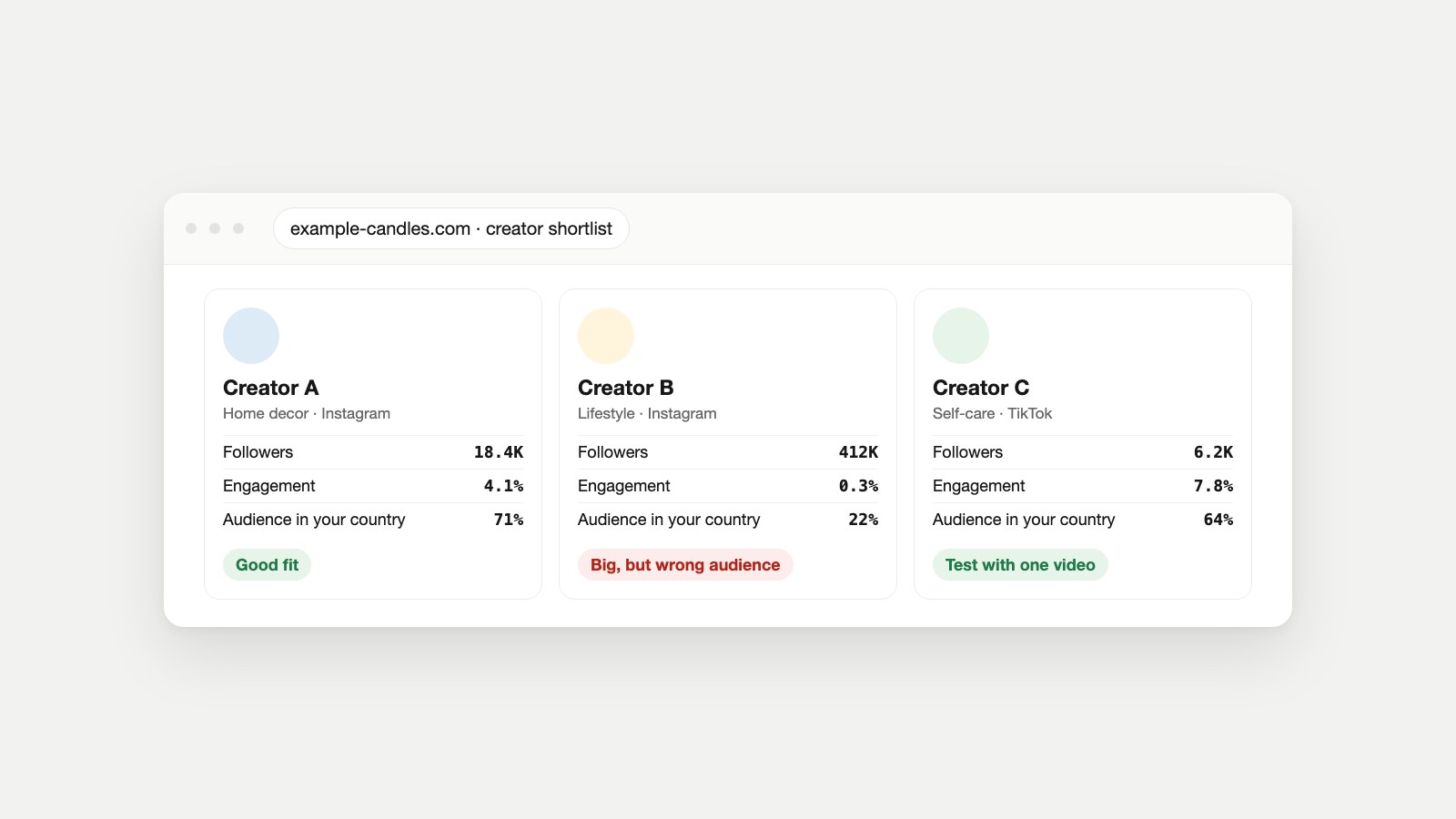
The Five-Minute Version
- Start with fit, not size. The best creators for a small brand talk to the exact people who buy from you, in your country, and their audience actually responds.
- Look where your customers already are: your own followers and tagged posts, hashtag and keyword search, the platforms' own creator tools, and creator marketplaces.
- Check before you pay: engagement relative to followers, comments that sound human, audience location, and past brand work. Buying fake followers is now banned in the US.
- Price depends on format, usage rights, exclusivity and effort, not just follower count. Ask for a rate card and compare what's included.
- Both sides must disclose. The FTC wants a clear "ad" or "sponsored" label on the post itself, and inside the video for video.
A Candle Brand's First Creator Campaign
Picture example-candles.com, a small online shop selling hand-poured soy candles, mostly to people within its own country. The founder wants to try influencer marketing for the winter season, has a modest budget, and has no idea where to start. "Do I just message the biggest home account I can find?"
No, and the shortlist at the top of this page shows why. The account with 412,000 followers has a 0.3% engagement rate and most of its audience in another country. The account with 6,200 followers gets far more response per follower and mostly reaches the shop's own market. The rest of this guide is how the founder got from "no idea" to that shortlist, and what happened next.
Who Counts as an Influencer?
An influencer is anyone whose recommendations a specific audience trusts enough to act on. People usually group creators by follower count, though the boundaries vary from source to source:
| Tier | Rough size | Usually good for |
|---|---|---|
| Nano | Up to about 10,000 followers | Tight, local or niche communities; product seeding; first tests |
| Micro | About 10,000 to 100,000 | Niche reach with strong engagement; most small-brand campaigns |
| Mid-tier | About 100,000 to 500,000 | Wider reach in a category; launches |
| Macro and mega | Hundreds of thousands to millions | Broad awareness; bigger budgets and contracts |
For most small businesses, nano and micro creators are where the value is. They cost less, they're easier to reach, and their followers are often closer to a real community than a broadcast audience.
Where to Find Influencers
There's no single influencer database that covers everyone, so combine a few sources. In rough order of how good the leads tend to be:
- Your own followers and tagged posts. Customers who already post about you are the warmest leads you'll ever get. Check who tags your products, comments often, or mentions you in stories.
- Your customers' favourite accounts. Ask in a post-purchase email or a short survey: "Who do you follow for home ideas?" The same names coming up three times is a signal.
- Hashtag and keyword search on each platform, for your product category, your city and the problems you solve (#cosyhome, "candle haul", "winter self-care"). Sort by recent posts, not just top posts, to find smaller creators who are active now.
- Competitors' collaborations. Look at who your competitors have worked with and who comments on those posts. Our guide to competitive intelligence covers how to research rivals ethically.
- The platforms' own creator tools. Instagram, TikTok and YouTube each offer official ways for brands to find and partner with creators. What's available varies by country and account type.
- Creator marketplaces, where creators list themselves and their rates, and you can book directly.
Save every candidate in a simple spreadsheet: handle, platform, niche, followers, a link to three recent posts, and a note on why they fit. A shortlist of 15 to 20 usually gets you three or four good partners.
How to Vet an Influencer Before You Pay
Followers are the easiest number to fake and the least useful one to judge by. Check these instead:
| Check | How | Warning sign |
|---|---|---|
| Engagement | Average likes and comments on recent posts ÷ followers | Very low for the size, or suddenly high on one post only |
| Comments | Read the last 50 | Generic "Nice! 🔥" from the same accounts, or comments in unrelated languages |
| Audience | Ask for a screenshot of their audience insights | Most followers outside the country you sell in |
| Growth | Look at follower history, or ask | A sudden jump of thousands overnight with no viral post |
| Content fit | Scroll a month of posts | Your product would look out of place |
| Past brand work | Look for disclosed partnerships | Undisclosed ads, or a different sponsor every day |
Fake engagement isn't just wasted money anymore. In August 2024 the US Federal Trade Commission announced a final rule that "prohibits anyone from selling or buying fake indicators of social media influence," such as followers or views generated by bots or hijacked accounts. Working with a creator who bought their audience is a risk to your brand as well as your budget.
How Much Do Influencers Charge?
There's no standard price, and any single figure you read online hides huge variation by country, niche, platform and format. What you can do is understand what drives the price, so you can compare offers fairly:
| Factor | Why it changes the price |
|---|---|
| Format | A video takes far more work than a story; a story disappears in 24 hours |
| Platform | Rates differ between Instagram, TikTok and YouTube, even for the same creator |
| Audience and engagement | A smaller, highly engaged niche audience can command more than a larger, passive one |
| Usage rights | Using their content in your own ads or website, and for how long, usually costs extra |
| Whitelisting | Running paid ads through the creator's account is a separate permission and fee |
| Exclusivity | Asking them not to work with competitors for a period limits their income, so it costs more |
| Revisions and timelines | Rush jobs and extra rounds of edits add cost |
Many creators publish a rate card: a short list of what they offer and what each costs. If they don't have one, ask for one. Here's the shape of a typical card (the numbers are placeholders, not market rates):
EXAMPLE RATE CARD · Creator A (home decor, Instagram + TikTok)

Instagram Reel (30–60 s)          $___
Instagram story set (3 frames)    $___
TikTok video (30–60 s)            $___
Bundle: 1 Reel + 3 stories        $___

Usage rights (your ads/site)      + __% per month
Whitelisting (ads from my handle) + $___ per month
Exclusivity (no competing brands) + $___ per month
Revisions included                1 round
Turnaround                        10 working days from receiving the product
Compare cards line by line, not total price. A cheaper quote that excludes usage rights may cost more the moment you want to reuse the video in an ad. Product-only deals ("gifting") are fine for nano creators who already like your brand, but don't expect guaranteed posts in return for free products.
Reaching Out Without Sounding Like Spam
Creators get a lot of copy-paste offers. A short, specific message stands out:
Hi [name], I run example-candles.com, a small soy candle shop.
Your post about [specific post] is exactly the kind of cosy-home content
our customers love, and most of your audience is in [country], where we ship.

We'd like to send you our winter collection and talk about a paid
Reel in November. Do you have a rate card you could share?

[Your name] · [link to your site]
Mention a real post, say why you're a fit, be upfront that it's paid (or that it's only gifting), and ask for their rates rather than naming yours first.
The Brief: One Deliverable, Clearly Defined
Most disappointing collaborations trace back to a vague brief. Agree, in writing:
- The deliverable: one Reel, one story set or one video, on which platform, and the posting window.
- The one message you want viewers to remember, plus anything they must not say (medical claims, prices that may change).
- Creative freedom. Give the goal and the facts, then let them make it in their own style. Their audience follows them, not your script.
- Usage rights, exclusivity and revisions, matching the rate card.
- Disclosure, spelled out (see below), and how you'll track results.
Plan the posts around the rest of your marketing so they don't collide with launches or sales. Our guide to building a content calendar shows how, and Scheduler Owl keeps that calendar for you.
Disclosure: The Rules Both Sides Must Follow
In the US, the FTC's Disclosures 101 for Social Media Influencers is the plain-English guide. Its main points:
- Disclose "when you have any financial, employment, personal, or family relationship with a brand," including free or discounted products.
- Put the disclosure "so it's hard to miss," with the endorsement itself, not buried in hashtags or behind "more."
- Simple words work: terms like "advertisement," "ad," and "sponsored." A hashtag such as #ad is fine but not required.
- For video, the disclosure "should be in the video and not just in the description." In live streams, repeat it periodically.
- "Don't assume that a platform's disclosure tool is good enough." Use it in addition to your own clear label.
In the UK, the ASA and CMA publish an equivalent influencers' guide on making clear that ads are ads, and the CMA has its own guidance for content creators on social media endorsements. Brands are responsible too. The FTC's own answers to common questions say advertisers "need to have reasonable programs in place to train and monitor members of their network," and the legal basis is the FTC's Endorsement Guides. Put the disclosure requirement in the brief and check posts before you share them.
Influencer Marketing Examples That Suit Small Brands
"Influencer marketing" covers several quite different deals. The ones that work best on a small budget:
| Type | How it works | Good for |
|---|---|---|
| Product seeding (gifting) | Send products with no obligation to post | Finding creators who genuinely like you |
| Paid post or video | A fee for a defined deliverable | Predictable content on a set date |
| Affiliate or discount code | Commission or a code per sale | Tracking sales directly |
| UGC (content only) | You pay for the video; it runs on your channels, not theirs | Ads and product pages |
| Takeover | The creator runs your account for a day | Fresh content and their audience visiting you |
| Ongoing ambassador | Several posts over months | Building familiarity, once a test has worked |
The candle shop started with seeding to six nano creators, paid two of them for a Reel each, and gave each a personal discount code. One Reel drove most of the code redemptions, and that creator became the shop's first ongoing partner.
Measuring Whether It Worked
Decide what success means before the post goes live, then track it:
- Unique discount codes or tagged links per creator, so sales are attributed to the right post. Google Analytics explains how to build campaign links with UTM parameters.
- Saves, shares and comments on the post, which say more about interest than likes do.
- Branded searches and direct traffic in the days after, in Search Console's Performance report and your analytics.
- Cost per result: what you paid divided by sales, sign-ups or new followers, compared across creators.
Also check what the post links to. If a creator sends their audience to your site, make sure the link preview looks right when it's shared (Open Graph Checker) and that the landing page loads fast on phones.
Where Owl Match Fits
Finding, contacting and paying creators one by one is slow. Owl Match is CMO Owls' creator marketplace: you browse creators by niche and platform, see their handles, follower counts and what they offer, and book one clear deliverable per order (a post, a story or a video on a specific platform) at the creator's own listed rate. Payment goes through secure checkout, a private chat opens for that order once it's paid, and the creator delivers the file there for you to confirm. Neither side's email or phone number is ever shown.
It doesn't replace vetting: still read the creator's recent posts and ask about their audience before you book. If you want to test a message before paying a creator at all, Owl Cam and Owl Studio make AI product videos you can try first, and Buzz Creator Owl helps get your brand mentioned in the places AI assistants read.
For the bigger picture of where creators fit alongside AI tools, see our guide to what AI marketing is and our practical AI marketing guide for small business.
What Brands Ask Us About Influencers
How do I find influencers in my niche for free?
Start with your own followers and tagged posts, then search hashtags and keywords for your category and city on each platform, sorted by recent posts. Check who your competitors work with. Save candidates in a spreadsheet with links to their recent posts.
How much do influencers charge per post?
It varies too much by country, niche, platform and format for a single honest figure. Ask each creator for a rate card, and compare what's included: format, usage rights, whitelisting, exclusivity and revisions.
What is an influencer rate card?
A short list of a creator's services and prices, such as a Reel, a story set or a TikTok video, plus add-ons like usage rights and exclusivity. It makes offers easy to compare and avoids surprises later.
How do I know if an influencer's followers are fake?
Compare engagement with follower count, read recent comments for generic or repeated replies, ask for audience insights showing location, and look for sudden follower jumps. In the US, buying or selling fake followers is now prohibited by the FTC.
Are micro influencers worth it for a small business?
Often, yes. They usually cost less, respond more, and reach a tighter community, which suits small budgets and niche products. Test with one deliverable before committing to a longer deal.
Do influencers have to say a post is an ad?
Yes, whenever there's a financial, employment, personal or family relationship, including free products. The FTC says the label must be clear and hard to miss, and for video it must appear in the video itself.
What are usage rights and whitelisting?
Usage rights let you reuse the creator's content in your own ads, site or emails for an agreed period. Whitelisting lets you run paid ads through the creator's own account. Both are usually priced separately.
Should I pay influencers with free products only?
Gifting works for nano creators who already like your brand, but it can't guarantee a post. For a defined deliverable on a date, pay a fee.
Rules and References
- Disclosures 101 for Social Media Influencers, U.S. Federal Trade Commission.
- FTC announces final rule banning fake reviews and testimonials, U.S. Federal Trade Commission, 2024.
- Influencers' guide to making clear that ads are ads, Advertising Standards Authority and CMA, 2023.
- Social media endorsements: guidance for content creators, Competition and Markets Authority (GOV.UK).
- Guides concerning the use of endorsements and testimonials in advertising (16 CFR Part 255), Electronic Code of Federal Regulations.
- FTC's Endorsement Guides: What People Are Asking, U.S. Federal Trade Commission.
- Performance report (Search results), Search Console Help.
- URL builders: collect campaign data with custom URLs, Google Analytics Help.