The Gist
- Competitive intelligence (CI) is the practice of collecting public information about competitors and your market, and turning it into decisions.
- It starts with a question ("should we match their price?"), not with a pile of data.
- Most useful CI comes from free public sources: competitors' websites and their archived versions, ad libraries, reviews, job posts, filings and search trends.
- It's legal when you stick to public information and honest methods. Theft, bribery and misrepresentation are "improper means" under US trade secret law.
A Price Cut on a Tuesday
Picture a small coffee roaster, example-roastery.com, that sells subscriptions online. One Tuesday a customer emails to cancel: a rival is now offering three bags for the price of two. The owner's first instinct is to match the price that afternoon.
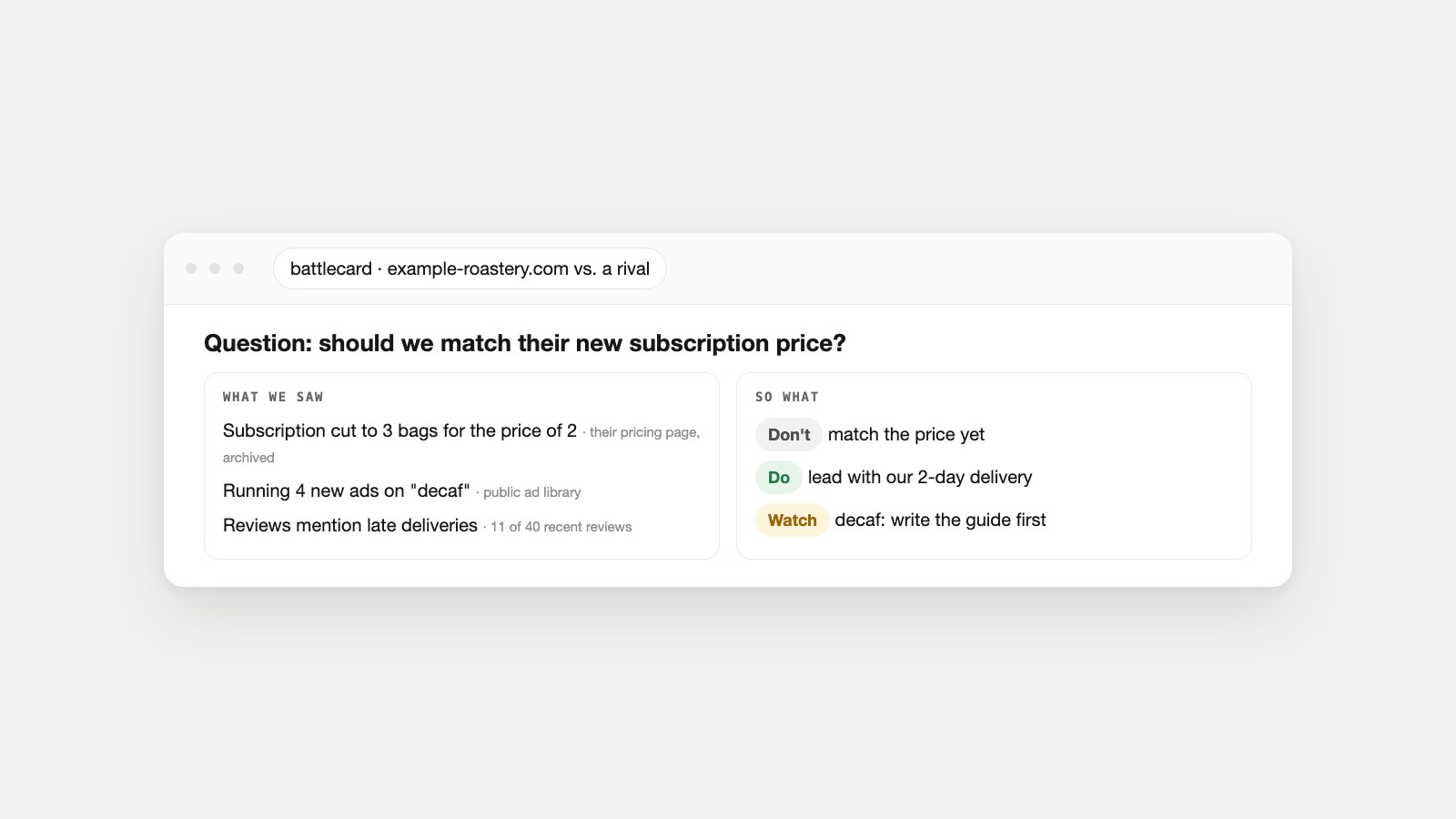
Competitive intelligence is what happens instead. In about an hour, the owner checks the rival's pricing page and its archived versions, looks at what the rival is advertising, and reads its most recent reviews. The picture that comes back is different from the panic: the offer is a month old, the rival is pushing hard on decaf, and a quarter of its recent reviews complain about late deliveries.
The decision changes. Don't match the price yet. Lead with fast delivery, which the rival is visibly struggling with. And write the decaf guide before they own that search. The battlecard at the top of this page is the result.
What Is Competitive Intelligence?
Competitive intelligence is the ongoing, ethical collection and analysis of information about competitors, customers and the market, done so you can make better decisions. The key word is decisions. A folder of competitor screenshots is research; it becomes intelligence when it changes what you do about pricing, product, messaging, sales or content.
Good CI has three properties. It answers a specific question. It's timely, since knowing about a price change a month late is history. And every claim in it can be traced to a source, so people trust it enough to act on.
Competitive Intelligence vs Market Intelligence vs Business Intelligence
These terms overlap and are often used loosely. The practical difference is what they look at:
| Term | Looks at | Typical question |
|---|---|---|
| Competitive intelligence | Competitors' moves, plus the market around them | What is our rival doing, and what should we do about it? |
| Competitor analysis | A snapshot of specific competitors | How do we compare with these three companies today? |
| Market intelligence | The whole market: size, trends, customers, regulation | Is demand for decaf growing, and where? |
| Business intelligence (BI) | Your own internal data: sales, operations, finance | Which subscriptions churn fastest? |
Competitor analysis is a single exercise; competitive intelligence is the habit that keeps it current. For the search-specific version (whose keywords, links and content beat yours), see our step-by-step guide to SEO competitor analysis.
The Competitive Intelligence Process in Five Steps
The process borrows its shape from the intelligence cycle used in government work, and it fits on one page:
- Ask one question. "Should we match their price?" or "Why are we losing deals to X?" A question tells you what to collect and when to stop.
- Collect from the sources most likely to answer it, starting with the free ones below. Note where and when each fact came from.
- Analyze. Separate what you saw from what you think it means. A price cut could mean a rival is winning, or that it's struggling to keep customers.
- Share in a format people will read: a one-page battlecard, not a 40-slide deck. Put the decision at the top.
- Decide and revisit. Record what you chose and set a date to check whether the picture has changed.
Then repeat for the next question. Teams that try to "monitor everything" usually end up monitoring nothing, because nobody reads the feed.
Free Sources Most Teams Ignore
You don't need a paid platform to start. Almost everything in the roaster's story came from public, free sources:
| Source | What it tells you | How to use it |
|---|---|---|
| Their website | Prices, products, positioning, who they target | Read pricing, product and "about" pages; check their sitemap to see what they publish |
| The Wayback Machine | How their site and prices have changed over time | Look up a page's archived versions by date |
| Ad libraries | Which ads they're running now, and their messages | Meta Ad Library; Google Ads Transparency Center |
| Reviews | What their customers love and hate | Read recent reviews; count the repeated complaints |
| Job posts | What they're building next | A rival hiring three mobile engineers is probably building an app |
| Google Alerts | News and new pages that mention them | Set an alert for each rival's name |
| Google Trends | Relative interest in their brand or category over time | Compare search terms; values are indexed 0–100, not raw volumes |
| Company filings | Revenue, ownership, strategy (larger or public firms) | SEC EDGAR in the US; Companies House in the UK |
| Communities | What practitioners say when the company isn't in the room | Forums, Reddit and Hacker News threads |
A few notes on using them well. The Wayback Machine lets you search archived pages by address and date range, which is how the roaster saw that the offer was a month old. Meta's Ad Library and Google's Ads Transparency Center show ads advertisers are running. Google Alerts sends an email "when new results for a topic show up in Google Search." And Google Trends scales its numbers "on a range of 0 to 100" relative to all searches, so it shows direction and comparison, not search volume.
For larger competitors, filings are underused. The SEC's EDGAR full-text search covers US public companies' filings, and Companies House lists UK company accounts and officers. Technical communities are often where honest product opinions surface first; our guide to using Hacker News covers how to search it.
Competitive Intelligence Examples
Four short examples of a question, a source and a decision:
Pricing
A meal-kit company sees a rival's new annual plan in an archived pricing page from three weeks earlier. Instead of copying it, it surveys its own churned customers and finds price wasn't the main reason they left.
Hiring signals
A bookkeeping software firm notices a competitor advertising for payroll specialists in two countries. It moves its own payroll integration up the roadmap, before the rival's launch, not after.
Review mining
A dental clinic reads 50 recent reviews of the two busiest clinics nearby. The repeated complaint is waiting times, so its ads lead with online booking and same-week appointments.
Search and content
A software company finds a rival ranking for a set of "how to" searches it has never written about. Those gaps become its next quarter's articles, planned on a content calendar.
Is Competitive Intelligence Legal?
Yes, when it uses public information and honest methods. The line is drawn around how information is obtained. US trade secret law, 18 U.S.C. § 1839, defines "improper means" as including "theft, bribery, misrepresentation, breach or inducement of a breach of a duty to maintain secrecy, or espionage through electronic or other means." The same definition says it does not include "reverse engineering, independent derivation, or any other lawful means of acquisition." The Defend Trade Secrets Act lets owners bring a civil action for misappropriation.
In practice, stay on the right side with a few simple rules (this isn't legal advice, and laws differ by country):
- Use public sources: websites, ads, filings, reviews, published interviews and trade shows.
- Never misrepresent who you are, for example by posing as a customer or a journalist to get confidential information.
- Don't ask new hires or ex-employees of rivals for confidential information, and don't accept it if offered.
- Respect site terms and technical limits when collecting data automatically.
Competitive Intelligence Tools: What Each Kind Does
Competitive intelligence software falls into a handful of categories. Most small businesses need one or two, not a platform for each:
| Type | What it tracks | Good for |
|---|---|---|
| Search and backlink research | Competitors' rankings, keywords and links | Content and SEO decisions |
| Web traffic estimates | Approximate visits and traffic sources | Sizing up rivals; spotting new channels |
| Change monitoring | Alerts when a competitor page changes | Pricing and product pages |
| Ad intelligence | Ads competitors are running | Messaging and offer tests |
| Review and social listening | Mentions, sentiment, complaints | Positioning and product gaps |
| Sales CI platforms | Battlecards and win/loss notes for sales teams | B2B companies with a sales team |
| AI search monitoring | Which brands AI assistants mention for your topics | Visibility in ChatGPT and AI Overviews |
Free competitive intelligence tools cover a lot of this already: the ad libraries, Google Alerts, Google Trends and the Wayback Machine above, plus our free AI Visibility Checker for the AI-search row, explained in our guide to checking AI visibility. Pay when you're spending hours a week collecting the same data by hand, and judge any tool by whether it tells you where its numbers come from. Estimates presented as facts are worse than no data.
For broader context on which marketing tools are worth paying for at all, see our roundup of AI marketing tools for small business.
The One-Page Battlecard
Whatever you collect, share it in one page. This template works for a founder, a marketing team or a sales team:
COMPETITOR: name · website · last updated: date
QUESTION: the one decision this card supports

WHAT WE SAW (fact + source + date)
- ...
- ...

WHAT IT PROBABLY MEANS
- ...

WHAT WE'LL DO
- Do: ...
- Don't: ...
- Watch: ... (check again on date)

WHEN THEY COME UP IN A SALES CALL
- They're strong at: ...   We answer with: ...
Keep the sources on the card. When someone asks "how do we know that?", the answer should be one click away. Storing cards in a shared place, such as your Knowledge Base of strategy documents, means everyone works from the same version.
Who Does Competitive Intelligence?
In large companies, a competitive intelligence analyst or manager does this full time, usually within strategy, product marketing or sales enablement. The job is mostly research, analysis and writing: turning scattered public information into short briefings people act on.
In a small business, it's the owner or the marketing lead, an hour or two a month. That's enough if the hour is spent on one real question. The most common failure isn't missing data; it's collecting data nobody asked for.
Mistakes That Waste the Effort
- Copying instead of deciding. Matching every move a rival makes hands them your strategy.
- Watching only the obvious competitors. Directories, marketplaces and "do it yourself" alternatives often take more customers than the rival you're fixated on.
- Treating estimates as facts. Traffic and keyword numbers from third-party tools are models, not measurements.
- No date on anything. Intelligence goes stale. Every fact needs the date you saw it.
- Reports nobody reads. If it doesn't fit on a page, it won't change a decision.
Where Spy Owl Fits
The search part of competitive intelligence is where software saves the most time, and it's the part Spy Owl does. It identifies competitors from evidence: comparison content on your own site, the sites that rank in live search results for your topics, and searches such as alternatives to your category. It groups them by type, so a big directory isn't mistaken for a direct rival. It then reports real ranking positions and who links to whom, and labels every finding as index-backed or a sample from live search, so you always know how solid it is.
Spy Owl researches; other agents act on it. Keywords a competitor ranks for and you don't become keyword ideas in your Game Plan Owl roadmap, and a rival buyers compare you with is a candidate for a head-to-head page from Growth Hacker. For your own traffic, Cash Cow Stalker watches for drops. And for the rest of a website check, our guides to an SEO audit and to sitemaps cover your own side of the comparison.
Common Questions About Competitive Intelligence
What is competitive intelligence in simple terms?
It's gathering public information about your competitors and market and using it to make decisions. The goal is to act earlier and better, not to collect data for its own sake.
What is an example of competitive intelligence?
Seeing in a public ad library that a rival has started advertising a new product, checking its archived pricing pages and reviews, and deciding how to respond before it takes your customers. Hiring posts, filings and search trends are other common sources.
Is competitive intelligence legal?
Yes, when it relies on public information and honest methods. Getting information through theft, bribery, misrepresentation or breach of confidentiality counts as improper means under US trade secret law.
What's the difference between competitive intelligence and market intelligence?
Competitive intelligence focuses on competitors and what to do about them. Market intelligence looks at the whole market: demand, customer trends, pricing levels and regulation.
What are the best competitive intelligence tools?
It depends on the question. Search research tools suit content and SEO decisions, change monitors suit pricing, ad libraries suit messaging, and sales CI platforms suit B2B sales teams. Start with the free sources and pay only for what you use weekly.
Are there free competitive intelligence tools?
Yes. Meta's Ad Library, Google's Ads Transparency Center, Google Alerts, Google Trends, the Wayback Machine and public company filings are all free, and together they cover most small-business needs.
What does a competitive intelligence analyst do?
They research competitors and markets, analyse what the findings mean, and brief product, marketing, sales or leadership teams. Most of the job is turning scattered public information into short, sourced recommendations.
How often should a small business do competitive intelligence?
An hour or two a month on one specific question is enough for most. Add alerts for each main competitor so big changes reach you without checking.
Sources and Further Reading
- 18 U.S. Code § 1839: Definitions, Legal Information Institute, Cornell Law School.
- 18 U.S. Code § 1836: Civil proceedings, Legal Information Institute, Cornell Law School.
- Using the Wayback Machine, Internet Archive Help Center.
- Ad Library, Meta.
- Ads Transparency Center, Google.
- Create an alert, Google Search Help.
- FAQ about Google Trends data, Google Trends Help.
- EDGAR full-text search, U.S. Securities and Exchange Commission.
- Find and update company information, Companies House (GOV.UK).