What You Need to Know First
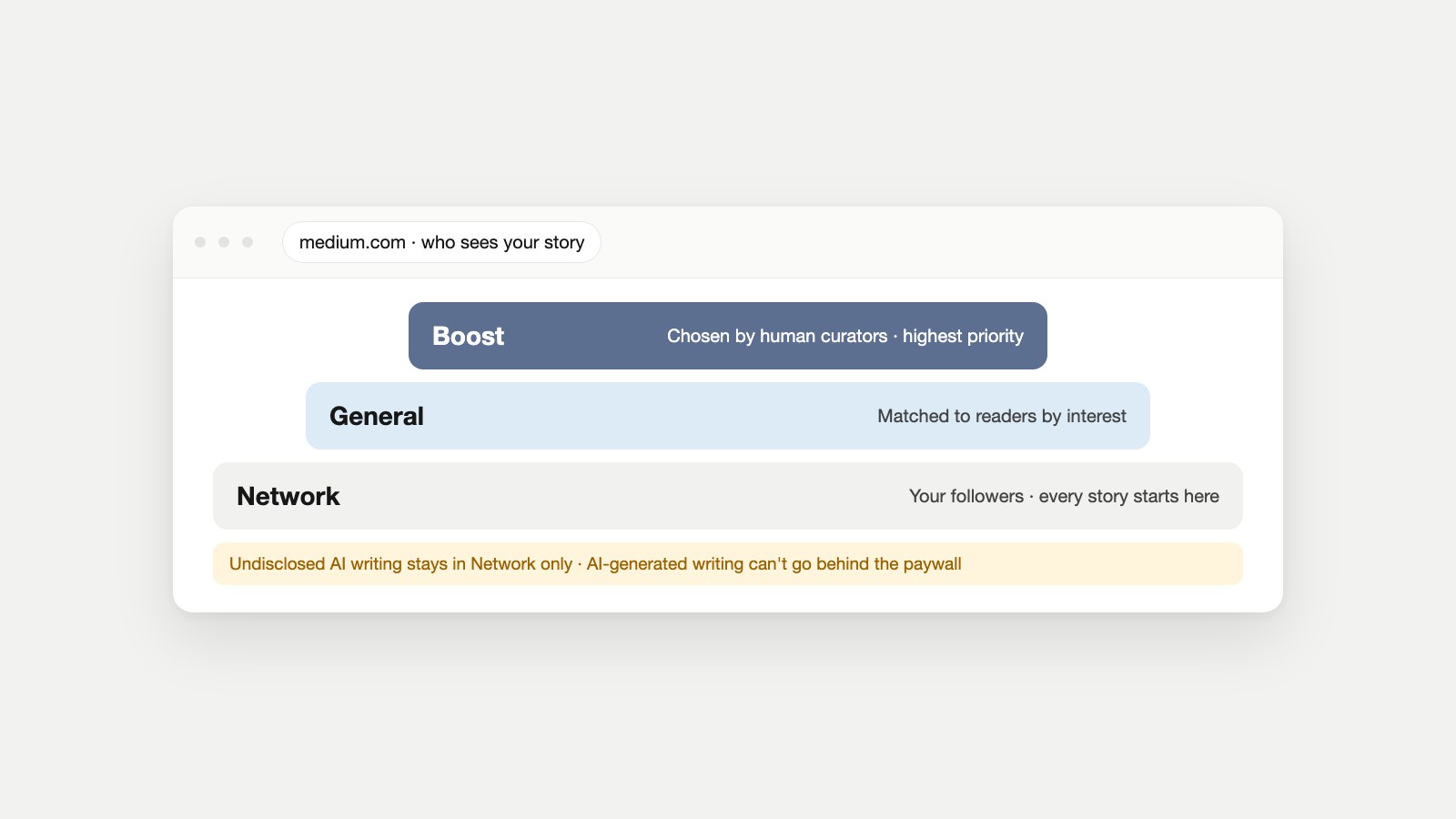
- Every Medium story reaches your followers (Network distribution). Stories matched to interested readers get General distribution, and a curated few get Boost, which human curators choose.
- Curators look for first-hand experience, real value to the reader, a fresh angle and good craft. A story must be human-created to be Boosted.
- AI rules are strict: AI-generated writing can't be paywalled, and any AI-written or AI-assisted text has to be disclosed, or the story stays with your followers only.
- The Partner Program pays from paying members' reading time and engagement, with bonuses for Boosted stories and for readers who arrive from outside Medium, including search.
One Story, Start to Finish
To keep this practical, we'll follow one example story. Dana is a freelance bookkeeper who has closed the year-end books for dozens of small cafés. She wants to write on Medium to find clients and, ideally, earn something from it. Her first idea is "10 Bookkeeping Tips for Small Businesses". By the end of this guide, it will be "The Five Receipts Every Café Loses in December (and What They Cost at Tax Time)", and the reasons for each change are the rules of writing for Medium.
How Medium Decides Who Sees Your Story
Medium's distribution guidelines put every story into one of three levels:
| Level | Who sees it | How a story gets there |
|---|---|---|
| Network | Your followers, and the publication's followers if it's in one | The baseline for any story that doesn't break Medium's rules |
| General | Readers matched by their interests and the writers and publications they follow | Matched by Medium's systems; also gets Network distribution |
| Boost | Higher priority across the homepage, emails and apps | Chosen by Medium's human curators, who review stories seven days a week |
These levels only affect discovery inside Medium. Anyone can still reach any story through a direct link, a search engine or social media, which matters for earnings, as you'll see below.
What Medium's Curators Look For
Medium's Boost guidelines describe the hallmarks of stories it's "especially proud to put in front of Medium readers." They're not a checklist, but they explain most decisions:
- The writer's experience. There's a clear reason this person is writing about this topic, with credible, first-hand experience. Medium says this matters more than credentials.
- Value and impact. The reader's life is better for reading it: they learn a skill or think about it days later.
- Respect for the reader. It doesn't read like a sales pitch or a bid for attention.
- Non-derivative. It brings a fresh perspective instead of rehashing what's easy to find elsewhere.
- Craft. Well written, free of errors, properly sourced, and the right length for its purpose. Images add value, with ALT text.
This is why Dana drops "10 Bookkeeping Tips". Thousands of near-identical lists exist, and nothing in it needs her. "The Five Receipts Every Café Loses in December" can only be written by someone who has closed those books, and it's useful to a specific reader.
Medium's Rules on AI Writing
Medium states it plainly in its AI content policy: "Medium is for human storytelling, not AI generated writing." The details matter if you use any AI tools:
| How you use AI | Allowed? | What happens |
|---|---|---|
| Spell, grammar or fact checks, or outlining | Yes | No disclosure needed |
| AI-assisted text (AI wrote some passages you kept) | Yes, if disclosed | Undisclosed: limited to Network distribution |
| AI-generated writing (mostly AI, little editing) | Only if disclosed, and never behind the paywall | Can't earn through the Partner Program; enrollment can be revoked |
| AI-generated images | Yes | Must be captioned as AI-generated |
| AI rewrites of someone else's work | No | Treated as plagiarism |
Disclosure is simple: a sentence within the first two paragraphs, such as "This story was written with the assistance of an AI writing program," and a caption on any AI image. And remember the Boost guideline: a Boosted story must not appear to be generated by AI.
In practice, AI is best used around the writing, not instead of it: researching, checking facts, tightening a draft you wrote. If you use a drafting tool such as Medium Owl, which researches a topic, drafts a story and runs nine fixed checks on it, treat the draft as notes. Rewrite it in your own words with your own examples, disclose any AI-written passages you keep, and don't put AI-generated writing behind the paywall.
How to Write a Medium Story That Gets Read
- Start from something only you know. A mistake you made, a number you measured, a process you've repeated a hundred times. Dana's is the receipts her café clients lose every December.
- Write the headline as a promise you'll keep. Specific beats clever. Medium's earnings formula adjusts down stories whose members click but don't read, so a headline that overpromises costs you money as well as trust.
- Use the subtitle to say who it's for. "For café owners who dread January: the receipts that go missing and how to catch them."
- Open with the moment, not the background. Dana opens with a café owner emptying a shoebox of crumpled receipts on her desk on January 3rd.
- Give each section one job, with a subheading a skimmer can follow. Short paragraphs read better on phones.
- Show your evidence. Link sources at the claim, and label examples as examples. Medium's AI policy specifically bans easily disprovable invented statistics.
- Add images that carry information, such as a photo, a chart or a checklist, each with ALT text and a caption. Our guide to image SEO covers writing good alt text.
- End with something the reader can do today. Dana closes with a one-page December receipt checklist.
Publishing: Tags, Publications and Timing
Before you publish, add tags for the topics your readers follow, starting with the most specific ("Small Business Accounting" rather than just "Business"). Tags tell readers and Medium what the story is about, so pick the ones your readers actually follow.
Consider submitting to a publication that covers your topic. A publication's editors can improve your story, and accepted stories also reach the publication's followers through Network distribution. Read each publication's submission guidelines first, since many have their own rules on length, format and how often you can submit.
If the story first appeared on your own blog, you can republish it on Medium; the Boost guidelines say syndicating your own work "is a great idea." Republished translations aren't eligible for Boost, though.
How the Medium Partner Program Pays Writers
To earn, you join the Partner Program. According to Medium's enrollment guide, you need an active Medium membership, must be 18 or older, and must meet the eligibility requirements; there's no application review. Payouts need a connected Stripe account and tax information submitted through Tipalti.
Medium's earnings calculation is based on paying members' activity on your paywalled stories:
| Component | What it rewards |
|---|---|
| Member reading time | Time paying members spend reading or listening. A read counts after 30 seconds |
| Engagement points | Reading time combined with members' claps, highlights and replies |
| Boost bonus | Boosted stories earn engagement points at a higher rate |
| External traffic bonus | A 5% bonus on member reads from outside Medium, with higher rates for readers from search engines and from email notifications |
| New member conversions | A one-time amount when someone becomes a paying member to read your story |
| Member read ratio adjustment | Up or down depending on how many members who open the story actually read it |
The takeaway for Dana: earnings follow real reading by paying members. A story that a small, specific audience reads to the end, and that people find through Google or her newsletter, can earn more than a viral headline that people abandon.
Getting Read Outside Medium
Because external readers earn a bonus and distribution levels don't affect direct links, promotion is part of writing for Medium:
- Share it where your readers already are. Dana posts a short version on LinkedIn with the link. Our guide to formatting LinkedIn posts covers how to make that post readable.
- Turn on email notifications when you publish, so subscribers get the story in their inbox.
- Write a headline people would search for. Medium stories can rank in Google, and readers from search earn at a higher rate. Our guide to writing meta titles applies here too.
- Check the preview card before you share, so the image and title show properly. The free Open Graph Checker shows what LinkedIn, X and Slack will display.
- Tag your links with the UTM Builder when you link from Medium to your own site, so you can see which stories send visitors.
Mistakes New Medium Writers Make
- Writing what anyone could write. Generic tips compete with thousands of near-identical stories and give curators no reason to Boost them. Start from your own work.
- A headline the story doesn't deliver. It may win the click, but Medium's read ratio adjustment lowers earnings when members open a story and don't read it.
- Pasting an AI draft as it is. Undisclosed AI writing stays with your followers, AI-generated writing can't be paywalled, and the Boost guidelines ask for human-created stories.
- Unsourced numbers. Medium's AI policy specifically bans easily disprovable invented statistics, and readers stop trusting a writer quickly when figures don't check out.
- Opening with background. Readers decide early whether to keep going; start with the moment, the problem or the result.
- Publishing and walking away. Readers from outside Medium earn more, so share the story where your audience already reads and turn on email notifications.
- Writing about everything. Readers follow writers for a subject. A clear focus, like Dana's bookkeeping for cafés, makes each new story easier to recommend to the right people.
Your Pre-Publish Checklist
- The topic comes from your own experience, and the story says so early.
- The headline is specific and the story delivers exactly what it promises.
- The subtitle names the reader.
- Every claim and number has a source, and examples are labelled.
- Images add information and have ALT text and captions; AI images are captioned as AI.
- Any AI-written passages you kept are disclosed in the first two paragraphs, and AI-generated writing is not paywalled.
- Tags are specific, and you've checked whether a publication fits.
- You know where you'll share it, and email notifications are on.
Writing for Medium: Common Questions
How do I start writing on Medium?
Create an account, click Write, and publish your first story on a topic you know first-hand. Every story gets Network distribution to your followers; quality and curation decide how much further it goes.
How do I get Boosted on Medium?
Write from real experience, deliver real value, bring a fresh angle and edit carefully. Boost is chosen by Medium's human curators, and the story must be human-created rather than AI-generated.
Can I use AI to write on Medium?
You can use AI for spelling, grammar, outlines and fact checks without disclosure. AI-written or AI-assisted text must be disclosed, and AI-generated writing can't be paywalled in the Partner Program.
How much do Medium writers make?
It varies widely. Earnings depend on how long paying members read your paywalled stories, their engagement, Boost, and bonuses for external and search traffic. Medium doesn't pay per view.
Do I need to be a Medium member to earn?
Yes. The Partner Program requires an active Medium membership, being 18 or older, and connected Stripe and tax details for payouts.
Can I republish my blog posts on Medium?
Yes. Medium's guidelines encourage syndicating your own work. Republished translations aren't eligible for Boost.
Do publications help on Medium?
Often. A publication's editors can improve a story, and accepted stories also reach the publication's followers. Follow each publication's own submission rules.
How long should a Medium story be?
As long as it needs to be. Medium's guidelines say well-crafted stories can be short or long, as long as the length serves the story.
Medium Help Center Pages Used
- Medium's Distribution Guidelines: how curators review stories for Boost, General and Network distribution, Medium Help Center, updated June 29, 2026.
- Artificial Intelligence (AI) content policy, Medium Help Center.
- Enroll in the Medium Partner Program, Medium Help Center.
- Medium Partner Program earnings calculation, Medium Help Center.
- Creating helpful, reliable, people-first content, Google Search Central.
- Alternative text, WebAIM.