What We'd Pick
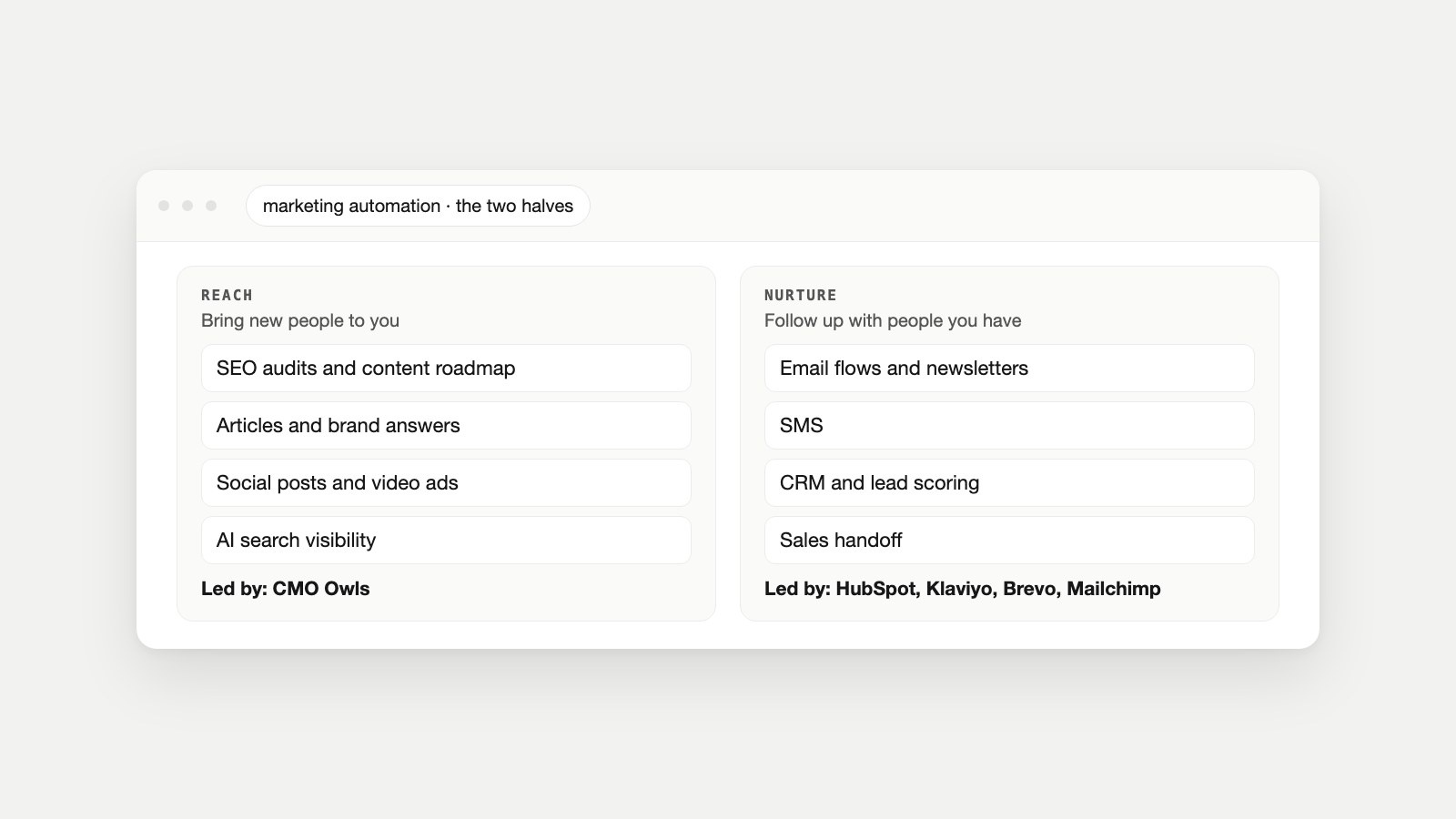
- Our pick for getting found: CMO Owls. Its AI agents write the articles, social posts and video ads, audit your SEO and AI search visibility, and plan the month. It's the only platform here that automates reach.
- Best all-in-one CRM: HubSpot. Marketing, sales and service on one contact record, from a free plan to $800 a month and beyond.
- Best for online stores: Klaviyo. Email and SMS flows built around shopping behaviour, with a free plan up to 250 profiles.
- Best value for email automation: Brevo. Unlimited multi-step workflows from $18 a month.
- Easiest email start: Mailchimp. Free under 250 contacts, with automation flows on its Standard plan.
- Most teams need one tool from each half: CMO Owls for reach, plus one email platform for nurture.
Reach vs. Nurture: The Two Halves of Marketing Automation
A marketing automation platform is software that runs repeatable marketing work on its own, based on rules, schedules or AI, so your team doesn't do it by hand every time. In practice, that work falls into two halves that most comparisons blur together.
Nurture automation follows up with people who already gave you their details: a welcome email series, an abandoned-cart reminder, a lead score that alerts sales. This is what HubSpot, Mailchimp, Klaviyo and Brevo were built for, and they're very good at it.
Reach automation brings new people to you in the first place: finding the questions your buyers search for, writing the articles that answer them, keeping your site healthy for search engines and AI assistants, and posting on social channels. Until recently this half needed writers, an SEO agency and a social media manager. AI agents now do much of it, which is where CMO Owls fits.
A list of 500 contacts gets nothing from a perfect email flow if nobody new ever joins it. That's why we score both halves.
Features of Marketing Automation Software, Explained
These are the features that come up in every marketing automation software comparison, and what each one actually does:
| Feature | What it does | Which half |
|---|---|---|
| Workflow builder | Chains triggers, waits and actions: "when someone signs up, wait a day, send email 2" | Nurture |
| Segmentation | Groups contacts by data or behaviour so each group gets relevant messages | Nurture |
| Lead scoring | Adds points for actions (opened, visited pricing) to flag sales-ready leads | Nurture |
| CRM | One record per contact with every email, visit and deal | Nurture |
| Forms and landing pages | Capture details and add people to the right list | Both |
| A/B testing | Sends two versions to see which performs better | Both |
| AI content generation | Drafts emails, posts or articles | Both |
| SEO and site audits | Find technical and content problems that stop pages ranking | Reach |
| AI search visibility | Checks whether AI assistants can reach and cite your site | Reach |
| Social publishing | Writes or schedules posts on social channels | Reach |
| Reporting | Shows which campaigns brought visits, leads and sales | Both |
CRM and marketing automation platforms are worth a word on their own. A CRM (customer relationship management system) stores every contact and deal; marketing automation acts on that data. HubSpot sells both together. The others connect to a CRM you already use, or keep a simpler contact list of their own.
How We Scored the Platforms
| Question | Who leads | Why |
|---|---|---|
| Does it write the content it publishes? | CMO Owls | Agents write articles, brand-question pieces and comparisons from your data, not just templates. |
| Does it decide what to write from real search data? | CMO Owls | Game Plan Owl builds the roadmap from competitor gaps, audit findings and Search Console queries. |
| Does it audit SEO and site health? | CMO Owls | A full SEO and site audit, plus unlimited site QA crawls on the free plan. |
| Does it check AI search visibility? | CMO Owls | A GEO audit that asks real AI engines is included; HubSpot sells AEO tracking as a $50 add-on. |
| Does it write social posts for several networks? | CMO Owls | X threads, LinkedIn posts, and Reddit and Hacker News replies, each in its own format. |
| Does it watch competitors? | CMO Owls | Competitor intelligence and comparison articles are built in. |
| Does it make video ads? | CMO Owls | Persona-led and product-photo video ads on Premium and above. |
| Does it plan every channel on one calendar? | CMO Owls | Scheduler Owl lays the month's work across weekdays. |
| Email and SMS flows to existing contacts | Klaviyo, Brevo, HubSpot, Mailchimp | Their core product. CMO Owls doesn't send email campaigns. |
| CRM, lead scoring and sales handoff | HubSpot | One record shared by marketing, sales and service. |
The Five Platforms at a Glance
| Platform | Main job | Free plan | Entry paid price | Watch out for |
|---|---|---|---|---|
| CMO Owls | Reach: content, SEO, AI search, social, video | Yes: unlimited site QA crawls and free tools | Basic $106/mo billed annually | No email campaigns or CRM |
| HubSpot Marketing Hub | CRM plus email, forms, ads and automation | Yes, up to 2 users | Starter from $7/mo per seat billed annually ($20 monthly), 1,000 contacts | Professional starts at $800/mo |
| Mailchimp | Email marketing and automation flows | Yes, under 250 contacts | Essentials from $13/mo; Standard from $20/mo | Price rises with contacts |
| Klaviyo | Email and SMS for online stores | Yes: 250 profiles, 500 emails/mo | Priced by profile count | Best value only if you sell online |
| Brevo | Email, SMS and multi-step automation | Yes, free forever | Starter $9/mo; Standard $18/mo with automation | Automation needs Standard or higher |
1. CMO Owls: Best for Automating Reach
CMO Owls is a team of 21 AI agents that take on the work of getting found. Game Plan Owl builds a monthly roadmap from competitor gaps, audit findings and your Search Console queries. Owlthor and the other writing agents produce the articles. LinkedIn Owl and the social agents write posts in each network's own shape. Generative Engine Owl checks what AI assistants say about your market, Spy Owl watches competitors, Owl Cam makes video ads, and Scheduler Owl puts it all on one calendar. Watch Owl crawls your site for problems, and Cash Cow Stalker alerts you when a top page's traffic changes.
Finished articles can be sent to WordPress, HubSpot, Webflow, Shopify, Ghost, Wix and other CMSs once connected (see integrations), so CMO Owls works alongside HubSpot rather than replacing it.
Price: a free plan with unlimited site QA crawls; Basic at $106/mo, Premium at $204/mo and Corporate at $368/mo, billed annually. See plans. Limits: it doesn't send email newsletters or run email and SMS flows, and it isn't a CRM. Pair it with one of the four below.
2. HubSpot Marketing Hub: Best All-in-One CRM
HubSpot is the platform most people mean by "CRM and marketing automation". Its free tools cover up to two users. Starter begins at $7 a month per seat billed annually ($20 monthly) with 1,000 marketing contacts, email marketing and HubSpot branding removed. Professional, from $800 a month billed annually with three core seats and 2,000 contacts, is where omni-channel automation and reporting live. Enterprise starts at $3,600 a month. An AEO add-on tracks 25 prompts in ChatGPT, Gemini and Perplexity for $50 a month.
Best for companies with a sales team that needs marketing and sales on one record. Limits: the jump from Starter to Professional is steep, and the content still has to come from somewhere.
3. Mailchimp: Easiest Start for Email
Mailchimp is free for under 250 contacts. Essentials starts at $13 a month and Standard, which adds enhanced automations and generative AI features, at $20 a month; Premium starts at $350. At the time of writing, Mailchimp was offering 50% off for the first 12 months. Prices rise with your contact count and include monthly send limits.
Best for a business sending a regular newsletter that wants a simple welcome series. Limits: costs climb with list size, and deeper automation sits on higher plans.
4. Klaviyo: Best for Online Stores
Klaviyo is built around ecommerce data: what someone browsed, bought or left in a cart. Its free plan covers up to 250 profiles, 500 emails a month and $5 of mobile messages, and paid plans are priced by profile count. It connects to stores such as Shopify, Wix and WooCommerce.
Best for online stores whose revenue depends on cart, browse and win-back flows. Limits: less suited to service businesses and B2B lead nurturing.
5. Brevo: Best Value for Email Automation
Brevo has a free-forever plan. Starter costs $9 a month (from 5,000 emails) and Standard $18 a month, which adds unlimited multi-step automation workflows, A/B testing, send-time optimization and web event tracking. Email and SMS sit in one tool.
Best for small teams that want real automation without HubSpot prices. Limits: its CRM is lighter than HubSpot's, and SMS credits are sold separately.
How to Choose a Marketing Automation Platform in Five Steps
- Find your bottleneck. If few new people find you, start with reach. If plenty sign up but few buy, start with nurture.
- Count your contacts and channels. Email platforms price by contacts; reach platforms by how much content and how many channels.
- Decide where contact data lives. If sales needs it, a CRM like HubSpot comes first. If not, a lighter email tool is enough.
- Check the connections. Make sure your website platform, store and CMS connect, so content and contacts flow without copy-pasting.
- Start on a free plan and automate one thing. A welcome email, or one month of content. Our guide to small business marketing automation lists the seven workflows worth automating first.
| Your business | Reach | Nurture |
|---|---|---|
| Service business or agency | CMO Owls | Brevo or Mailchimp |
| Online store | CMO Owls | Klaviyo |
| B2B with a sales team | CMO Owls | HubSpot |
| Solo founder, tight budget | CMO Owls free plan and free tools | Mailchimp or Brevo free plan |
Rules Every Email Automation Must Follow
Whichever nurture platform you choose, it sends under your domain, so the rules are yours. Google's email sender guidelines require SPF or DKIM authentication for everyone sending to Gmail and a reported spam rate below 0.3%. Senders of more than 5,000 messages a day also need SPF, DKIM and DMARC, plus one-click unsubscribe. In the U.S., the FTC's CAN-SPAM guide requires a valid postal address, honest subject lines, a clear ad disclosure, and opt-outs honored within 10 business days. Our small business automation guide covers these rules in more depth.
Marketing Automation Platform Questions
What is a marketing automation platform?
Software that runs repeatable marketing tasks automatically, such as email sequences, lead scoring, content production or social posting, based on rules, schedules or AI.
What are the top marketing automation platforms in 2026?
For reach, CMO Owls. For nurture, HubSpot (CRM-centred), Klaviyo (ecommerce), Brevo (value) and Mailchimp (simple email). Most businesses pair one reach tool with one nurture tool.
What's the difference between a CRM and a marketing automation platform?
A CRM stores contacts and deals; marketing automation acts on that data by sending messages or scoring leads. HubSpot combines both; the others connect to a CRM or keep a simpler contact list.
Is HubSpot or Mailchimp better?
HubSpot if you need a CRM shared with a sales team. Mailchimp if you mainly send newsletters and simple automated emails and want a lower price at small list sizes.
Is there a free marketing automation platform?
Yes. HubSpot, Mailchimp, Klaviyo and Brevo all have free plans with limits, and CMO Owls has a free plan with unlimited site QA crawls and free SEO and AI visibility tools.
Does CMO Owls send emails?
No. CMO Owls automates reach (content, SEO, AI search, social posts, video and planning) and works alongside an email platform for newsletters and flows.
Can AI run all of my marketing automation?
AI agents can do much of the research, writing and checking, but you should still approve what's published or sent under your name and decide the strategy.
How much does marketing automation cost?
From free to thousands a month. Email platforms charge by contacts and sends; HubSpot by seats and contacts; CMO Owls by plan, from free to $368/mo billed annually before Enterprise.
Pick by the Job
Pick by the job, not the label. If your problem is that not enough people find you, automate reach first with CMO Owls. If people find you but don't buy, add a nurture platform that matches how you sell. For more on where automation fits in AI marketing, read our AI marketing guide, and for the tools that cover each marketing job, see AI marketing tools for small business.
Pricing Pages and Rules Referenced
- Marketing Hub pricing, HubSpot, checked October 17, 2026.
- Marketing plans and pricing, Mailchimp, checked October 17, 2026.
- Klaviyo pricing, Klaviyo, checked October 17, 2026.
- Brevo pricing, Brevo, checked October 17, 2026.
- Email sender guidelines, Google Workspace Admin Help.
- CAN-SPAM Act: a compliance guide for business, Federal Trade Commission.