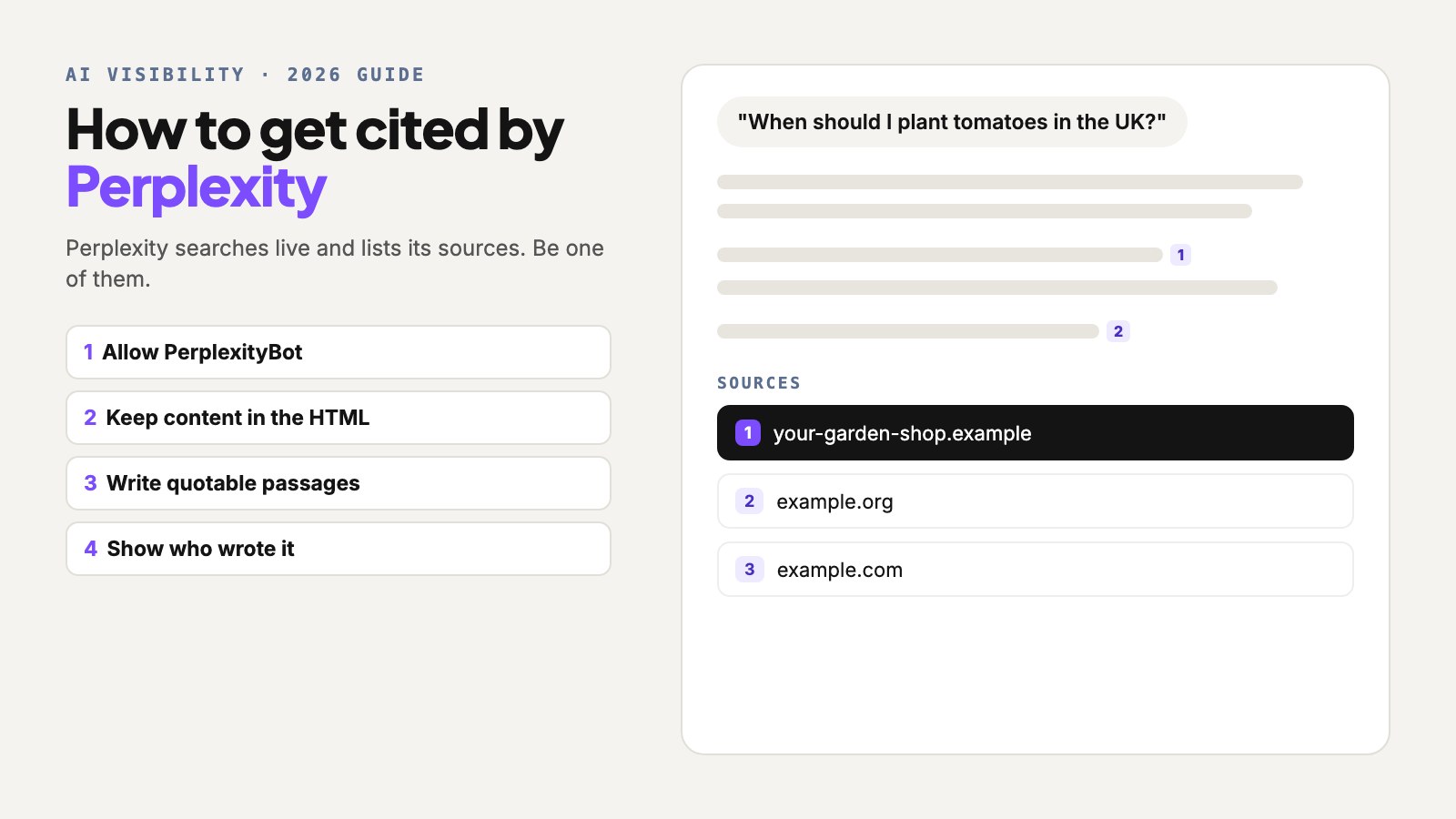
Perplexity answers questions by searching the web live and listing its sources under every answer. That makes it one of the few AI assistants where a citation is visible and clickable, and where a small site can appear next to big ones. This guide explains how to get cited by Perplexity: the crawler you must allow, how to write pages it can quote, the trust signals it reviews, and how to tell whether it's working.
Key Takeaways
- Allow PerplexityBot in robots.txt and at your CDN. Perplexity says it's the crawler that helps sites appear in its results, and it isn't used to train AI models.
- Put your content in plain HTML. A 2024 study by Vercel found PerplexityBot doesn't run JavaScript, so content that only appears after scripts load is invisible to it.
- Write passages worth quoting: a direct answer first, then specific facts, numbers and sources. In the GEO study's Perplexity tests, adding quotations gave the biggest boost.
- Show you're trustworthy: Perplexity's source reviews ask whether a site corrects mistakes, names its authors and keeps news separate from advertising.
- Measure visits from perplexity.ai in your analytics and check a set of real questions each month.
How Perplexity Picks Its Sources
Perplexity searches the internet in real time for each question, then writes an answer with numbered citations to the pages it used. Its help article on how Perplexity works describes it as using AI "to search the internet in real-time," and every answer lists the sources behind it.
Perplexity doesn't publish a ranking formula, so be wary of anyone who claims to know one. What it does publish is useful: which crawler to allow, and the questions it asks when it reviews a source. Everything else in this guide follows from those, plus the research on what makes content quotable.
| Category | Perplexity | ChatGPT search | Google AI Overviews |
|---|---|---|---|
| Crawler to allow | PerplexityBot | OAI-SearchBot | Googlebot |
| Sources shown | Numbered citations on every answer | Inline links and a sources list | Supporting links beside the summary |
| Runs JavaScript? | No (Vercel study, 2024) | No (Vercel study, 2024) | Yes, Googlebot renders |
| Our guide | This one | Getting recommended by ChatGPT | Ranking in AI Overviews |
Step One: Let PerplexityBot In
If PerplexityBot can't crawl your site, Perplexity can't cite you from its own index. Perplexity's crawler documentation says PerplexityBot helps websites show up and get linked in its results and "is not used to crawl content for AI foundation models." It recommends allowing PerplexityBot in robots.txt and allowing its published IP ranges at your firewall.
There's a second agent, Perplexity-User, which fetches a page when a person asks a question about it. Perplexity says it "generally ignores robots.txt rules" because a user triggered it, and that it isn't used for crawling or training.
| User agent | What it does | Follows robots.txt? |
|---|---|---|
| PerplexityBot | Crawls pages so they can appear and be linked in Perplexity's results | Yes; allow it if you want to be cited |
| Perplexity-User | Fetches a page when a user's question needs it | Generally no, per Perplexity |
Check your setup with our free AI Crawler Access Test, which shows what your robots.txt and server return to each AI crawler. If you need to change the file, our robots.txt generator writes one that allows search crawlers. Our AI crawler guide lists the other bots worth knowing.
A note on the crawling dispute
In August 2025 Cloudflare published claims that Perplexity used undeclared crawlers to get around sites that had blocked it. Perplexity disputed this the same day, arguing that the traffic came from user-requested fetches and that some was misattributed. You don't need to settle that argument to act: if you want citations, allow PerplexityBot; if you don't, block it and ask your CDN about its bot controls.
Step Two: Make Sure Your Content Is in the HTML
PerplexityBot reads the HTML your server sends and doesn't run JavaScript, so anything that only appears after scripts load is invisible to it. A December 2024 study by Vercel and MERJ found that PerplexityBot, like OpenAI's and Anthropic's crawlers, doesn't render JavaScript.
The quick test: open a page, choose "View page source" and search for a sentence from your main content. If it isn't there, crawlers can't see it. Our deep-dive on why AI crawlers can't see JavaScript sites explains the fixes, from server rendering to static pages.
Step Three: Write Passages Perplexity Can Quote
Perplexity quotes short passages, so each section should answer one question completely in its first two sentences, then back it up. The original GEO study by Pranjal Aggarwal and colleagues (KDD 2024) tested content changes on a generative engine and then on Perplexity itself. Adding quotations, statistics and source citations raised visibility, and on Perplexity adding quotations from credible sources produced the largest gain. Keyword stuffing did worse than making no change.
Practical habits that follow:
- Lead with the answer. "A heat pump costs more to install than a gas boiler but less to run" beats three sentences of background.
- Use specific numbers with a source. "Prices rose 12% between 2024 and 2026, according to [source]" is more quotable than "prices have risen."
- Quote named experts or official documents where you can, word for word, with a link.
- Keep one idea per paragraph and use tables for comparisons, so a single passage stands on its own.
- Date your pages. Perplexity searches live, and a visible updated date helps a reader trust that the facts are current.
CMO Owls' Owlthor writes articles in this answer-first shape, with sources, for the questions your audit shows you're missing from.
Step Four: Earn the Trust Signals Perplexity Reviews
Perplexity reviews some sources and labels them Government, Academic or Trusted, based on whether the site behaves like a reliable publisher. Its help article on source labels lists the review questions: "Does the site correct its mistakes?", "Does it say who wrote each piece?" and "Does it keep news separate from advertising and opinion?" It also says "partnerships, payments, and other business arrangements do not affect a site's label."
Labels are a separate process from everyday citations, but the same habits make any page more citable:
- Add a byline and an author page to every article, saying who wrote it and why they know the subject.
- Publish a corrections note when you fix a factual error, and keep an updated date on the page.
- Separate sales pages from advice. Label sponsored content and keep product pitches out of how-to guides.
- Earn mentions elsewhere. Honest answers in communities such as Reddit, reviews and articles that mention you give AI systems independent evidence. Reddit Owl finds threads where you can genuinely help.
Google's guidance on helpful, people-first content asks similar questions about who wrote a page and why, so this work helps your search rankings too.
Worked Example: A Garden Supplies Shop
Here's how the steps play out for one business. The shop and numbers are an EXAMPLE.
An online garden supplies shop wants to be cited when people ask Perplexity "what's the best time to plant tomatoes in the UK?"
- Access: the access test shows its CDN's bot setting blocks PerplexityBot. They allow it.
- HTML: its planting guides load from a JavaScript widget. They move the guide text into the page itself.
- Quotable: they rewrite the guide's opening as a direct answer with dates by region, cite the Royal Horticultural Society, and add a table of planting months.
- Trust: they add the head gardener's name and experience to every guide, plus an updated date.
A month later they ask the same question in Perplexity and check whether the guide is cited, and look for perplexity.ai in their analytics referrals. There's no guaranteed timeline, so they keep checking monthly.
Tracking Your Perplexity Citations
Track two things: visits that come from Perplexity, and whether Perplexity cites you for your key questions.
- Referrals: in Google Analytics, visits from Perplexity appear with perplexity.ai as the source. Google's help on traffic-source dimensions explains where to find it. Tag links you share yourself with our UTM builder so you can tell them apart.
- Citations: ask Perplexity 10 to 20 real customer questions each month and record whether you're cited, for which page, and who else appears. Our guide on checking AI visibility walks through the method.
CMO Owls' Generative Engine Owl automates this for ChatGPT, Gemini, Claude and Google AI Overviews in each paid audit; Perplexity is still a by-hand check there, so keep your monthly question list. For how this fits with the rest of your SEO, see GEO vs SEO.
Which Pages to Optimise First
Start with the pages that answer the questions your buyers ask Perplexity, not your homepage. People use Perplexity to research: comparisons, how-tos, prices and "is X worth it" questions. Those are the pages most likely to be cited.
- Pricing and plans pages. "How much does X cost" is one of the most common questions. A clear, text-based price list is easy to quote.
- Comparison pages. "X vs Y" and "alternatives to X" questions are research by definition. An honest comparison with a table gives Perplexity a ready answer.
- How-to guides in your niche. Step-by-step answers with specific numbers are the passages the GEO study found most quotable.
- Your About page. When someone asks who you are, Perplexity needs a plain description of what you do, where and since when.
Leave thin category pages and old news posts until last. One well-sourced guide is worth more than ten pages that say the same thing in different words.
Mistakes That Keep Sites Out of Perplexity
- Blocking every AI bot at once. A blanket "block AI crawlers" setting stops PerplexityBot too. Decide per bot.
- Hiding answers behind JavaScript, tabs or logins. If the crawler can't read it, it can't quote it.
- Writing vague, unsourced copy. Passages without specific facts give Perplexity nothing worth citing.
- Expecting payment to help. Perplexity says business arrangements don't affect its source labels.
Perplexity Citation Questions
How do I get my website cited by Perplexity?
Allow PerplexityBot to crawl your site, make sure your content is in the page HTML rather than loaded by JavaScript, and write answer-first passages with specific facts and sources. Then track citations and perplexity.ai referrals monthly.
What is PerplexityBot?
It's Perplexity's crawler. Perplexity says it helps sites appear and get linked in its results and isn't used to train AI models.
Does blocking PerplexityBot stop Perplexity from using my site?
It stops PerplexityBot from crawling it. Perplexity-User, which fetches pages when a user asks, generally ignores robots.txt according to Perplexity, so use your CDN's bot controls if you want a firmer block.
Does Perplexity read JavaScript?
A 2024 study by Vercel found PerplexityBot doesn't run JavaScript. Keep important content in the HTML your server sends.
Can I pay Perplexity to cite my site?
Perplexity says partnerships and payments don't affect its source labels. Citations come from your content and reputation, not a fee.
How long does it take to get cited by Perplexity?
There's no fixed timeline. Because Perplexity searches live, a well-structured page that it can crawl may appear quickly, but check monthly and expect it to vary.
How do I see traffic from Perplexity?
Look for perplexity.ai as a referral source in Google Analytics, and compare it month to month.
Start With Access
Run the free AI Crawler Access Test now to see whether PerplexityBot can reach your site. If it can, rewrite your three most important pages answer-first with sources. When you want the rest of your AI visibility measured and fixed, compare CMO Owls plans.
Sources
- Perplexity crawlers, Perplexity, 2026.
- How does Perplexity work?, Perplexity Help Center, 2026.
- Understanding source labels, Perplexity Help Center, 2026.
- Perplexity is using stealth, undeclared crawlers to evade website no-crawl directives, Cloudflare, 2025.
- Agents or bots? Making sense of AI on the open web, Perplexity, 2025.
- The rise of the AI crawler, Vercel, 2024.
- GEO: Generative Engine Optimization, Aggarwal et al., KDD 2024.
- Traffic-source dimensions, manual tagging, and auto-tagging, Google Analytics Help, 2026.
- Creating helpful, reliable, people-first content, Google Search Central, 2026.