Key Takeaways
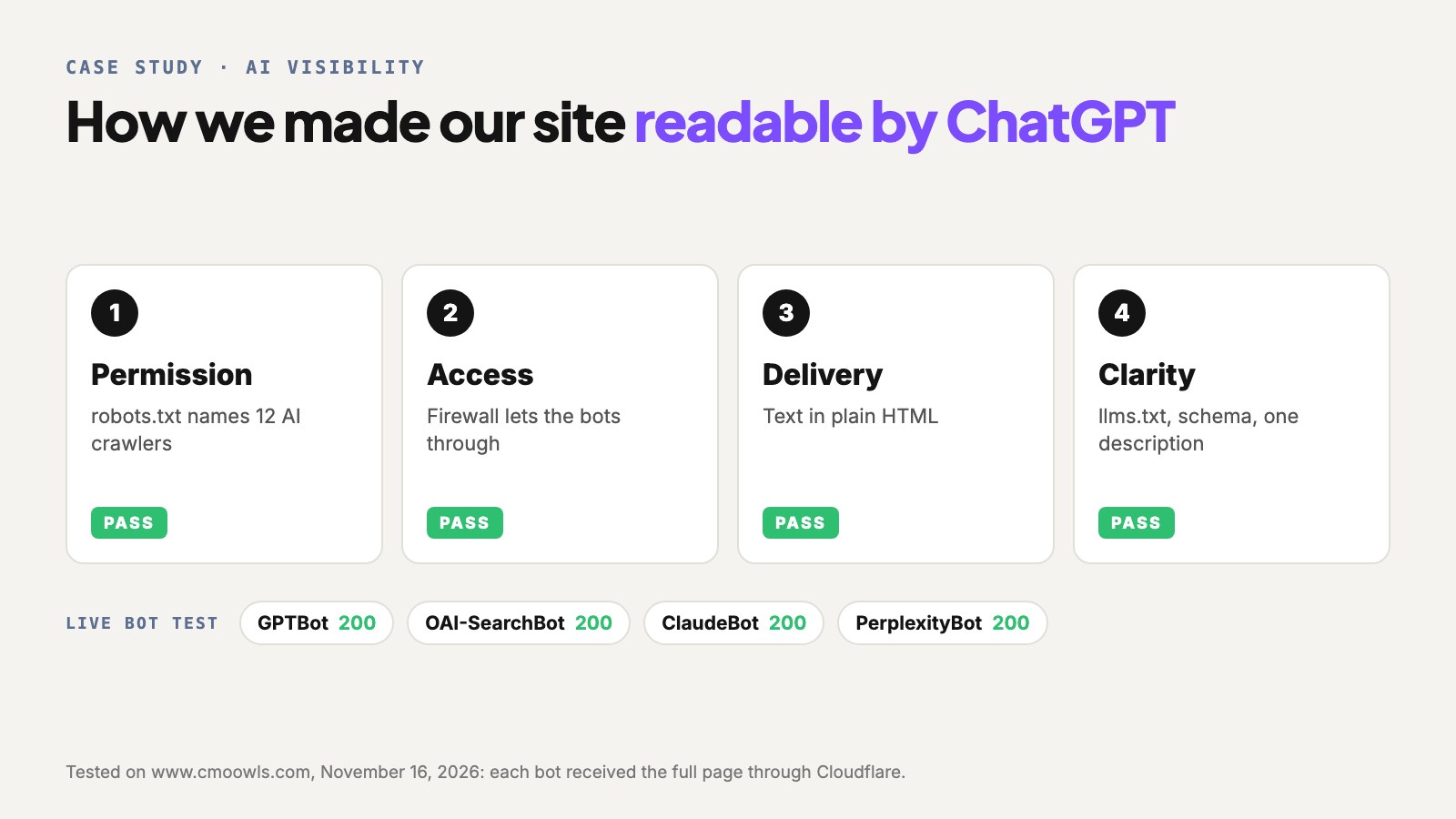
- For an AI assistant to cite a website, it has to pass four gates: permission (robots.txt), access (firewall and CDN), delivery (text in the HTML) and clarity (content and structured data it can understand).
- On November 16, 2026, GPTBot, OAI-SearchBot, ClaudeBot and PerplexityBot all received our real pages through Cloudflare. All four technical gates pass.
- We name 12 AI crawlers in robots.txt, publish an 18 KB llms.txt file and add BlogPosting, FAQPage and BreadcrumbList schema to every article.
- The gaps are honest ones: two newer Anthropic crawlers aren't named yet, and the off-site trust that gets a brand recommended takes far longer than ten weeks to build.
Why We Wrote This Case Study
We help small businesses get found by AI assistants, so our own site has to be the proof. This AI visibility case study shows the exact setup on cmoowls.com, with every file and test result, so you can copy what works and skip what doesn't.
If you want the method for checking your own site, start with our guide on how to check your AI visibility. This article is the worked example: one real SaaS site, ten weeks old, set up deliberately for ChatGPT, Claude, Perplexity and Google's AI features.
The Four Gates Every Site Must Pass
An AI assistant can only cite what it can reach, load and understand. Each gate depends on the one before it, so a failure early on makes everything after it irrelevant.
| Gate | Question | Our setup | Status |
|---|---|---|---|
| 1. Permission | Does robots.txt allow the AI crawlers? | 12 AI crawlers named and allowed | Pass |
| 2. Access | Does the firewall or CDN let them through? | Cloudflare serves real pages to all four tested bots | Pass |
| 3. Delivery | Is the text in the HTML, without JavaScript? | Static HTML pages; about 2,000 words of homepage text in the raw source | Pass |
| 4. Clarity | Can the AI understand who we are and what a page says? | llms.txt, schema, one consistent description | Pass, with gaps |
Gate 1: Permission in robots.txt
We list every major AI crawler by name and give it the same rules as everyone else. Our robots.txt only blocks private areas: the login page, the dashboard, a few URL parameters and our internal tool API.
The robots.txt standard, formalised as RFC 9309, lets a site give different rules to different crawlers. A general block for all crawlers would already allow the AI bots, but we name them anyway, for two reasons. It makes our decision explicit and easy to audit, and it protects us if someone later adds a stricter general rule without thinking about AI search.
The crawlers we name are GPTBot, ChatGPT-User and OAI-SearchBot from OpenAI; ClaudeBot, Claude-Web and anthropic-ai associated with Anthropic; PerplexityBot and Perplexity-User; Google-Extended; Amazonbot; cohere-ai; and CCBot from Common Crawl. Each company documents its own bots, and they do different jobs:
| Crawler | Company | Job |
|---|---|---|
| OAI-SearchBot | OpenAI | Finds pages to show in ChatGPT search |
| GPTBot | OpenAI | Collects content that may be used to train models |
| ChatGPT-User | OpenAI | Visits a page when a ChatGPT user's request needs it |
| ClaudeBot | Anthropic | Collects content for model development |
| Claude-SearchBot | Anthropic | Improves Claude's search results |
| Claude-User | Anthropic | Fetches pages when a Claude user asks a question |
| PerplexityBot | Perplexity | Surfaces and links sites in Perplexity search; not used for training |
| Perplexity-User | Perplexity | Visits a page during a user's question |
Sources: OpenAI's crawler documentation, Anthropic's crawler help page and Perplexity's crawler documentation. OpenAI notes that robots.txt changes can take about 24 hours to affect its search results. Perplexity says Perplexity-User generally ignores robots.txt, because a person asked for the page.
The decision we made: we allow training crawlers as well as search crawlers. For a business that wants to be known, being part of what models learn about the category is worth more than keeping our marketing pages out of it. A publisher selling content would reasonably choose differently. Our Robots.txt Generator lets you make that choice per crawler.
The gap we found: Anthropic now documents Claude-SearchBot and Claude-User, and our file doesn't name them yet. They're still allowed, because our general rule covers every crawler, but naming them is on our list. The full background on these bots is in our guide to what an AI crawler is.
Gate 2: Access Through the Firewall
A welcoming robots.txt means nothing if your firewall blocks the bot at the door. That's the most common hidden failure we see.
Cloudflare announced on July 1, 2025 that it was changing its default to block AI crawlers unless site owners choose otherwise. Our site sits behind Cloudflare, so we tested what each bot actually receives. We requested a real article while identifying as GPTBot, OAI-SearchBot, ClaudeBot and PerplexityBot. All four received status 200 and the full page.
Our test has a limit. It checks that a request with the bot's name gets through, but a firewall can also verify real bots by IP address, which our test can't imitate. That's why we also look for real crawler visits in the server logs. You can run the same name-based test on your own site with the free AI Crawler Access Test.
Gate 3: Delivery in Plain HTML
Every important word on our site is in the HTML the server sends, before any JavaScript runs.
This matters more than most site owners realise. Vercel's analysis of its network in December 2024 found that major AI crawlers fetched JavaScript files but didn't execute them, so content that only appears after scripts run can be invisible to them. Our marketing site and blog are static HTML pages. Our homepage's raw source contains about 2,000 words of readable text, and every article is complete without scripts.
The interactive dashboard is the exception. It's a JavaScript app behind a login, and that's fine, because nothing there needs to be found. If your public pages are built with a JavaScript framework, read our guide on whether AI crawlers can render JavaScript.
We also make sure nothing tells crawlers to stay away. Every public page carries a robots meta tag that allows indexing and full-length snippets, and none sends a noindex header.
Gate 4: Clarity for Machines and People
Once a bot can read the page, it has to understand it. We help with three things: an llms.txt file, structured data and one consistent description.
llms.txt: a briefing for AI systems
llms.txt is a proposed standard: a plain text file at the root of a site that summarises what the site is and links to its most useful pages. Ours is 18 KB. It opens with a one-paragraph description, then lists the agents, free tools and key guides, each with a short explanation. No AI company has committed to reading it, so we treat it as a cheap bet rather than a ranking factor. Our guide to llms.txt explains the trade-offs, and the LLMs.txt Generator builds one for you.
Structured data on every page
Structured data is code that states facts about a page in a fixed format. Google explains how it uses it in its introduction to structured data. Our homepage declares an Organization (with links to our YouTube, TikTok, Instagram, X and GitHub profiles), a WebSite and a SoftwareApplication. Every article declares a BlogPosting, a BreadcrumbList and, when there is an FAQ, an FAQPage that matches the visible questions exactly. You can test any page with our Schema Markup Checker, and our schema markup guide explains each type.
One description, everywhere
AI systems build their picture of a brand from every place it appears. We use the same one-line description, "an AI marketing team for small businesses", on the homepage, in llms.txt, in schema and on social profiles. Inconsistent descriptions make it harder for a model to be confident about what you do.
The Results So Far
The technical side is done. Being recommended is a much slower problem, and we're early.
- Search engines: in ten weeks, Google showed our pages 79,422 times, excluding our home country, at an average position of 73.6. The details are in our new website SEO case study.
- Crawlers: all four tested AI bots receive our full pages.
- Site health: our website audit case study found no broken links across 142 pages, so crawlers don't waste visits.
- AI answers: at ten weeks, our brand is too new to appear in most category answers. That's expected, and it's what the next section is about.
This is the part many AI visibility articles leave out. Passing the four gates makes a site eligible to be cited. Whether it is cited depends on whether the wider web talks about it: reviews, mentions, community answers and coverage. Our guide on how to get recommended by ChatGPT covers that off-site side.
What We'd Do Differently
- Name crawlers from day one, and review the list every quarter. AI companies add new bots, as Anthropic did with Claude-SearchBot and Claude-User.
- Check the firewall before writing a single article. It costs nothing and catches the most damaging problem.
- Start off-site work earlier. Technical setup took days. Building mentions takes months, so it should have started in week one.
- Set up a fixed list of test questions. Ask the same questions in ChatGPT, Claude and Perplexity each month and record whether we appear, so progress is measurable.
Copy Our Setup in an Afternoon
The four technical gates take a few hours to set up, even without a developer.
- Run the free AI Visibility Checker to see where you stand.
- Decide which crawlers to allow, then update robots.txt with the Robots.txt Generator. Our guide to robots.txt explains each rule.
- Test real access with the AI Crawler Access Test, and fix any firewall setting that blocks the bots you want.
- Open your key pages, view the source and confirm the main text is there without JavaScript.
- Add an llms.txt file and check your schema.
- Write one brand description and use it everywhere.
If you'd rather have it done for you, our Generative Engine Owl checks all four gates and the off-site signals behind them, and Watch Owl re-checks the site on a schedule. If you run a software company, our SaaS marketing strategy guide shows where AI visibility fits in the wider plan.
How the Owls Check All Four Gates for You
We set up our own site by hand to learn what matters. CMO Owls now runs these checks for you, gate by gate.
| Gate | Agent | What it does for you |
|---|---|---|
| Permission and access | Generative Engine Owl | Shows why AI assistants skip your brand, including access problems, with fixes |
| Delivery | Watch Owl | Opens your pages in a real browser, so content that only appears with JavaScript, broken pages and errors show up |
| Clarity | Owlthor and Buzz Creator Owl | Write articles with structured data, FAQ and sources, and answer the questions people ask AI about products like yours |
| Off-site trust | Reddit Owl and Hacker News Owl | Find real conversations where you can help, and draft a reply for you to post yourself |
| Measurement | Generative Engine Owl | Tracks what ChatGPT, Gemini, Claude and Google AI Overviews say about your brand over time |
The off-site row matters most after the first month. Our own results show the technical gates can be passed in a day, while being recommended takes steady, genuine participation in the places your buyers already talk. The Owls find those places and draft the help; you post it under your own name.
Mind Map: Making a Site Readable by AI
Frequently Asked Questions
What does it mean for a website to be readable by ChatGPT?
It means OpenAI's crawlers are allowed in, can get past your firewall, and find your content as plain text in the HTML. It doesn't guarantee ChatGPT will recommend you, only that it can.
Should a SaaS company allow AI training crawlers like GPTBot?
Most SaaS companies benefit, because being known to AI models helps buyers discover the product. Blocking training crawlers makes more sense for publishers whose content is the product.
Does naming each AI crawler in robots.txt matter if the general rule allows them?
Technically no, because a general rule already covers them. Naming them makes your decision explicit and protects you if someone later tightens the general rule.
How did you test whether AI bots can access the site?
We requested a real page while identifying as each bot and checked that the full page came back with status 200. Server logs then confirm real visits, since firewalls can also check a bot's IP address.
Is llms.txt required to appear in AI answers?
No. It's a proposed standard that no major AI company has committed to reading. It's cheap to add, so we use it, but it isn't a ranking requirement.
How long does it take to appear in AI assistant answers?
The technical setup can be done in a day, but being cited depends on off-site trust that usually takes months. At ten weeks, we're still building it.
What's the most common reason a site isn't readable by AI?
In our experience, a firewall or CDN setting that blocks AI crawlers while robots.txt allows them. The site owner usually doesn't know the setting exists.
The Next Step
Run the AI Visibility Checker on your homepage today, then fix the first gate that fails. Everything else depends on it. You can start free if you'd like the Owls to keep checking for you.
Sources
- RFC 9309: Robots Exclusion Protocol, IETF, 2022.
- Overview of OpenAI crawlers, OpenAI, 2026.
- Does Anthropic crawl data from the web, and how can site owners block the crawler?, Anthropic, 2026.
- Perplexity crawlers, Perplexity, 2026.
- Content Independence Day: no AI crawl without compensation, Cloudflare, 2025.
- The rise of the AI crawler, Vercel, 2024.
- The /llms.txt file, llmstxt.org, 2024.
- Introduction to structured data markup in Google Search, Google Search Central, 2026.
- BlogPosting, Schema.org, 2026.