Key Takeaways
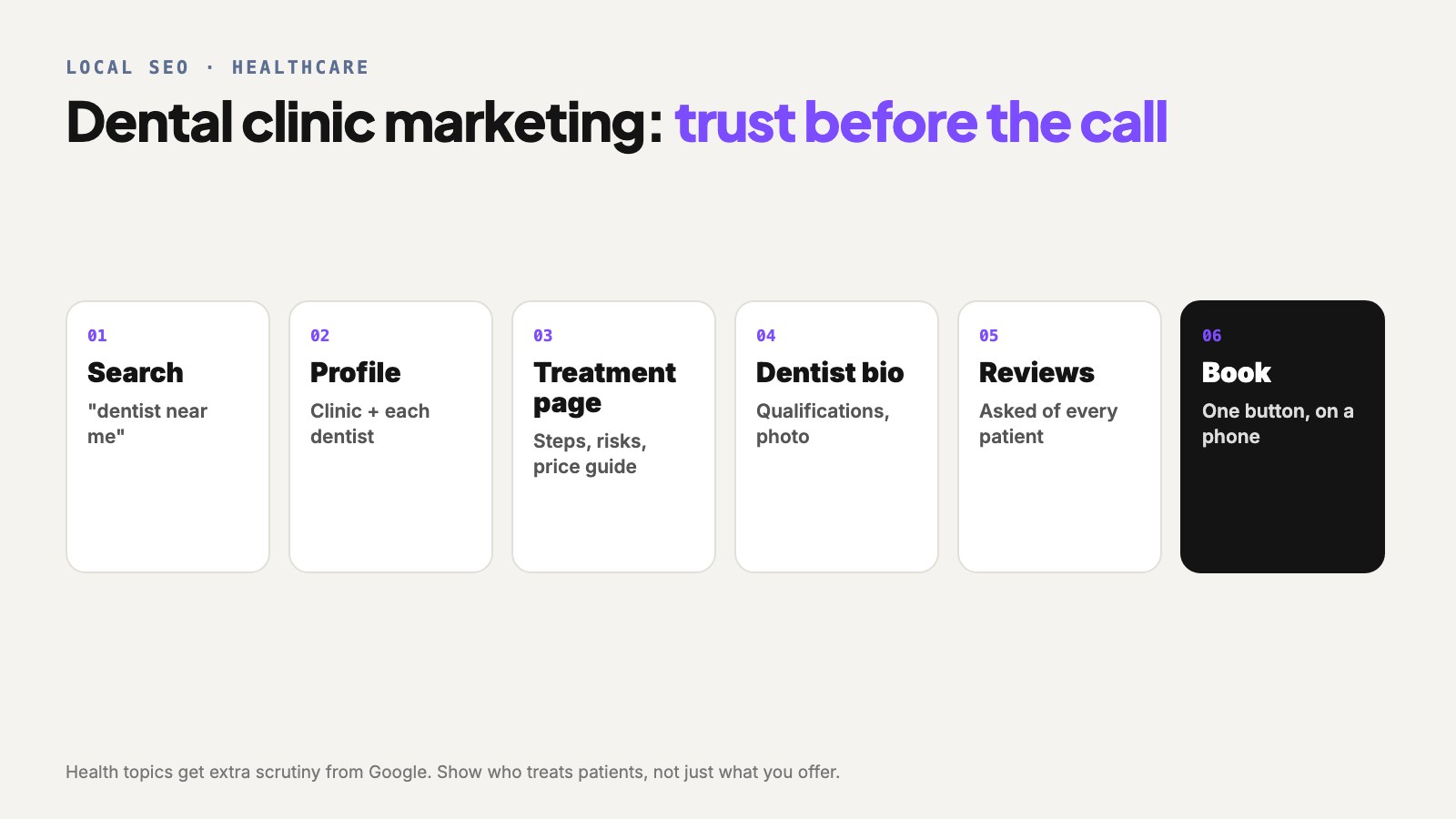
- Dental clinic marketing works when it answers a nervous patient's real questions before they pick up the phone: who will treat me, what will happen, what will it cost and can I trust you?
- Google gives extra weight to trustworthy content on health topics, which it calls "Your Money or Your Life" (YMYL). Clinics have to show their expertise, not just claim it.
- Each public-facing dentist or doctor can have their own Google Business Profile, alongside the clinic's own profile, under Google's rules for individual practitioners.
- Reviews are powerful and regulated. Never pay for them, never post them yourself, and never confirm in a public reply that someone is your patient.
Why Clinics Are Judged More Strictly
Google holds health content to a higher standard because bad advice can hurt people. In its guide to creating helpful, reliable content, Google says its systems give even more weight to content showing strong experience, expertise, authoritativeness and trust (E-E-A-T) for topics that could significantly affect someone's health, finances or safety. It calls these "Your Money or Your Life" topics.
The same page says trust is the most important of the four, and that E-E-A-T isn't a specific ranking factor on its own. In practice, that means a clinic can't win with keywords and stock photos. It wins by showing real people, real qualifications and careful, accurate information. Google's Search Quality Rater Guidelines describe how human raters judge this, and they're worth skimming once. For the concept itself, read our guide to what E-E-A-T is; this article is about applying it to a clinic.
Patients think the same way. Someone booking a root canal or a first check-up for their child is anxious and comparing. The clinic that answers their questions clearly feels safer than the one that just says "modern, friendly care".
Step 1: Set Up the Clinic and Practitioner Profiles
Most new patients meet your clinic on Google Maps first, so your Business Profiles do more work than any advert. A clinic usually needs more than one.
Google's guidelines for representing your business name doctors and dentists as "individual practitioners". The rules that matter for a clinic:
- Each public-facing practitioner can have their own profile, and it may include a title or degree such as Dr. Support staff shouldn't have one.
- When several practitioners work at one location, the clinic gets its own profile, and each practitioner's profile uses only their own name, not the clinic's.
- One profile per practitioner, not one per speciality. A dentist who does implants and whitening still has one profile.
- A solo practitioner at a branded clinic can share one profile with the clinic, named like "[Clinic]: Dr. [Name]".
Then complete the clinic profile properly: the most specific primary category ("Dentist", "Dental clinic" or a specialty if that's what you are), accurate hours, real photos of the reception and treatment rooms, and your services. Google's category help notes that health and beauty businesses can add a booking button and a list of services. Our full guide to Google Business Profile optimization covers the rest.
Step 2: Build a Page for Every Treatment
A single "Our services" page with a list of treatments can't rank for any of them. Patients search for the treatment: "dental implants", "emergency dentist", "teeth whitening cost", "Invisalign". Each needs its own page that answers the questions they're afraid to ask.
A strong treatment page covers:
- Who it's for: the problem it solves and when it isn't the right choice.
- What happens: the steps, how many visits, how long each takes, and whether it hurts, in honest terms.
- Recovery and aftercare: what to expect afterwards and when to call you.
- Risks and alternatives: stated plainly. This is exactly what builds trust on a health page.
- Price guide: a "from" price or a range, and what changes it. Patients leave clinics that hide every price.
- Who performs it: a link to the dentist's bio, with their relevant training.
- Reviewed by and updated on: the clinician who checked the page and the date.
Our guide to service page SEO shows how to structure each page so it ranks for the treatment and converts the visitor. Add Dentist or MedicalClinic structured data to your clinic details, following Google's local business structured data guide, and check it with our free schema checker.
Step 3: Write Dentist Bios That Prove Who You Are
A patient choosing a clinic is really choosing a person, so every clinician needs a real bio page. It's also the clearest way to show the expertise Google looks for on health topics.
- Full name, a real photo and their role.
- Qualifications, registration and where they trained, with anything a patient can verify.
- Years in practice and the treatments they focus on.
- A few lines in their own words about how they work with nervous patients or children, if that's true.
- Links to the treatment pages they perform, and from those pages back to the bio.
| Page | Must include | Trust signal patients notice |
|---|---|---|
| Homepage | Who you treat, where, how to book | Real team photo, rating with real reviews |
| Treatment page | Steps, recovery, risks, price guide | "Reviewed by Dr. [Name]" and a date |
| Dentist bio | Qualifications, registration, focus areas | Photo, training, links to their treatments |
| Prices page | "From" prices or ranges, what's included | No surprises at the first visit |
| Booking page | Times, what to bring, cancellation policy | A booking that works on a phone in a minute |
Step 4: Earn Reviews Without Breaking Privacy or the Rules
Reviews decide many clinic choices, but healthcare reviews come with stricter rules than most businesses face.
Asking for reviews
- Ask every patient the same way, for example with a link in the follow-up message or a card at reception. Google's policy on fake engagement bans rewards for reviews and selectively asking only patients you expect to be happy.
- In the US, the FTC's rule on consumer reviews and testimonials bans fake reviews, buying positive or negative reviews, undisclosed reviews from staff and suppressing negative ones. Other countries have similar consumer laws.
- Never have staff or family post reviews.
Replying to reviews
- Never confirm in public that someone is a patient, and never mention their treatment, even if they did first. Health information is protected by privacy law in most countries.
- Reply with a general, kind message and an offer to talk privately: "Thank you for your feedback. We'd like to understand more; please call the practice manager on [number]."
- Reply to positive reviews too, briefly and without health details.
Our guide to getting more Google reviews has templates you can adapt.
Step 5: Make Booking the Easiest Thing on the Page
Every page should end with one obvious way to book, and it has to work on a phone. Many clinic websites lose the patient at the last step: a form that asks for too much, a phone line that's busy at lunchtime, or a booking widget that doesn't fit a phone screen.
- Add a booking button to your Google profile. Google's help on bookings through a provider explains how to connect a supported booking system, or you can add your own booking link.
- Show the next available appointment if your system allows it.
- Offer an emergency route clearly: a phone number and the hours it's answered.
- Test the booking on your own phone every month, and check your pages with our mobile-friendly checker.
If visitors arrive but don't book, our guide to website traffic but no leads walks through where they drop off.
Step 6: Show Up When Patients Ask AI
More patients now ask AI assistants questions like "which dentist near me is good with nervous patients?" Those answers draw on what the web says about local clinics: profiles, reviews, treatment pages and articles that mention you.
Clinics that appear tend to have clear treatment pages, named clinicians with visible qualifications, consistent details across profiles and reviews that mention specific things, like gentle care or short waiting times. Our guide on how to get recommended by ChatGPT explains the steps; the trust work above is most of it.
Claims to Avoid in Clinic Marketing
Overpromising is the fastest way to lose trust, and in many countries it breaks the rules for healthcare advertising. Avoid:
- "Painless", "guaranteed results" or "permanent" unless you can stand behind them for every patient.
- "Best dentist in [city]" with no independent basis.
- Before-and-after photos without written consent, or edited photos.
- Testimonials that promise outcomes, such as "cured my gum disease in a week".
Rules differ by country and profession, so check your national dental or medical regulator's advertising guidance before you publish. When in doubt, describe what you do and let patients' reviews speak for the results.
Measure New Patients, Not Clicks
- Calls, direction requests and bookings from each Google Business Profile.
- Online bookings from the website, set up as a conversion in your analytics. Our guide to measuring content in GA4 shows how.
- Which treatments people search for, from Google Search Console.
- New reviews per month and your replies.
- "How did you hear about us?" on the new patient form.
How CMO Owls Supports a Clinic's Marketing
CMO Owls is an AI marketing team that handles the website, content and search work for small businesses, so clinicians can stay with patients. You approve every page before it goes live, which matters for health content: a clinician should always review what's published.
| Part of the plan | Agent | What it does |
|---|---|---|
| Treatment pages | Owlthor | Researches what ranks for each treatment and drafts the page, sent to WordPress or your CMS for your clinician to review |
| Patient questions | Buzz Creator Owl | Finds the questions people ask AI assistants about treatments and answers each one as an article |
| Clinic facts and tone | Knowledge Base | Two short documents about your clinic and tone, shared with the writing agents so every draft sounds like you |
| Website health and booking path | Watch Owl | Opens up to 500 pages in a real browser and finds broken pages, errors and slow loading, worst first |
| Visibility in AI answers | Generative Engine Owl | Measures what ChatGPT, Gemini, Claude and Google AI Overviews say about your clinic, and why they skip you |
| Pages losing patients | Cash Cow Stalker | Checks your top pages every five days and alerts you when clicks fall or a page drops out of Google |
Mind Map: Dental Clinic Marketing
Frequently Asked Questions
What is the best marketing for a dental clinic?
For most clinics, complete Google Business Profiles for the clinic and each dentist, plus a page for every treatment, bring the most new patients. Genuine reviews and easy online booking turn that visibility into appointments.
How do I get more patients for my dental practice?
Make each treatment easy to find and understand, show who will treat patients and what it costs, ask every patient for a review and let people book online from a phone. Then track which treatments bring bookings and build more of those pages.
Should each dentist have their own Google Business Profile?
Each public-facing dentist can have one under Google's rules for individual practitioners, alongside the clinic's profile. Each dentist gets one profile only, not one per speciality, and support staff shouldn't have their own.
Can I reply to a patient's review?
Yes, but never confirm they're a patient or mention their treatment. Thank them in general terms and offer to talk privately by phone.
Can a clinic give patients a gift for leaving a review?
No. Google bans rewards for reviews, and US federal rules also ban buying positive reviews. Ask every patient the same way and let them decide what to write.
Do clinics need to show prices online?
It isn't always required, but a "from" price or a range helps patients choose you and reduces no-shows. Explain what changes the price so nobody feels misled.
Does this apply to medical clinics as well as dentists?
Yes. Physiotherapy, dermatology and general medical clinics face the same trust standards. The structure here, with practitioner profiles, a page per treatment and careful reviews, works for all of them.
The Next Step
Pick your most-booked treatment and check its page against the list in Step 2. If it's missing the steps, the price guide or who performs it, start there. Then add your clinic's website to CMO Owls to see a website report and what AI tools say about you, and read our guide to what E-E-A-T is to strengthen your dentist bios.
Sources
- Creating helpful, reliable, people-first content, Google Search Central, 2026.
- Search Quality Rater Guidelines, Google, 2025.
- Guidelines for representing your business on Google, Google Business Profile Help, 2026.
- Manage your business category, Google Business Profile Help, 2026.
- Set up bookings through a provider, Google Business Profile Help, 2026.
- Maps user-contributed content policy: Fake engagement and prohibited practices, Google, 2026.
- 16 CFR Part 465: Use of consumer reviews and testimonials, Federal Trade Commission (eCFR), 2024.
- Dentist, Schema.org, 2026.
- MedicalClinic, Schema.org, 2026.
- Local business (LocalBusiness) structured data, Google Search Central, 2026.