Key Takeaways
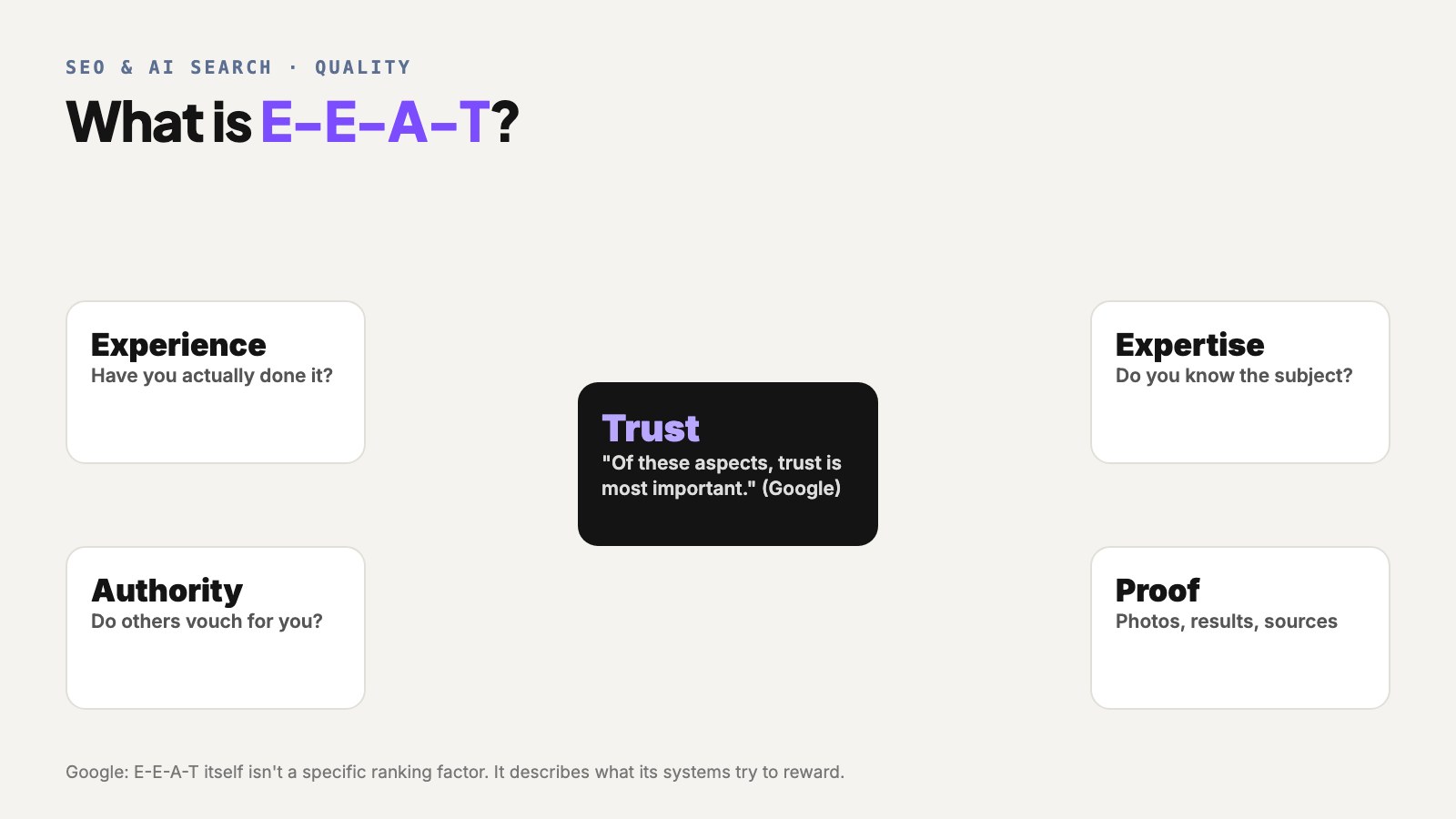
- E-E-A-T stands for Experience, Expertise, Authoritativeness and Trust: the qualities Google asks its human raters to look for in content.
- Google says trust matters most: "Of these aspects, trust is most important."
- It isn't a direct ranking factor. Google's SEO Starter Guide lists "Thinking E-E-A-T is a ranking factor" as a misconception: "No, it's not."
- You show it with evidence, not badges: real names, first-hand photos and results, sources, accurate details and an honest way to contact you.
What E-E-A-T Means
E-E-A-T is Google's shorthand for the qualities that make content believable: Experience, Expertise, Authoritativeness and Trust. It comes from the guidelines Google gives its search quality raters, people who review results to help Google judge whether its systems work.
It used to be E-A-T. In December 2022 Google announced "E-A-T is gaining an E: experience", meaning content that shows "some degree of experience, such as with actual use of a product" (Google Search Central Blog).
| Letter | The question it asks | Example of good evidence |
|---|---|---|
| Experience | Has the author actually done or used this? | Photos of the job, results from your own test, a real customer story |
| Expertise | Does the author know the subject well? | Qualifications, years in the trade, accurate detail |
| Authoritativeness | Is the site or author a known source on it? | Mentions, links and reviews from others |
| Trust | Is the page accurate, honest and safe? | Correct facts, clear contact details, secure site, sources |
Is E-E-A-T a Ranking Factor?
No, not directly, and Google says so plainly. Its SEO Starter Guide lists "Thinking E-E-A-T is a ranking factor" under common misconceptions, with the answer "No, it's not." Its guidance on helpful, people-first content adds "While E-E-A-T itself isn't a specific ranking factor" and that "Rater data is not used directly in our ranking algorithms."
So why does it matter? Because Google uses raters to check whether its ranking systems reward the right pages, and those systems look for signals that line up with E-E-A-T. The 2022 announcement put it carefully: rater assessments "don't directly influence ranking". Think of E-E-A-T as a description of what Google is trying to reward, not a lever you pull.
That's also why you can't "add E-E-A-T" with a plugin or a badge. You add evidence that a reader can see.
Why Trust Is the Centre
Google's own guidance puts trust above the other three: "Of these aspects, trust is most important." A page can be written by an expert and still be untrustworthy if its facts are wrong, its prices are out of date or it hides who is behind it.
Trust is also the part customers feel directly. A "Not secure" warning, a missing address or a review that reads like it was written by the owner all lower it. Our guide to the "Not secure" warning covers the simplest trust fix on any site.
Who Needs E-E-A-T Most: YMYL Topics
The higher the stakes for the reader, the more trust matters. Google calls pages that could affect someone's health, finances, safety or wellbeing "Your Money or Your Life" topics: "We call these "Your Money or Your Life" topics, or YMYL for short" (Google Search Central).
A bakery's opening hours and a clinic's advice on medication both need to be accurate, but the second needs far stronger evidence of expertise. If your business gives health, legal, money or safety advice, show qualifications clearly, cite official sources and have qualified people review what you publish. For a worked example, see our guide to dental clinic marketing.
Ask Who, How and Why
Google suggests a simple test for any page: who made it, how it was made and why it exists. Its guidance calls this asking "Who, How, and Why" about your content, and describes the "Why" as "perhaps the most important question to answer about your content."
| Question | What a reader should be able to see | Weak version | Strong version |
|---|---|---|---|
| Who | A named person or business with relevant background | "Admin" | "Written by Maria Laine, electrician since 2009" |
| How | How the advice was produced or tested | Nothing | "We tested three heaters in our own shop over a winter" |
| Why | The page exists to help the reader, not just to rank | A page targeting a keyword with nothing new | Answers a question customers really ask |
On bylines specifically, Google's 2023 guidance on AI content says "You should consider having accurate author bylines when readers would reasonably expect it", and that "Giving AI an author byline is probably not the best way" to disclose AI use. Our guide on AI content and Google covers that side in detail.
10 Ways to Show E-E-A-T on Your Website
Each of these adds evidence a reader can check.
- Name a real author on articles and advice pages, with a short bio covering what they've actually done.
- Show first-hand proof: photos of real jobs, your own test results, screenshots of real data.
- Cite sources for facts and figures, linking to the original rather than a summary.
- Keep facts current and show an honest updated date. Google asks sites to "Add a user-visible date to the page and feature it prominently" (Google Search Central); our guide to updating old content explains when a date change is justified.
- Make contact easy: a real address, phone number and named people on an About page.
- Show real reviews, including the occasional imperfect one, and reply to them; see how to get more Google reviews.
- Be specific. Prices, timings, limits and conditions show knowledge better than adjectives; our semantic SEO guide shows how.
- Say what you don't do or when a reader should go elsewhere. Honesty about limits is a trust signal.
- Keep your details consistent across your site, Google Business Profile and directories.
- Use structured data accurately to describe the author and organisation, matching what's visible.
Experience: The Easiest Letter for a Small Business
Small businesses usually have more first-hand experience than big publishers; they just don't show it. Google's guidance on writing reviews asks writers to "Provide evidence such as visuals, audio, or other links of your own experience with what you are reviewing", and its ranking systems guide says its reviews system "aims to better reward high quality reviews" written "by experts or enthusiasts who know the topic well."
| Business | Experience you already have | How to show it |
|---|---|---|
| Car repair shop | Hundreds of brake jobs a year | Before-and-after photos, the three faults you see most |
| Bakery | Years of wedding orders | Real cakes with serving sizes, what couples usually choose |
| Accountant | Seasonal deadlines and common mistakes | A checklist built from real client questions (anonymised) |
| Software company | Your own product data | Screenshots and numbers from your own use |
Collect this evidence as you work, not when you sit down to write. A folder of job photos, a note of the questions customers asked this month and a record of results you can share will supply years of first-hand material. Ask permission before using customer details, and anonymise anything personal.
Author Pages and Structured Data
Structured data can confirm who wrote a page, but only if it matches what readers see. Google's Article structured data documentation describes author.url as "A link to a web page that uniquely identifies the author of the article", and advises: "In the author.name property, only specify the name of the author" and "Use the Person type for people, and the Organization type for organizations."
A simple author page with a photo, background, qualifications and links to their published work is enough. Our schema markup guide shows the code, and the free Schema Checker confirms what a page already has.
A One-Page E-E-A-T Check
Run this on any page in five minutes; every "no" is a quick improvement.
| Question | Where to look | If the answer is no |
|---|---|---|
| Can I tell who wrote or stands behind this page? | Byline, About page, footer | Add a named author or the business name with contact details |
| Is there first-hand evidence? | Photos, results, examples | Add one real photo or result |
| Are facts and figures sourced? | Links at each claim | Link to the original source |
| Is everything still accurate? | Prices, dates, product details | Update it and show the date |
| Would a nervous customer feel safe acting? | Address bar, reviews, contact options | Fix warnings, add reviews and a phone number |
| Does it say what it can't do? | Limits, exclusions, when to go elsewhere | Add one honest limit |
Do this for your top ten pages first. On most small business sites, the same two or three gaps repeat on every page, so fixing the template fixes many pages at once.
E-E-A-T Mistakes That Look Like Trust
| Mistake | Why it doesn't work | Instead |
|---|---|---|
| Adding "expert" badges or seals | They prove nothing a reader can check | Show the qualification and where it's from |
| Fake or invented author names | Misleading, and easy to expose | Use real people, or the business name |
| Stock photos of "our team" | Readers recognise them | Real photos, even simple ones |
| Long bios with no relevance | Volume isn't expertise | Two lines on why this person knows this topic |
| Citing other blogs for facts | Copies of copies drift from the truth | Link to the original source |
| Assuming E-E-A-T fixes rankings alone | It isn't a direct ranking factor | Combine it with content people actually need |
E-E-A-T and AI Answers
AI assistants also need reasons to trust a source, and the same evidence helps. Named authors, specific facts, citations and consistent business details make it easier for an assistant to describe you accurately. Our guide on checking your AI visibility shows how to see what assistants currently say.
How CMO Owls Checks and Builds Trust Signals
E-E-A-T is evidence spread across many pages, which makes it hard to check by eye. CMO Owls reviews it page by page and helps you fill the gaps.
| Job | On your own | A generic SEO tool | CMO Owls |
|---|---|---|---|
| Review experience, expertise and trust signals | Read every page | Rarely | Owl-gorithm Hacker reviews E-E-A-T signals and topical authority |
| Check structured data matches the page | Manual | Validates syntax | Owl-gorithm Hacker checks schema is valid and matches what's visible |
| Keep brand facts consistent across content | Remember them | No | Knowledge Base gives the writing agents your real product and tone |
| Catch a security warning or broken page | When a customer tells you | Partly | Watch Owl checks SSL and every page it crawls |
| See what AI assistants say about you | Ask them one by one | Rarely | Generative Engine Owl, with reasons and fixes |
- Owl-gorithm Hacker reviews content quality, topical authority and experience, expertise and trust signals, and every finding carries a confidence score.
- Knowledge Base holds two short documents about your product and tone, written from real brand data, so the writing agents describe you accurately.
What the Owls can't do is invent experience. Add your photos, results and people; the Owls make sure every page shows them.
Mind Map: E-E-A-T
Frequently Asked Questions
What does E-E-A-T stand for?
Experience, Expertise, Authoritativeness and Trust. Google added the first E, for experience, in December 2022.
Is E-E-A-T a Google ranking factor?
No, not directly. Google says E-E-A-T itself isn't a specific ranking factor, but its systems look for signals that align with it, especially trust.
Which part of E-E-A-T matters most?
Trust. Google's guidance says that of the four aspects, trust is most important.
What are YMYL pages?
Pages about topics that could affect a person's health, finances, safety or wellbeing. They need stronger evidence of expertise and accuracy.
Do I need an author bio on every page?
Not on every page. Google suggests bylines where readers would reasonably expect them, such as articles and advice.
Can AI-written content have good E-E-A-T?
Only if a knowledgeable person adds real experience, checks the facts and stands behind it. The evidence matters, not the tool.
How do small businesses show expertise without qualifications?
Show experience: real jobs, real photos, the problems you solve most often and the results. Specific detail is strong evidence.
Should I add author markup to my articles?
Yes, if the article has a real author shown on the page. Use the Person type with the author's name and a link to their author page, and keep it identical to the visible byline.
The Next Step
Pick your three most important pages and add one piece of first-hand evidence to each this week: a real photo, a named author or a specific result. Then add your website to CMO Owls to see which pages are short of experience and trust signals.
Sources
- Our latest update to the quality rater guidelines: E-A-T gets an extra E for Experience, Google Search Central Blog, 2022.
- SEO Starter Guide, Google Search Central, accessed 2026.
- Creating helpful, reliable, people-first content, Google Search Central, accessed 2026.
- Google Search's guidance about AI-generated content, Google Search Central Blog, 2023.
- Write high quality reviews, Google Search Central, accessed 2026.
- A guide to Google Search ranking systems, Google Search Central, accessed 2026.
- Influence your byline dates in Google Search, Google Search Central, accessed 2026.
- Article structured data, Google Search Central, accessed 2026.