Key Takeaways
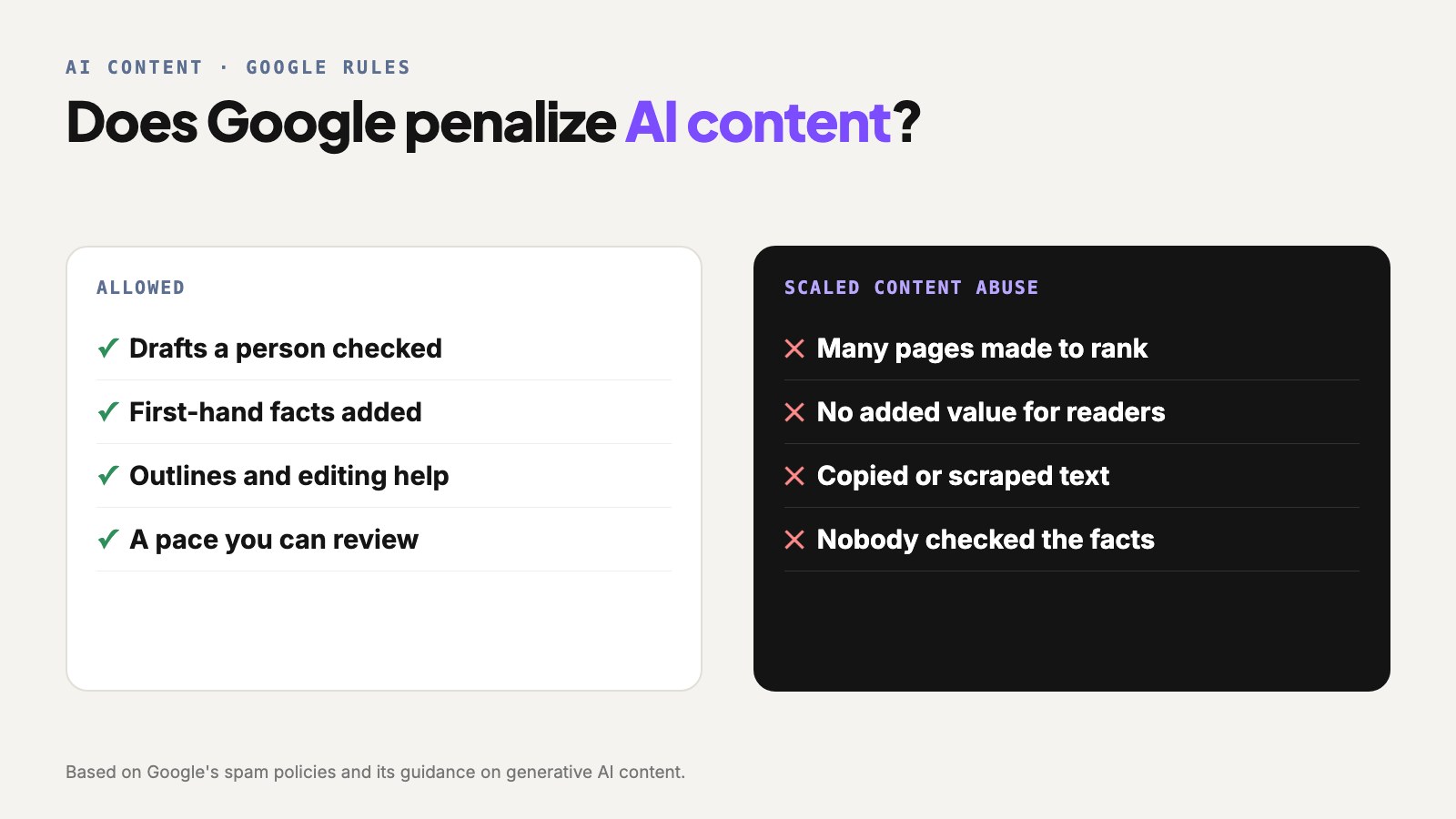
- Google doesn't penalize content for being made with AI. It says "Appropriate use of AI or automation is not against our guidelines."
- What it acts on is scaled content abuse: many pages made mainly to manipulate rankings, with little value for people. Humans can break that rule too.
- AI pages get indexed on the same terms as any page: reachable, not blocked, not a duplicate and good enough to be worth keeping. Indexing is never guaranteed.
- The safest routine is simple: add something first-hand, check every fact, publish at a pace you can review and fix or remove what doesn't earn its place.
Does Google Penalize AI Content? The Short Answer
No, not for being AI-generated; yes, if it's mass-produced to rank and adds nothing. Google's February 2023 guidance describes its focus as "the quality of content, rather than how content is produced". The same post removes the opposite myth: "Using AI doesn't give content any special gains. It's just content."
The confusion comes from sites that published thousands of pages, vanished from results and blamed AI. What they share is usually scale without value. The tool made it cheap, but the rule would apply to a room full of people writing the same empty pages.
Why Some AI Content Gets Penalized
It's the purpose and the value that break the rules, not the software. Google's spam policies define scaled content abuse as "when many pages are generated for the primary purpose of manipulating" rankings, and one listed example is "Using generative AI tools or other similar tools to generate many pages without adding value for users".
Its guidance on generative AI says the same from the other side. AI "can be particularly useful when researching a topic, and to add structure to original content", but making many pages without adding value "may violate" the policy.
| What you publish | Risk | Why |
|---|---|---|
| A draft from your notes, checked and edited | Low | Original input and human review |
| AI used to outline, tidy or translate your own work, reviewed | Low | It supports content that has value |
| A few general articles with nothing new | Medium | Unlikely to be spam, but easy for Google to ignore |
| Hundreds of city or keyword pages from one template | High | Scale without value for the reader |
| Other sites' articles rewritten by AI | High | The policy names scraped and transformed content |
| Medical, legal or money advice nobody checked | High | Errors can harm readers |
Penalty, Demotion or Just Not Indexed?
Most AI pages that fail aren't penalized at all; they're simply not chosen. Those are three different situations with three different fixes.
| What happened | How to tell | What to do |
|---|---|---|
| Manual action | A message in Search Console's Manual actions report | Fix the cause across the site, then request a review |
| Spam systems lower or remove pages | A broad drop with no message | Remove or improve low-value pages, then wait for recrawling |
| Not indexed | The page is listed as not indexed | Improve the page and its links, or merge it |
| Indexed but invisible | Impressions near zero | Answer the search better, or target a different one |
Google says violations are found by automated systems and, "as needed, human review that can result in a manual action", and that sites "may rank lower in results or not appear in results at all." A manual action is the only one that comes with a notice: Google's Manual actions help page says one is issued when "a human reviewer at Google has determined" that pages break its policies, and lists "Thin content with little or no added value" among the types.
If traffic fell and that report is empty, don't assume AI is the cause. Our guide to finding why traffic dropped goes through the other suspects first.
When Does Google Index AI Content?
Google indexes an AI-assisted page when it can crawl it, is allowed to index it, sees it as the main version and judges it worth keeping. Google's explanation of how Search works is frank: "Indexing isn't guaranteed; not every page that Google processes will be indexed." It lists low-quality content as one of the common problems.
- Discovery. Google finds the page through a link or your sitemap. A hundred new pages that nothing links to are a hundred orphans; our internal linking guide covers the fix.
- Crawling. Google fetches the page. A firewall, server errors or a robots.txt rule can stop it here.
- Permission. A noindex tag keeps it out. The free Indexability Checker shows the common blockers.
- Selection. Google groups near-identical pages and keeps one. Templated AI pages often lose here.
- Quality. Google decides whether the page is worth indexing at all.
There's no fixed waiting period. Google's page on requesting a recrawl says crawling "can take anywhere from a few days to a few weeks", and that a request doesn't guarantee inclusion "instantly or even at all". The exact status is in the Page indexing report, and our guide to pages that aren't indexed explains each reason.
Can Google Tell That a Page Was Written by AI?
Google doesn't publish a test for AI authorship, and its rules don't need one. The policies describe what a page does, such as copying, scaling or misleading, rather than which tool typed it.
That's why "beating the detector" is the wrong goal. Detectors estimate from patterns and can be wrong in both directions. Our free AI Content Detector is useful for spotting flat, generic passages to rewrite, but a low score doesn't make a page helpful and a high one isn't proof of a violation.
A 9-Point Check Before You Publish AI Content
If a page can't pass these nine, don't publish it yet. Google's AI guidance calls it "critical to manually factcheck and review all AI-generated content" before publishing.
- Purpose: would you publish this if search engines didn't exist?
- First-hand value: is there at least one thing only you could add, such as a price, photo, test, number or customer question?
- Facts: has a person checked every claim, date and figure against its original source?
- Invented details: are there quotes, studies, reviews or features you can't trace? Remove them.
- Duplication: does another page of yours already answer this? If so, see our guide to competing pages.
- Meaning: does it state specifics rather than generalities? Our semantic SEO method shows how to fix a vague draft.
- Byline: Google suggests accurate author bylines where "readers would reasonably expect it".
- Pace: could your team read every page you plan to publish this month? If not, publish fewer.
- Upkeep: who will correct it when something changes?
A Worked Example: The Same Draft, Two Outcomes
What separates a risky draft from a useful page is usually an hour of real input. This is an invented plumbing firm.
| Element | Published as generated | After an hour's work |
|---|---|---|
| Opening | "Boiler problems can be frustrating." | "If your boiler shows low pressure, check the gauge first: our engineers look for 1 to 1.5 bar when cold." |
| Evidence | None | Photo of the gauge, and the three faults the firm saw most last winter |
| Price | "Costs vary." | Call-out fee and what it includes |
| Safety | Generic tips | When to stop and call a qualified engineer, checked by one |
| Pages made | 40 town copies | One page, plus town pages only where the firm has real jobs |
The second page takes longer, and you'll publish fewer of them. That's the point. Figures like the pressure range must come from your own engineers or the manufacturer, never from the draft. If nobody on your team can confirm a sentence, take it out.
How to Recover If AI Content Hurt Your Site
Cut the low-value pages, improve the ones worth keeping and give Google time to see the change.
- Open the Manual actions report in Search Console. If there's a notice, follow its instructions.
- List every page published in the same push, with clicks and impressions for the last three months.
- Sort each into keep, improve, merge or remove. Our guide to updating old content has the decision table.
- Improve the pages with real demand first, and redirect merged ones to the survivor.
- If you had a manual action, submit a review request that explains what you changed.
Don't delete pages in a panic. Google's people-first questions warn against "removing a lot of older content primarily because you believe it will help your search rankings". Remove a page because it's no use to anyone.
Common Mistakes With AI Content
- Publishing everything at once. Volume nobody has read is the pattern the policy describes.
- Trusting fluent text. A confident sentence can still be false, so check the claim and not the tone.
- Writing to a word count. Google answers its own question about a preferred length with "(No, we don't.)"
- Stuffing in E-E-A-T badges. The Starter Guide lists thinking E-E-A-T is a ranking factor as a misconception. Show real experience instead. Our guide to what E-E-A-T means shows how.
- Hiding AI where readers would care. Google says disclosures are useful where someone might wonder how content was made.
How CMO Owls Keeps AI Content on the Right Side
CMO Owls uses AI to write, so this rule applies to us too. The workflow is built around evidence, limits and your approval rather than volume.
| Step | A chatbot on its own | A bulk AI writer | CMO Owls |
|---|---|---|---|
| Where ideas come from | Your prompt | A keyword list | Your audit, Search Console queries and competitors, through Game Plan Owl |
| What it writes from | General knowledge | Templates | Opportunity Owl writes from evidence your audit recorded; Owlthor researches what ranks |
| Brand facts | You paste them | Often generic | Knowledge Base keeps your product and tone for the writing agents |
| Duplicate check | None | Rarely | Owl-gorithm Hacker checks cannibalization between your pages |
| Goes live by default | You paste it | Often yes | Owlthor sends WordPress posts as drafts by default |
| After publishing | Nothing | Nothing | Cash Cow Stalker alerts you when a tracked page slips |
- Opportunity Owl sorts each finding into a precise fix or an article aimed at a real gap, so you don't create a page when a fix would do.
- Owlthor writes the article and defaults to draft on WordPress, which leaves the fact check and the publish button with you.
What no tool can do is know your prices, jobs and opinions. Add those before you approve a draft, because they're what makes the page worth indexing. For AI beyond articles, see our AI marketing guide.
Mind Map: Google and AI Content
Frequently Asked Questions
Can using AI hurt my whole site in Google?
It can if you publish low-value pages at scale, because spam systems and manual actions can affect a site broadly. Checked, original pages made with AI help aren't against Google's guidelines.
Will Google index AI content?
It can, under the same conditions as any other page. Google must be able to crawl it, be allowed to index it and find it good enough to keep, and indexing is never guaranteed.
Can AI content rank on the first page?
Yes, Google doesn't exclude it for being AI-assisted. It also says using AI gives content no special gains, so the page has to earn its place.
What is scaled content abuse?
It's Google's spam policy on making many pages mainly to manipulate rankings while offering little value to users. Generative AI is named as one way of doing it.
Do I have to disclose that I used AI?
Google's search guidance calls disclosure useful where readers might wonder how something was made. Separate legal or platform rules may apply where you operate, so check those too.
How many AI articles can I publish a day?
Google publishes no number. A sensible limit is the number a knowledgeable person can fully read, check and improve.
How do I know if I have a manual action for AI content?
Open the Manual actions report in Search Console. If it shows no issues, a drop has another cause, though spam systems can lower pages without a message.
Should I delete all my AI content?
No. Review each page, improve the useful ones, merge duplicates and remove only those with no value to readers.
The Next Step
Take the last five pages you published with AI and run the nine-point check on them today. Then add your website to CMO Owls to find the pages that overlap or fall short before Google decides for you.
Sources
- Google Search's guidance about AI-generated content, Google Search Central Blog, 2023.
- Spam policies for Google web search, Google Search Central, accessed 2026.
- Guidance on using generative AI content, Google Search Central, accessed 2026.
- Manual actions report, Search Console Help, accessed 2026.
- In-depth guide to how Google Search works, Google Search Central, accessed 2026.
- Ask Google to recrawl your URLs, Google Search Central, accessed 2026.
- Page indexing report, Search Console Help, accessed 2026.
- Creating helpful, reliable, people-first content, Google Search Central, accessed 2026.
- SEO Starter Guide, Google Search Central, accessed 2026.