Key Takeaways
- Keyword cannibalization is when two or more pages on your site answer the same search, so they compete instead of adding up.
- Sharing a keyword isn't proof. The test is whether the pages serve the same need and Google keeps swapping or splitting them.
- It isn't a Google penalty. Google says duplicate content on your site "is not a violation of our spam policies", but the wrong page may be the one people see.
- The fix is one of five: merge, separate, re-link, canonicalize or leave alone. A one-page keyword map stops it coming back.
What Is Keyword Cannibalization?
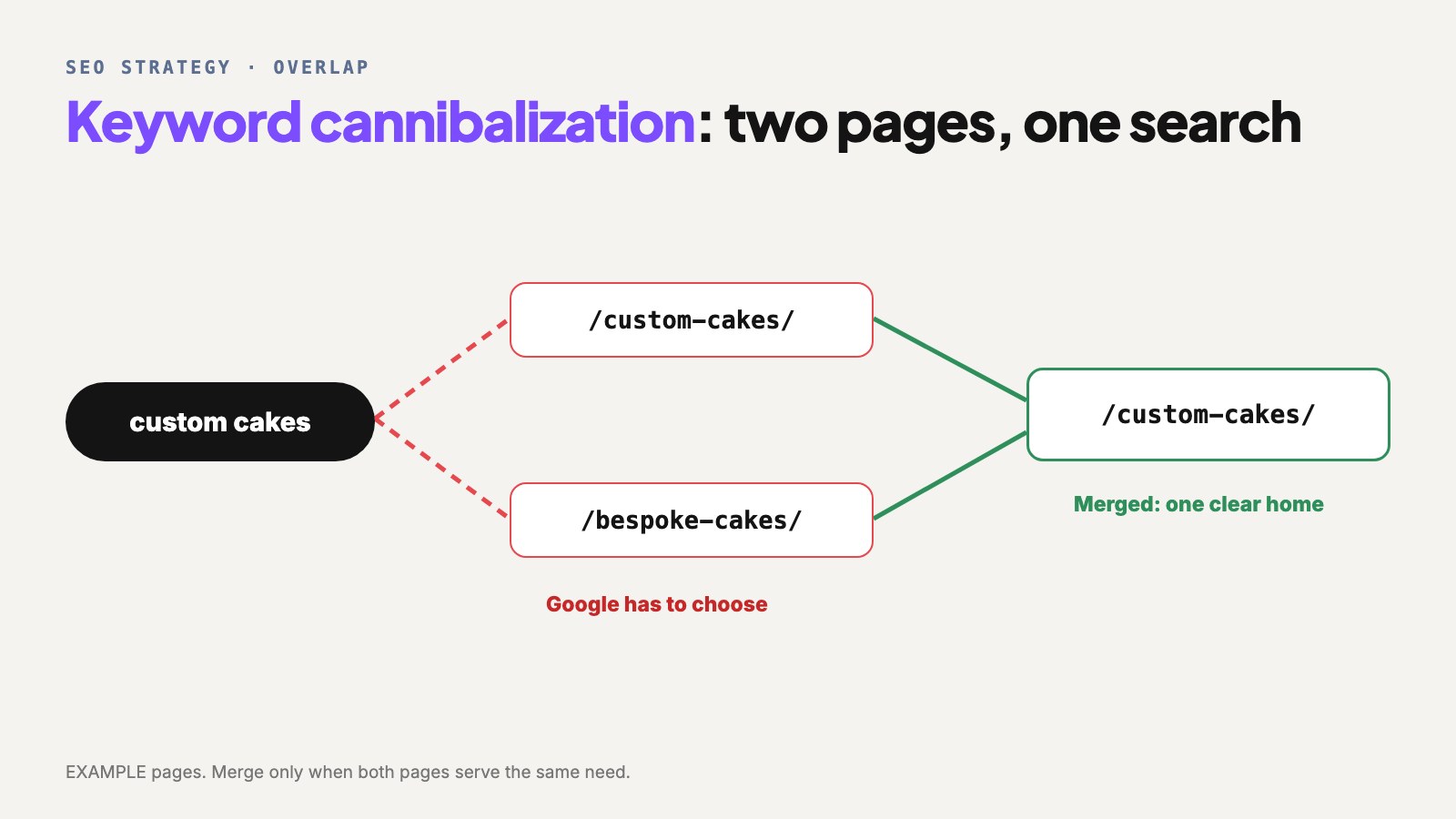
Keyword cannibalization happens when several pages on one site target the same search and compete with each other. Links, clicks and effort get split between them, and Google decides which to show. Often it's a blog post that outranks the service page you'd rather people saw.
It creeps in as a site grows. Someone writes "Custom cakes" in 2022, "Bespoke cakes" in 2024 and an article called "How to order a custom cake" this year. Each looked reasonable on the day. Together they ask Google to pick.
When Two Pages for One Keyword Are Fine
Two pages can share a phrase without competing if they do different jobs. Google can also show more than one of your pages when both help.
Google's ranking systems guide says it generally won't show "more than two web page listings from the same site in our top results", but that it may when its systems find it especially relevant. So two listings can be a success rather than a fault.
| Pair of pages | Same need? | Verdict |
|---|---|---|
| "Custom cakes" and "Bespoke cakes" service pages | Yes | Cannibalization: merge |
| "Custom cakes" service page and "How much does a custom cake cost?" | No: order vs price | Fine: link the article to the service |
| "Best running shoes" 2023 and 2026 posts | Yes | Merge into one evergreen page |
| Brake repair in Turku and brake repair in Naantali | Different places | Fine if each has real local detail |
| Category page and a product inside it | No: browse vs buy | Fine if titles are distinct |
| A blog post and a landing page both selling the same audit | Yes | Choose one to sell; let the other teach |
Why It's a Problem
It's a problem when the wrong page shows, neither page does well, or you're paying to maintain both.
- The wrong page ranks. A reader lands on an old article instead of the page with prices and a booking button.
- Signals split. Some sites link to one page, some to the other, and your own menu points at both.
- Results wobble. Google tries one URL, then the other, and your reports look like random noise.
- Work doubles. You update two pages to say one thing, and sooner or later they disagree.
What it isn't is a punishment. Google's SEO Starter Guide lists duplicate content worries among its myths, saying it "is not a violation of our spam policies", though it can be a bad experience for users.
How to Find Keyword Cannibalization
The best free evidence is Search Console: look for one query with two of your pages attached. Our Search Console guide shows where the tabs are.
- Open Performance and choose a search that matters to your business.
- Click the query, then switch to the Pages tab.
- Note every URL with meaningful impressions. One dominant page is healthy.
- Compare two periods. If the leading URL changes back and forth, that's a strong sign.
- Read both pages side by side and ask if one person would want both.
- Search Google for site:yourdomain.com plus the phrase, to spot overlap that gets no impressions yet.
Be careful with the numbers. Google's help page explains that when data isn't grouped by page, "if two results from the same site appear for one query, they count as a single impression" (Performance report). Its definitions page adds that position is "the topmost position" your site held (impressions, position and clicks). In plain terms, the totals can hide a fight. The Pages tab shows it.
| Pattern in the Pages tab | Likely meaning |
|---|---|
| One page has nearly all impressions | No problem, even if others mention the phrase |
| Two pages alternate by week | Strong sign of competition |
| Both steady, both getting clicks | Probably complementary; leave them |
| A weak page leads and a sales page trails | Wrong page is chosen; fix links and focus |
| Many pages, all with tiny numbers | Thin or templated set; consider one strong page |
How to Fix Keyword Cannibalization: Five Options
Choose the lightest fix that gives each search one obvious home.
| Fix | Use it when | What happens to the other page |
|---|---|---|
| Merge | Both serve the same need | Redirected to the survivor |
| Separate | Each could serve a different need | Rewritten for its own search |
| Re-link | The right page is under-linked | Stays, but links to the main page |
| Canonicalize | Near-copies must both exist | Stays live, points to the main version |
| Leave alone | Both earn useful clicks | Nothing |
1. Merge
Pick the survivor by links, clicks and how well it sells. Move the best parts across, then redirect the other address. Google treats a redirect as a "strong signal that the target of the redirect should become canonical" (consolidating URLs), and its redirects guide recommends a permanent server-side one. Our 301 guide has the steps, and the Redirect Checker confirms it lands in one hop.
2. Separate
If each page could own a different need, sharpen both. Change the title, main heading and opening so nobody could confuse them. Google's title guidance asks for "distinct text that describes the content of the page". Then make the content match, using our semantic SEO method.
3. Re-link
Your own links tell Google which page is the main one. Google's link guidance says good anchor text is "descriptive, reasonably concise, and relevant". Use the main phrase as anchor text only for the main page; our internal linking guide explains the pattern.
4. Canonicalize
Use this for near-identical versions, such as filtered product lists. A canonical is "a hint, not a rule" in Google's words (what is canonicalization), and it doesn't suit two genuinely different articles. See our canonical tag guide.
5. Leave it alone
If both pages get clicks from different people, breaking them apart may lose traffic. Check which queries each one earns before you touch either. Write the decision down so nobody "fixes" it later.
Fixes That Usually Make It Worse
- Blocking one page in robots.txt. It stops crawling but doesn't merge anything.
- Adding noindex to a page that has links. Google drops the page, and its value goes nowhere. Merge it instead. Google's noindex page says it will "drop that page entirely".
- Deleting without a redirect. Visitors and links hit a dead end.
- Removing a word from one page. The need is the same, so the competition is too.
- Redirecting to the homepage. Send it to the closest match.
Example: Four Cake Pages Become Three
Three pages, one search, and a plan that keeps the best of each. The bakery and its numbers are invented.
| URL | Impressions | Clicks | Decision |
|---|---|---|---|
| /custom-cakes/ | 1,900 | 38 | Survivor: has prices and the order form |
| /bespoke-cakes/ | 1,400 | 11 | Merge: move the gallery, then redirect |
| /blog/how-to-order-a-custom-cake/ | 900 | 24 | Separate: focus on timing and steps, link to the survivor |
| /blog/custom-cake-prices/ | 600 | 31 | Keep: a price question, linked to the survivor |
Four pages become three, each with one job. The gallery isn't lost, the price article keeps its own readers, and every internal link that says "custom cakes" now points to one place.
Build a Keyword Map So It Doesn't Come Back
A keyword map is a list of your pages with the one search each page owns. Check it before you write anything new.
| Page | Owns | Leaves to another page |
|---|---|---|
| /custom-cakes/ | custom cakes turku | Prices, ordering steps |
| /blog/custom-cake-prices/ | how much does a custom cake cost | Ordering |
| /blog/how-to-order-a-custom-cake/ | how far ahead to order a cake | Prices |
We run this check on our own blog. Before publishing five articles on November 21, 2026, we compared their target phrases, headings and FAQ questions with every existing post. It found one clash: a draft on website redesigns listed "traffic drop after redesign", a phrase an older article already targeted. We removed it from the draft and linked the two instead.
The column most people skip is the last one. Writing down what a page won't cover is what keeps the next page honest. To choose the searches in the first place, use our keyword research method.
Service and City Pages: A Special Case
Pages for different places are fine when each one is genuinely useful there. Copies with the town name swapped are not. Give every town real jobs, photos, prices or travel details, as our service area guide describes, and give each service a page with one clear purpose, as in our service page guide.
How CMO Owls Stops Your Pages Competing
Spotting overlap by hand works for twenty pages and breaks at two hundred. CMO Owls checks your pages against each other and then helps you act.
| Job | By hand | A rank tracker | CMO Owls |
|---|---|---|---|
| Find pages competing for a search | Query by query | When URLs swap for tracked terms | Owl-gorithm Hacker checks keyword intent and cannibalization between your pages |
| Find duplicate titles | Spreadsheet | Not its job | Watch Owl compares titles and descriptions across the site |
| Find duplicate text with no canonical | Hard | Not its job | Watch Owl flags duplicate content without a shared canonical |
| Avoid a clash before writing | Remember your archive | No | Owlthor's keyword guidance asks first if another page already targets it |
| Decide fix or new page | Judgment | No | Opportunity Owl sorts findings into a fix or an article |
| Watch the survivor after a merge | Manual | Position only | Cash Cow Stalker checks tracked pages every five days |
- Owl-gorithm Hacker reads your pages as a set, so it can judge intent and overlap rather than matching words, and gives each finding a confidence score.
- Watch Owl covers the measurable side across up to 500 pages: duplicate titles, duplicate descriptions and duplicate content without a shared canonical.
Which page should win is still a business decision. Pick the one that helps a customer act, and let the Owls keep the rest pointing at it.
Mind Map: Keyword Cannibalization
Frequently Asked Questions
What is an example of keyword cannibalization?
A "Custom cakes" page and a "Bespoke cakes" page that offer the same service are a typical example. They answer one need, so they compete for the same searches.
Is keyword cannibalization bad for SEO?
It can be, because the wrong page may show and signals get split. It isn't a Google penalty, and some overlap is harmless.
How do I check for keyword cannibalization for free?
In Search Console, click a query and open the Pages tab. Two URLs that trade places over time for the same query are the clearest sign.
Can two pages rank for the same keyword?
Yes. Google can show more than one page from a site when both are useful, though it generally limits a site to two listings in the top results.
Which page should I keep when two compete?
Keep the page that best serves the customer, weighing its links, clicks, conversions and how easily it can absorb the other one. The newest page isn't automatically the right choice, and neither is the longest.
Does internal linking fix keyword cannibalization?
Sometimes. If the right page is simply under-linked, clear links with descriptive anchor text can be enough, but two pages with the same purpose still need merging.
How long does it take to recover after merging pages?
It depends on how soon Google recrawls both addresses, which can take days to weeks. Compare the surviving page's queries after one and two months.
What is a keyword map?
A keyword map is a list that gives every page one main search to own and notes what it leaves to other pages. Checking it before writing prevents most overlap.
The Next Step
Pick your three most valuable searches and open the Pages tab for each one today. If two URLs are sharing a search, use the fix table, and our guide to updating old content for the merge. Then add your website to CMO Owls to check every page against every other.
Sources
- A guide to Google Search ranking systems, Google Search Central, accessed 2026.
- SEO Starter Guide, Google Search Central, accessed 2026.
- Performance report (Search results), Search Console Help, accessed 2026.
- What are impressions, position, and clicks?, Search Console Help, accessed 2026.
- How to specify a canonical URL, Google Search Central, accessed 2026.
- Redirects and Google Search, Google Search Central, accessed 2026.
- Influencing your title links, Google Search Central, accessed 2026.
- Link best practices for Google, Google Search Central, accessed 2026.
- What is canonicalization, Google Search Central, accessed 2026.
- Block Search indexing with noindex, Google Search Central, accessed 2026.