Key Takeaways
- Semantic SEO is optimizing a page for the meaning behind a search: the things it's about (entities), the facts about them and the questions people ask.
- Google has been moving from matching words to understanding things since at least 2012, and says its language systems can relate a page to searches that use different words.
- The practical method: choose one topic, list its entities and facts, answer the real questions, and state relationships plainly.
- You don't need a special keyword list or a magic word count. You need specific, true information that a vague competitor page leaves out.
What Is Semantic SEO?
Semantic SEO is the practice of writing and structuring a page so that its meaning is clear, instead of repeating one phrase. "Semantic" simply means "to do with meaning". A semantically strong page makes three things obvious: what it's about, how the parts relate, and which questions it answers.
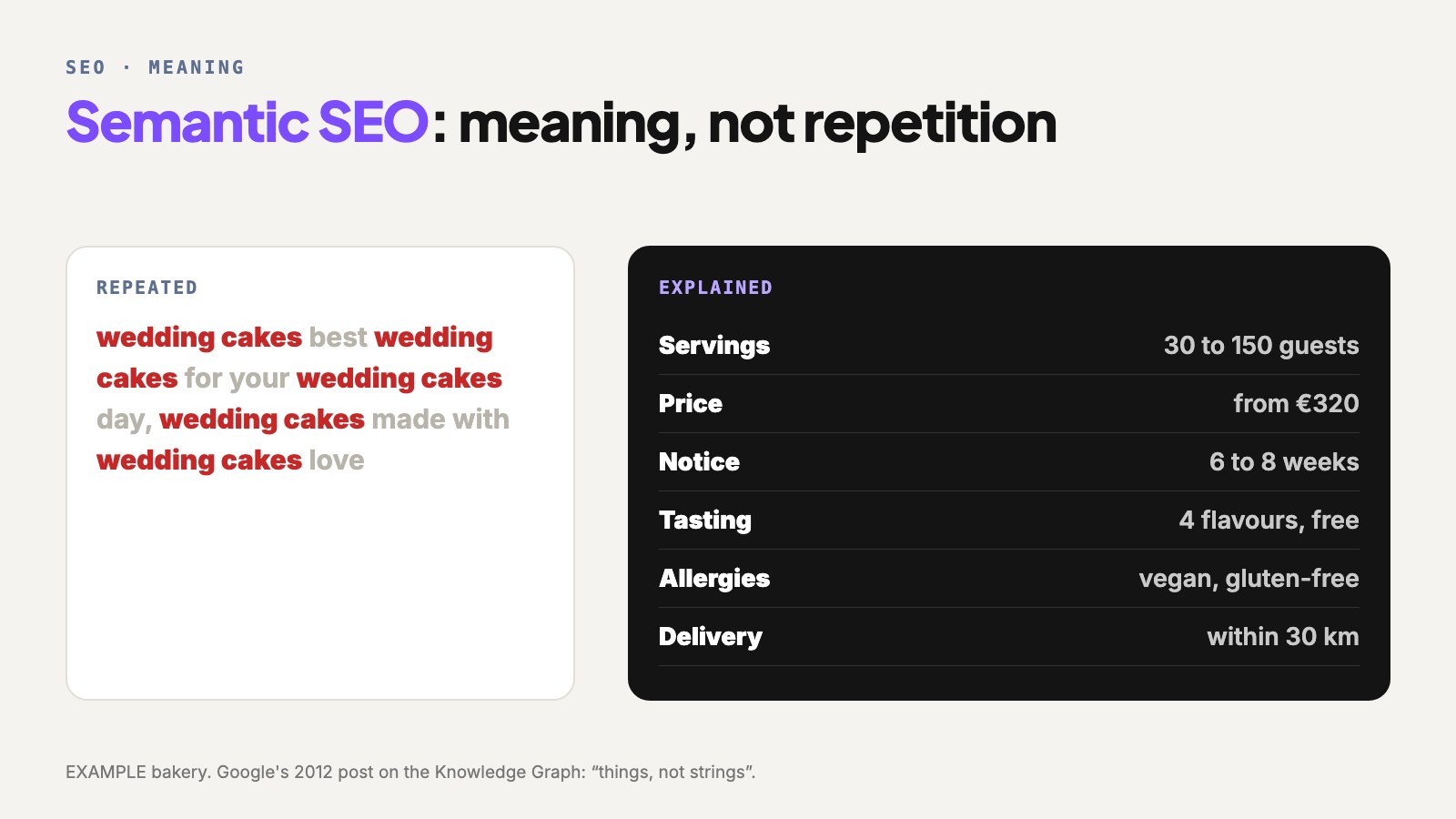
Take a bakery that wants customers for wedding cakes. A page that says "wedding cakes" twenty times tells a reader almost nothing. A page that covers flavours, servings, prices, tastings, allergens and delivery distance tells the reader, Google and an AI assistant exactly what's on offer. Both pages target the same search. Only one explains it.
How Google Went From Matching Words to Understanding Things
Google's own posts describe a steady move from matching keywords to understanding concepts. The 2012 post that introduced the Knowledge Graph was titled "things, not strings" and said that for decades search had "essentially been about matching keywords to queries".
| System | What Google says it does | What it means for your page |
|---|---|---|
| Knowledge Graph (2012) | "understands real-world entities" and their relationships | Name people, places, products and services clearly |
| BERT (2019) | Considers "the full context of a word by looking at the words that come before and after it" | Write full, natural sentences; small words change meaning |
| RankBrain | "helps us understand how words are related to concepts" | You can rank for wording you never used |
| Neural matching | Understands "representations of concepts in queries" and pages | Cover the concept, not each variation |
| Passage ranking | Identifies "individual sections or "passages" of a web page" | Make each section answer one thing on its own |
The BERT wording comes from Google's 2019 announcement, and the last three rows from its guide to ranking systems. The SEO Starter Guide draws the practical conclusion: "Google's language matching systems are sophisticated", so you don't need to predict every way someone might phrase a search.
Keyword Optimization vs Semantic Optimization
Keyword work chooses the search; semantic work makes the page deserve it. You still need both. Our guide to finding keywords and sorting them by intent covers the first job.
| Question | Keyword-only approach | Semantic approach |
|---|---|---|
| What do you start with? | A phrase to repeat | A topic and the person asking about it |
| How do you add depth? | More variations of the phrase | More facts, options, limits and examples |
| How do you structure it? | Headings built around variations | Headings built around questions and decisions |
| How do you check it? | Count the phrase | Ask what a customer would still need to know |
| What goes wrong? | It reads like a machine wrote it | It drifts off topic if you cover too much |
What Are Entities?
An entity is a specific thing that can be named and described: a person, company, place, product, service, event or concept. Google's Cloud Natural Language documentation says entity analysis "inspects the given text for known entities". That's a developer product rather than Google Search itself, but it's a useful way to picture how software reads a page.
What makes an entity useful is its attributes. "Wedding cake" is a thing. "Three tiers, serves 80, from €320, 6 weeks' notice, delivered within 30 km of Turku" is a thing a customer can choose and an assistant can quote.
| Entity | Attributes to state | Question it answers |
|---|---|---|
| The cake | Tiers, servings, size | How big a cake do I need? |
| Flavours | Sponge, filling, vegan and gluten-free options | Can you cater for allergies? |
| Price | Starting price, what changes it | How much will it cost? |
| Timeline | Notice needed, tasting date, final changes | When should I order? |
| Delivery | Area, setup, fee | Will you bring it to the venue? |
| The baker | Name, experience, photos of real work | Can I trust you with this? |
How to Optimize a Page Semantically in 7 Steps
Work through one page at a time, starting with a page that already matters to your business.
- Write the topic as one sentence. "This page helps couples near Turku choose and order a wedding cake." If you need two sentences, you may need two pages.
- List the entities. Write every thing the topic involves: options, people, places, materials, tools, standards and alternatives.
- Add the attributes. For each one, note the facts a buyer would compare: price, size, time, limits, location, proof.
- Collect the questions. Use the ones customers really ask, plus the follow-ups Google shows in People also ask.
- Answer first, then explain. Open each section with a one- or two-sentence answer that still makes sense if it's read alone.
- State the relationships. "Gluten-free sponge costs €40 more because it's baked separately" connects three facts. A list of words connects none.
- Link to the next meaning. Send side topics to their own pages. Our internal linking system shows how to connect them.
A Worked Example: Before and After
The strongest change is usually replacing adjectives with facts. This is an invented bakery, so you can see the method clearly.
Before (EXAMPLE)
"Looking for wedding cakes in Turku? Our wedding cakes are the best wedding cakes for your big day. We make beautiful wedding cakes for every wedding. Contact us for wedding cakes today."
After (EXAMPLE)
"We bake wedding cakes in Turku for 30 to 150 guests. Prices start at €320 for two tiers, and most couples order six to eight weeks ahead. Every order includes a free tasting of four flavours. Vegan and gluten-free tiers are baked separately, and we deliver and set up within 30 km."
| Signal | Before | After |
|---|---|---|
| Times it says "wedding cakes" | 5 | 1 |
| Facts a customer can use | 1 (the city) | 8 |
| Questions answered | None | Size, price, timing, tasting, allergies, delivery |
| A sentence an assistant could quote | None | Every one |
The second version is also easier to keep honest: each claim can be checked. If you want to see whether a page leans on one phrase, paste it into our free Keyword Density Checker. Google's spam policies describe keyword stuffing as "filling a web page with keywords or numbers" to manipulate rankings, so a high count is a reason to rewrite.
Use Structured Data to Confirm the Meaning
Structured data repeats your key facts in a format machines read without guessing. Google's introduction to structured data says you can help by "providing explicit clues about the meaning of a page".
Use it to confirm what's already visible, never to add claims the page doesn't make. A bakery might use LocalBusiness for itself and Product for a cake it sells. Our guide to schema markup shows the code, and the free Schema Checker tells you which types a page already has.
Semantic SEO and AI Answers
AI assistants need statements they can lift and attribute, which is what a semantically clear page provides. A sentence with a subject, a fact and a limit ("delivery is free within 10 km") survives being quoted. A slogan doesn't.
Two habits help most. Keep each section self-contained, and repeat the subject instead of writing "it" or "this" when a passage might be read alone. For the wider picture, see how to rank in Google AI Overviews and how to get recommended by ChatGPT.
What Semantic SEO Won't Do
Clear meaning helps Google understand a page; it doesn't guarantee a ranking. Competition, links, location and trust still count.
- It isn't about length. The Starter Guide says "The length of the content alone doesn't matter for ranking purposes". Stop when the topic is covered.
- It isn't a score you can buy. Tools that grade a page on related terms can suggest gaps, but a high score isn't a Google metric.
- It isn't permission to cover everything. A page about cakes doesn't need a history of weddings. Google's people-first guidance is a good filter: write what helps the reader finish their task.
- It doesn't replace separate pages. Two different jobs need two pages; two versions of one job need merging, as our keyword cannibalization guide explains.
Semantic SEO Checklist
| Check | Pass looks like |
|---|---|
| Topic | You can say what the page helps someone do in one sentence |
| Entities | The main things are named, not implied |
| Attributes | Prices, sizes, times, places and limits are stated |
| Questions | The top five customer questions are answered on the page |
| Passages | Each section makes sense on its own |
| Relationships | Sentences explain why and compared with what |
| Proof | Photos, examples, names or sources support the claims |
| Markup | Structured data matches what's visible |
How CMO Owls Does Semantic SEO for You
Doing this for one page takes an afternoon. Doing it for every page, and spotting which pages miss the point, is the part CMO Owls takes on.
| Job | By hand | A term-scoring tool | CMO Owls |
|---|---|---|---|
| Check the page matches its topic | Read it yourself | Compares word lists | Owl-gorithm Hacker judges whether the title, H1 and opening match the real topic |
| Check markup against visible text | Compare by eye | Not its job | Owl-gorithm Hacker checks schema is valid and matches what's visible |
| Judge topical authority | Guess | Scores one page | Owl-gorithm Hacker looks across your subject |
| Keep brand facts consistent | Remember them | Not its job | Knowledge Base holds your product and tone for the writing agents |
| Write the page | You | You, with a word list | Owlthor researches what ranks and writes the article |
| Answer customer questions | You collect them | Suggests terms | Buzz Creator Owl finds questions people ask AI and answers them |
- Owl-gorithm Hacker measures facts such as titles and heading counts with code first, then specialists judge topic alignment, and every finding carries a confidence score.
- Owlthor researches what ranks for your keyword, writes the article with images, mind maps and charts, and saves WordPress posts as drafts by default.
Start with the audit to see which pages are vague, then let Owlthor write the ones that are missing. You check the facts, because you know your prices and limits better than any tool.
Mind Map: Semantic SEO
Frequently Asked Questions
What is semantic SEO in simple terms?
Semantic SEO means making the meaning of a page clear by covering the things, facts and questions behind a search. It replaces repeating a phrase with useful, specific information.
Is semantic SEO the same as keyword research?
No. Keyword research tells you which search to target and what the person wants. Semantic SEO decides what the page must say to answer that search properly.
What is an example of semantic SEO?
A wedding cake page that states servings, prices, tasting, allergy options, notice and delivery area is a good example. A page that repeats "wedding cakes" without those facts is not.
What is entity SEO?
Entity SEO is the part of semantic SEO that deals with named things such as businesses, people, places and products. You name them clearly, state their attributes and keep the details the same everywhere.
Do I still need to use my keyword?
Yes. Use it in the title, main heading and opening so people recognise the page. After that, write naturally and let the facts carry the meaning.
Does semantic SEO need structured data?
No, but structured data can confirm facts that are already on the page. The visible text matters first.
How long should a semantically optimized page be?
As long as it takes to answer the search, and no longer. Google says content length alone doesn't matter for ranking.
Can I apply semantic SEO to existing pages?
Yes, and it's often the fastest place to start. Pick a page with impressions and few clicks, add the missing facts and answers, and follow our guide to updating old content.
The Next Step
Choose one money page, write its topic in a sentence, and add the five facts a customer would ask for next; if it's a service, use our service page guide, and if it's an ageing article, our guide to updating old content. Then add your website to CMO Owls to see which of your pages don't yet match the topic they claim.
Sources
- Introducing the Knowledge Graph: things, not strings, Google, 2012.
- Understanding searches better than ever before, Google, 2019.
- A guide to Google Search ranking systems, Google Search Central, accessed 2026.
- SEO Starter Guide, Google Search Central, accessed 2026.
- Natural Language API basics, Google Cloud, accessed 2026.
- Spam policies for Google web search, Google Search Central, accessed 2026.
- Introduction to structured data markup, Google Search Central, accessed 2026.
- Creating helpful, reliable, people-first content, Google Search Central, accessed 2026.