Key Takeaways
- Real estate agent marketing isn't about convincing people to use an agent. Most already will. It's about being the agent they find and trust first.
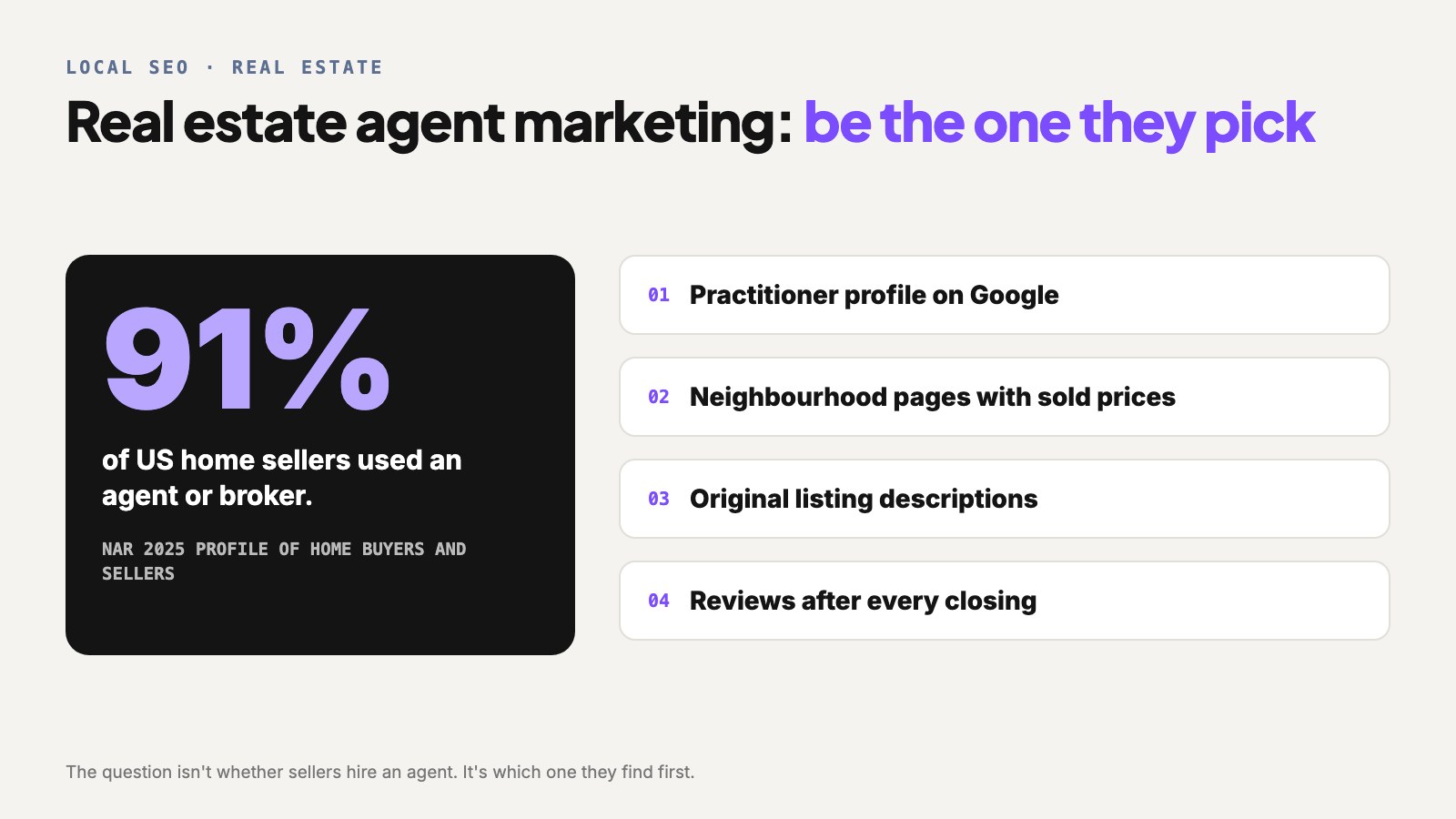
- In the US, 91% of home sellers and 88% of buyers used an agent or broker, according to NAR's 2025 Profile of Home Buyers and Sellers.
- As an individual practitioner, you can have your own Google Business Profile, separate from your brokerage's, under Google's rules.
- Neighbourhood pages and original listing descriptions win local searches that portals can't, as long as the wording follows fair housing rules.
What Buyers and Sellers Do Before They Call
Nearly every seller and buyer hires an agent, so your marketing competes against other agents, not against doing it alone. NAR's 2025 Profile of Home Buyers and Sellers found that 91% of US sellers and 88% of buyers used an agent or broker, and that for-sale-by-owner sales fell to a historic low of 5% of sellers.
The same report shows how the market is changing: first-time buyers fell to 21% of buyers, the lowest share since NAR began collecting the data in 1981. More of your clients are repeat buyers and sellers who've done this before and compare agents carefully.
Before they call, most of them will search your name, your brokerage and their neighbourhood, look at your reviews, and often ask an AI assistant who's good locally. The agent who shows up with proof at each of those moments gets the call.
Your Google Profile as an Individual Practitioner
Google's guidelines name real estate agents as "individual practitioners", which means you can have a Business Profile of your own. The rules in Google's guidelines for representing your business matter here:
- You must be public-facing and contactable at the verified location during your stated hours.
- One profile per agent, not one per speciality. You can't create separate profiles for "luxury homes" and "first-time buyers".
- At an office with several agents, the brokerage has its own profile and each agent's profile uses only the agent's name.
- If you're the only agent at a branded office, Google suggests one shared profile named like "[Brand]: [Your name]".
- Sales associates or lead-generation agents for corporations aren't eligible.
If you work from home and meet clients at properties, you're a service-area business: hide your address and set the areas you cover. Our guide to service area business SEO explains how. Then fill in the profile properly: the right category, your service areas, real photos, a description of the neighbourhoods and property types you know, and posts about recent sales. Our Google Business Profile optimization guide covers every setting. Google's guide to improving your local ranking is clear that you can't pay for a better organic local position; relevance, distance and prominence decide it.
Neighbourhood Pages That Win Local Searches
A neighbourhood page is a guide to one area written by someone who sells homes there, and it's the page type most agent websites are missing. Big portals have every listing; they rarely have first-hand local knowledge. That's your advantage.
How to write one
- Pick the areas you actually sell in. Start with three to five. Our guide to keyword research for small businesses shows how to see which area names people search for.
- Describe the homes: property types, typical sizes, age of the housing, what a typical home sold for recently and how fast homes have been selling, with your source and date.
- Describe the place: transport links, parks, shops, schools with links to official information, and what's changing, like new developments or roadworks.
- Add your own evidence: photos you took, homes you sold there, what buyers ask you about the area.
- End with a next step: a free valuation for owners and a search link for buyers.
- Update it every quarter with new sold prices, and show the date.
Keep the wording fair
In the US, the Fair Housing Act regulation at 24 CFR 100.75 makes it unlawful to publish housing advertising that indicates any preference, limitation or discrimination based on race, colour, religion, sex, disability, familial status or national origin. Describe the property and the place, not the people. "Two parks and a train station within a 10-minute walk" is fine; "ideal for a couple without kids" or "in a Christian neighbourhood" signals a preference and can break the rule. Other countries have their own equality laws, so check what applies to you.
Listing Pages: Write Your Own Descriptions
If your listing pages use the same text as every portal and every other agent's site, Google has no reason to show yours. Google's guide to consolidating duplicate URLs explains that when it finds duplicate content, it picks one version to show. With syndicated listings, that's rarely the agent's own site.
- Write an original description for your own listings: who the home suits in terms of space and layout, what you noticed walking through it, what's nearby.
- Use your own photos and floor plans, with descriptive file names and alt text, as our image SEO guide explains.
- Link each listing to its neighbourhood page, and back.
- Keep sold listings online as "sold" case studies with the result, rather than deleting them. They prove you sell in that area.
- If you republish the same text in several places on your own site, a canonical tag tells Google which page is the main one.
Add RealEstateAgent structured data to your contact and about pages, following Google's local business structured data guide, and check it with our free schema checker. Property photos make agent websites heavy, so if pages are slow on phones, our guide to why a website is slow shows where to start.
| Page | Who it's for | What wins the visit |
|---|---|---|
| Agent bio | Sellers comparing agents | Track record, areas, real reviews, a real photo |
| Neighbourhood guide | Buyers and owners in that area | First-hand detail and recent sold prices |
| Listing page | Buyers | Original description, own photos, link to the area guide |
| Sold case study | Sellers | What you did and the result, with permission |
| Valuation page | Owners thinking of selling | A clear way to request a valuation |
| Market report | Owners and investors | Quarterly numbers with sources and dates |
Reviews After Every Closing
A home sale is one of the biggest transactions in a client's life, so a review from a past client carries real weight with the next one. Ask at the moment the client is happiest: keys handed over, or the sale completed.
- Ask every client the same way, with a direct link. Google's policy on fake engagement bans rewards for reviews and asking only clients you expect to be happy.
- In the US, the FTC's rule on consumer reviews and testimonials bans fake reviews, buying positive reviews and undisclosed reviews from insiders, such as colleagues at your brokerage.
- Reply to each review, mentioning the area or property type in general terms, never private details of the sale.
Our guide to getting more Google reviews has templates. Over time, reviews that mention specific neighbourhoods help you show up for those areas.
Showing Up When Sellers Ask AI
Sellers increasingly ask AI assistants questions like "who's a good estate agent in [area]?" or "what's my flat worth in [area]?" The answers draw on what's published about local agents: profiles, reviews, area guides and market reports.
Google says in its guide to helpful, reliable content that its systems give extra weight to trustworthy content on topics that affect people's financial stability. Selling a home is one. Agents who publish clear, dated, sourced area information under their own name give both Google and AI assistants something solid to cite. Our guide on how to get recommended by ChatGPT explains the rest.
Content That Wins Seller Listings
Buyers come and go with listings; sellers are where an agent's income starts, so most of your content should speak to owners.
- A quarterly market report for each area you cover: what sold, for how much, how fast, with sources.
- "What's my home worth?" content that explains how valuations work and invites a free appraisal.
- Sold case studies: the challenge, what you did, the result, with the client's permission.
- Honest guides to the selling process, costs and timelines in your market.
- Short videos walking through a street or a sold home, posted where your local audience spends time.
Four Mistakes on Agent Websites
- Only showing the brokerage's listings feed. Hundreds of sites show the same feed. Your own area knowledge and sold results are what make yours different.
- No real photo or bio. Sellers are choosing a person to trust with their biggest asset. A stock image of a handshake tells them nothing.
- Market numbers without dates or sources. Prices change fast. Undated figures look stale, and wrong ones damage trust.
- A valuation form that asks for everything. Name, address and a phone number or email are enough to start. Ask the rest at the appointment.
Measure Listings Won, Not Likes
- Valuation requests from the website and profile, tracked as conversions.
- Calls and direction requests from your Google profile.
- Which neighbourhood pages bring visitors, from Google Search Console.
- New reviews after each closing.
- "How did you find me?" asked at every valuation appointment.
How CMO Owls Helps an Agent's Marketing
CMO Owls is an AI marketing team for small businesses and independent professionals: it writes and checks your pages, watches competing agents and tracks your visibility in AI answers, while you're out at viewings. You approve everything before it's published.
| Task | Agent | What it does |
|---|---|---|
| Neighbourhood and seller guides | Owlthor | Researches what ranks for each area and writes the page, sent to WordPress or your CMS for you to add local detail |
| Questions sellers ask AI | Buzz Creator Owl | Finds the questions people ask AI assistants about selling and answers each one as an article |
| Competing agents | Spy Owl | Finds your real competitors, what they rank for that you don't and who links to them |
| Website health | Watch Owl | Opens up to 500 pages in a real browser and finds broken pages, errors and slow loading, worst first |
| Pages losing traffic | Cash Cow Stalker | Checks your top pages every five days and alerts you when clicks fall or a page drops out of Google |
| AI visibility | Generative Engine Owl | Measures what ChatGPT, Gemini, Claude and Google AI Overviews say about you, and why they skip you |
Mind Map: Real Estate Agent Marketing
Frequently Asked Questions
What is the best marketing for real estate agents?
A complete Google Business Profile with reviews from past clients, neighbourhood pages with recent sold prices and original listing descriptions bring the most local enquiries. Seller-focused content like market reports wins listings over time.
Can a real estate agent have their own Google Business Profile?
Yes. Google treats real estate agents as individual practitioners, so a public-facing agent can have one profile, separate from the brokerage's. One profile per agent, not one per speciality.
How do realtors get listings online?
By showing owners proof: sold case studies, area market reports, reviews that mention their neighbourhood and an easy valuation request. Owners choose the agent who clearly knows their area.
Do neighbourhood pages still work for realtor SEO?
Yes, when they contain first-hand detail and current sold data that portals don't have. Thin pages that only swap the area name are what stop working.
What should I avoid in real estate ads?
In the US, avoid any wording that shows a preference for or against people based on race, colour, religion, sex, disability, familial status or national origin. Describe the home and the place, not who should live there.
Should I write my own listing descriptions?
Yes. The same portal text everywhere gives Google no reason to show your page, while an original description with your own photos can rank and shows your knowledge of the home.
The Next Step
Choose the one neighbourhood where you sell most and write its guide this month, using the steps above. Then add your website to CMO Owls to see your website report, which competitors outrank you and what AI tools say about you, and read our guide on getting more Google reviews to build proof after every sale.
Sources
- Top 10 takeaways from NAR's 2025 Profile of Home Buyers and Sellers, National Association of Realtors, 2025.
- Guidelines for representing your business on Google, Google Business Profile Help, 2026.
- Tips to improve your local ranking on Google, Google Business Profile Help, 2026.
- 24 CFR 100.75: Discriminatory advertisements, statements and notices, US Department of Housing and Urban Development (eCFR), 2026.
- Consolidate duplicate URLs, Google Search Central, 2026.
- Creating helpful, reliable, people-first content, Google Search Central, 2026.
- Maps user-contributed content policy: Fake engagement and prohibited practices, Google, 2026.
- 16 CFR Part 465: Use of consumer reviews and testimonials, Federal Trade Commission (eCFR), 2024.
- RealEstateAgent, Schema.org, 2026.
- Local business (LocalBusiness) structured data, Google Search Central, 2026.